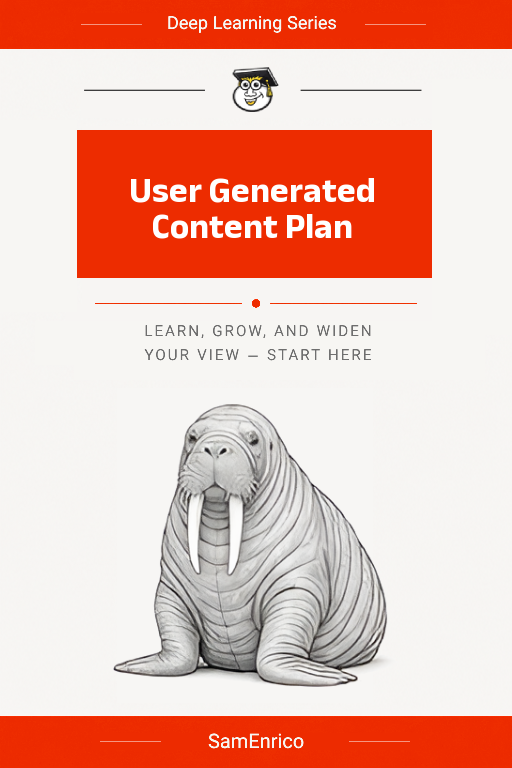
User Generated Content Plan eBook
Encourage customer photos, reviews, and videos usi
Encourage customer photos, reviews, and videos using a one-page legal and incentive framework.
Formats
Free sample
Chapter 1: The Collapse of Authority--–- On a Tuesday morning in early 2025, a mid-level marketing director at a 200millionskincarebranddidsomethingthatwouldhavebeenunthinkablefiveyearsearlier.Shedeletedtheprofessionallyproduced,200 million skincare brand did something that would have been unthinkable five years earlier. She deleted the professionally produced, 200millionskincarebranddidsomethingthatwouldhavebeenunthinkablefiveyearsearlier.Shedeletedtheprofessionallyproduced,85,000 hero video from the product page and replaced it with a blurry, poorly lit screenshot from a customer's Instagram story. The customer was sitting in a messy bathroom, wearing a bathrobe, with visible toothpaste residue on the mirror. The video had been shot on a three-year-old phone. The lighting was terrible.
The customer hadn't even bothered to crop out the toilet in the background.–- Within seventy-two hours, that product page's conversion rate had increased by 34 percent.–- This is not an anomaly. This is not a fluke. This is the Collapse of Authority—a fundamental, irreversible shift in how consumers decide what to believe and what to buy. And if you are reading this book, you are likely already feeling the effects. Your paid ads are getting more expensive and delivering lower returns.
Your influencer campaigns are generating engagement but not trust. Your internal creative team is producing stunning work that customers scroll past without a second glance. Meanwhile, a customer you have never met posts a grainy photo of your product from a hotel room, and that single post generates more revenue than your entire quarterly advertising budget.–- This chapter is about understanding why that happens, why it is accelerating, and why your only sustainable path forward is to build a system that turns your customers into your primary content engine. By the end of this chapter, you will understand the data behind the Trust Crash of 2025–2026, the psychological mechanisms that make customer content more persuasive than professional advertising, and the fundamental strategic shift required to succeed in this new environment. More importantly, you will understand why the rest of this book—the legal frameworks, the incentive structures, the operational systems—is not optional.
It is the difference between riding this wave and being crushed by it.The Death of the Megaphone–- For most of modern marketing history, the model was simple. Brands controlled the message. Brands controlled the distribution. Brands controlled the narrative. You produced a television commercial, bought media placement, and broadcast that message to a passive audience.
The audience could either buy or not buy, but they could not meaningfully participate in the conversation. The brand was the authority. The brand was the expert. The brand held the megaphone, and everyone else listened.–- That era is over.–- The internet did not kill the megaphone. Social media did not kill the megaphone.
What killed the megaphone was the collision of three forces: the democratization of content creation tools, the collapse of institutional trust, and the algorithmic amplification of peer voices over brand voices. Every person with a smartphone now carries a professional-grade camera, an editing suite, and a global distribution network in their pocket. The cost of producing a piece of content that can reach a million people has fallen from millions of dollars to zero dollars. At the same time, trust in institutions—including corporations, media, and government—has fallen to historic lows. And the algorithms that govern attention on every major platform have been optimized to surface content from people, not from brands.–- Consider the data.
In 2010, a professionally produced television commercial was the most trusted form of advertising according to every major survey. By 2020, user-generated content had surpassed all forms of brand-produced content in trustworthiness. By 2025, the gap had widened into a chasm. According to aggregated data from multiple industry studies, 93 percent of consumers now say that user-generated content influences their purchase decisions more than traditional advertising. Seventy-nine percent say that a customer photo or video is more authentic than a brand's professionally produced content.
And critically, 68 percent say they actively avoid brand-produced content when researching a purchase, seeking out customer content instead.–- This is not a preference. This is a behavioral shift so deep that it has rewired the consumer decision journey. The old funnel—awareness, consideration, conversion, loyalty—has been replaced by a new loop. Customers discover products through other customers. They validate purchase decisions through other customers.
They remain loyal to brands that showcase other customers. The brand is no longer the protagonist of the story. The brand is the stage. The customers are the actors. And the audience trusts the actors, not the stage.The Trust Crash of 2025–2026–- If the shift toward customer content was gradual through the early 2020s, the period of 2025–2026 represented a sudden, violent acceleration.
Marketers now refer to this period as the Trust Crash, and its causes are worth understanding because they are not temporary.–- The first cause was AI-generated content saturation. By early 2025, the internet was flooded with synthetic images, videos, and reviews. Consumers could no longer tell what was real and what was generated. More importantly, they stopped trying. The default assumption shifted from "this is probably real" to "this is probably fake unless proven otherwise." This hurt brand-produced content disproportionately because brand content had always existed on a spectrum of artificiality—carefully staged, meticulously edited, professionally lit.
When AI content arrived, it looked similar enough to brand content that consumers began lumping them together. Both were suspect. Both were treated as potentially fabricated.–- The second cause was influencer fatigue. The influencer industry, which had grown to nearly $30 billion by 2025, collapsed under its own weight. Audiences realized that their favorite creators were promoting products they did not use, wearing clothes they did not own, and endorsing services they had never tried.
The scandals were relentless. A fitness influencer with eight million followers was exposed for photoshopping her "transformation" photos. A beauty influencer was caught returning products after filming her "reviews." A travel influencer fabricated an entire trip to Bali from a studio in Los Angeles. Each scandal eroded trust not just in that influencer, but in the entire category of paid endorsements. By the end of 2025, the most valuable signal a piece of content could carry was not a blue checkmark or a high production value.
It was the absence of a #ad disclosure.–- The third cause was the algorithmic realignment. Every major platform quietly adjusted their recommendation engines to prioritize what they called "authentic engagement signals"—likes, shares, and saves from real users that happened organically, not as a result of paid amplification. This had the effect of burying brand-produced content, which rarely generated the same density of organic engagement as customer content. A brand's million-dollar Super Bowl ad, when posted to social media, might generate a few thousand likes. A customer's unboxing video, posted from a bedroom with no lighting equipment, might generate hundreds of thousands.
The platform showed the customer's video to more people because that was what the platform's own metrics identified as valuable.–- These three forces did not operate in isolation. They reinforced each other. AI content made everything suspect, so consumers sought out the one category of content that had not yet been fully corrupted by AI: raw, unedited customer photos. Influencer fatigue made paid endorsements toxic, so consumers gravitated toward unpaid, unsolicited customer posts. Algorithmic realignment…
This is the end of the free sample. Get the eBook to keep going. Buy now
About this book
Details
- Author
- Harder Felisha
- Publisher
- SamEnrico
- Language
- English
- Genre
- Non-Fiction, Business Brief, Community Marketing
- Released
- 2026-06-01
- Pages (approx.)
- 138
- Available as
- eBook, Audiobook

Read better in the ZLOADR app
Your eBooks on your phone or tablet. Sign in with your SamEnrico account and start reading.
More by Harder Felisha
 Wrestler Self Hypnosis GuideHarder Felisha$11.99
 Waterfall Mist Calming GuideHarder Felisha$11.99
 Tide Pool ExplorationHarder Felisha$11.99
 The Phone Focus FixHarder Felisha$11.99
 Senior Spiritual Worth GuideHarder Felisha$11.99
 Self Talk for Anxiety ReliefHarder Felisha$11.99
 Runner's Self Hypnosis GuideHarder Felisha$11.99
 Remote Communication for Distributed TeamsHarder Felisha$11.99
 Blood and Gold: Pizarro's Gambit at Cajamarca (1532)Harder Felisha$11.99
 The Enlightenment: Architects of Modern ThoughtHarder Felisha$11.99The Enlightenment: Architects of Modern ThoughtHarder Felisha$11.99
 How to Produce Development BoardsHarder Felisha$11.99