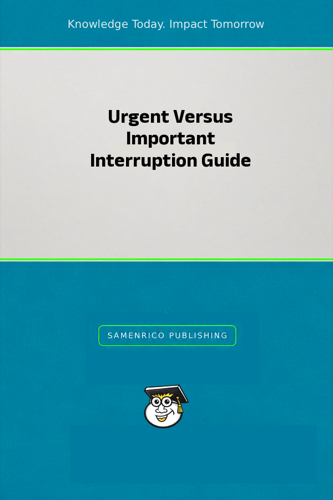
Urgent Versus Important Interruption Guide eBook
Teaches Eisenhower matrix application specifically
Teaches Eisenhower matrix application specifically to interruptions, helping users quickly triage disruptions.
Formats
Free sample
Chapter 1: The Interruption Economy--–- You are not lazy. You are not undisciplined. You are not broken.If you have ever reached the end of a workday feeling exhausted yet somehow empty—as though you ran a marathon but ended up exactly where you started—this chapter is your unshaming. The problem is not a flaw in your character. The problem is the water you are swimming in, and you have been swimming in it for so long that you have forgotten it is even there.The average knowledge worker is interrupted every eleven minutes.
Not once an hour. Not twice an afternoon. Every eleven minutes. And here is the cruel math that most productivity books gloss over: it takes an average of twenty-three minutes to fully refocus after each interruption. Do the multiplication, and you arrive at a staggering truth.
A single interruption does not cost you eleven minutes. It costs you eleven minutes of lost work plus twenty-three minutes of recovery time, plus the cognitive friction of switching between contexts, plus the emotional tax of starting and stopping and starting again. By the end of an eight-hour day, the typical professional has lost upwards of four hours to the gap between interruption and recovery. That is not a bad day. That is a Wednesday.This chapter will show you why your brain is not designed for the modern workplace, why multitasking is a myth perpetuated by people who have never read a single peer-reviewed study on attention, and why President Eisenhower—a man who commanded the Allied forces during World War II and later ran the most powerful country on earth—stumbled upon the only framework that can save your sanity.
By the time you finish this chapter, you will stop blaming yourself and start seeing the system. And once you see the system, you can finally fight back.The Invention of Interruption There was a time—not so long ago, historically speaking—when the word "interruption" meant something genuinely rare. A knock on a wooden door. A telegram delivered by a uniformed messenger. A phone call on a wire that tethered you to a wall.
Interruptions were events. They required effort. They announced themselves with ceremony.That world is gone.Today, interruption is the default state. Your pocket buzzes. Your wrist taps.
Your browser tab flashes. Your email inbox chimes with the arrival of a message from someone who expects an answer within hours if not minutes. Slack, Teams, Discord, Whats App, SMS, Messenger, Linked In DMs, calendar reminders, news alerts, weather warnings, app update notifications, and the quiet, persistent hum of social media waiting for your thumb to scroll. The average smartphone user touches their phone 2,617 times per day. Extreme users exceed 5,000.
You are not addicted to your phone in the clinical sense of chemical dependency, but you have been trained—by the most sophisticated behavioral engineers on the planet—to respond to notifications as if they were survival threats.This is not hyperbole. When you hear a notification chime, your brain releases cortisol. Cortisol is the stress hormone. It is the same chemical that floods your system when a predator approaches. Your body cannot distinguish between a Slack message from your boss and a saber-toothed tiger in the bushes.
Both trigger the same fight-or-flight response. Both hijack your prefrontal cortex—the rational, planning, goal-oriented part of your brain—and hand control over to your amygdala, the ancient alarm system that cares only about immediate survival.You are not weak for checking your phone. You are responding exactly as you were designed to respond. The problem is that the designers of your digital environment know this better than you do. They have weaponized your biology against your best interests.The Cognitive Switching Cost Let us get precise about what an interruption actually costs you.In 2001, a team of researchers at the University of Michigan published a study that should have ended the myth of multitasking forever.
They asked participants to perform two simple tasks: solving math problems and identifying geometric shapes. When participants did these tasks one after the other, they performed quickly and accurately. When the researchers forced them to switch back and forth between the tasks—solve a math problem, identify a shape, solve another math problem, identify another shape—performance collapsed. Response times slowed by an average of 40 percent. Error rates more than doubled.The researchers called this the "switching cost." Every time you shift your attention from one task to another, your brain must perform a series of unconscious operations: disengage from the previous task, shift attention to the new task, reactivate the relevant rules and goals, and reorient yourself to the context of the new task.
This entire sequence takes between a few tenths of a second and several seconds, depending on the complexity of the tasks involved. That does not sound like much. But multiply it by the hundreds of times you switch tasks every day, and you arrive at a staggering cumulative loss.Worse, the switching cost does not fully account for the recovery period. In a later study at the University of California, Irvine, researchers followed workers in a real-world office environment. They found that after even a brief interruption, it took an average of twenty-three minutes and fifteen seconds to return to the original task with the same level of focus and cognitive depth.
During those twenty-three minutes, workers did not simply resume their work. They checked email. They opened browser tabs they had closed. They re-read documents they had already reviewed. They mentally retraced their steps, reconstructing the state of mind they had lost when the interruption struck.Here is the cruelest part of all.
Most interruptions are not even necessary. The same UC Irvine study found that nearly half of all workplace interruptions were self-inflicted—the worker switching tasks voluntarily to check email, respond to a non-urgent message, or browse the web. We are not only interrupted by others. We interrupt ourselves, constantly, habitually, as if our attention is a hot potato we cannot wait to drop.The IQ Drop If the time cost is not enough to convince you, consider the cognitive cost.In a landmark experiment conducted by researchers at the University of London, subjects who performed creative problem-solving tasks while simultaneously managing incoming emails and instant messages showed a measurable drop in effective IQ of up to ten points. To put that number in perspective, smoking marijuana produces a drop of approximately four to five IQ points.
Staying awake for thirty-six hours straight produces a drop of about seven points. Interruptions are more damaging to your cognitive function than sleep deprivation or cannabis intoxication.Ten IQ points is the difference between being in the top ten percent of the population and being perfectly average. It is the difference between catching a subtle error in a contract and missing it entirely. It is the difference between coming up with a creative solution to a stubborn problem and staring blankly at your screen until someone else solves it for you.And here is the trap that most knowledge workers fall into. You feel busy.
You are answering emails, responding to messages, attending meetings, putting out small fires. Your brain is active. Your calendar is…
This is the end of the free sample. Get the eBook to keep going. Buy now
About this book
Details
- Author
- Carroll Devin
- Publisher
- SamEnrico
- Language
- English
- Genre
- Non-Fiction, Self-Help, Priority Management
- Released
- 2026-06-10
- Pages (approx.)
- 133
- Available as
- eBook, Audiobook

Read better in the ZLOADR app
Your eBooks on your phone or tablet. Sign in with your SamEnrico account and start reading.
More by Carroll Devin
 Self Hypnosis for Spartan RaceCarroll Devin$11.99
 Mastodon Timeline OverloadCarroll Devin$11.99
 Senior Adaptability GuideCarroll Devin$11.99
 Shadows of the Southern Seas: The Yakuza’s Forgotten Australian GambitCarroll Devin$11.99
 Sculpting MiniaturesCarroll Devin$11.99
 How to Start a Hobby in Antique carsCarroll Devin$11.99
 Remote Hiring Legal Checklist PrimerCarroll Devin$12.99
 How to Produce an Agricultural RobotCarroll Devin$11.99