
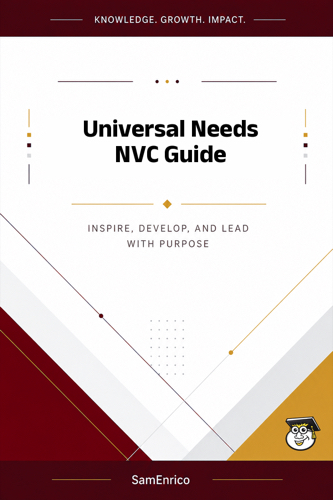
Non-FictionSelf-HelpHuman Needs
Universal Needs NVC Guide eBook
Identify the universal human needs behind every fe
Identify the universal human needs behind every feeling and conflict.
Formats
Free sample
Chapter 1: The Spoon That Ended Everything...--–- Sarah and Michael had been together for eleven years. They had survived job losses, a cross-country move, the death of a parent, and the sleepless first year of raising twins. They considered themselves strong. Resilient. The kind of couple that friends pointed to and said, “You two really know how to communicate.”And yet, on a Tuesday evening in March, at approximately 7:42 PM, their marriage nearly ended over a single dirty spoon in the kitchen sink.The spoon was ceramic, hand-painted, a wedding gift from a friend who had since moved to Portugal.
It had been used to stir a pot of tomato sauce. Michael had left it in the sink—not on the counter, not in the dishwasher, but right there in the sink, resting against a bowl of soapy water. Sarah walked into the kitchen after putting the twins to bed. She saw the spoon. And something inside her cracked open.“You left the spoon again,” she said.
Her voice was flat, but the flatness was a lid over a boiling pot.Michael looked up from his laptop at the kitchen table. “I was going to wash it in a minute. I just had to finish this email.”“You always say that.”“That’s not true. Last week I did the dishes twice without you asking.”“Twice. In seven days.
Do you want a medal?”“What do you want me to say, Sarah? That I’m a terrible husband because of a spoon?”“I don’t want you to say anything. I want you to see. I want you to look around this house and see what needs to be done without me having to write you a chore chart like you’re a third child.”“That’s not fair.”“Fair? You want to talk about fair?”And then, like a car sliding on black ice, they were somewhere they never intended to go.
The spoon disappeared from the conversation entirely. What remained was a blur of accusations, defenses, counter-accusations, and the kind of silence that is louder than any word.“Maybe we should just call it,” Michael said finally, staring at the table.“Call what?”“This. Us. Maybe we’re just not good at this anymore.”Sarah did not disagree. She walked out of the kitchen, closed the bedroom door, and sat on the edge of the bed with her face in her hands.
She was not thinking about the spoon. She was not thinking about Michael, really. She was thinking about a question she could not answer: How did we get here?The Hidden Architecture of Every Fight If you had asked Sarah the next morning what the fight was about, she would have said, “He doesn’t help around the house.” If you had asked Michael, he would have said, “She criticizes everything I do.” Both would have been wrong. Not lying—wrong. Because neither answer goes deep enough.The fight was not about the spoon.
The fight was not about chores. The fight was not about who works harder or who is more considerate or who said what three years ago.The fight was about needs.Universal human needs. The same ones that drive every conflict you have ever had, from the whispered argument in the grocery store parking lot to the screaming match at the family dinner table to the cold, silent war that happens entirely inside your own head when you look in the mirror.Here is the central argument of this book, and I need you to hear it clearly, because everything that follows depends on it:Every human action, no matter how destructive or beautiful, no matter how loving or cruel, is an attempt to meet a universal need.Every. Single. One.The parent who yells at their child is trying to meet a need for safety or order or respect.
The spouse who withdraws into silence is trying to meet a need for peace or autonomy or protection. The employee who sabotages a coworker is trying to meet a need for recognition or fairness or contribution. The teenager who slams a door is trying to meet a need for autonomy or to be heard. The stranger who cuts you off in traffic is trying to meet a need for efficiency or safety or maybe just to get home to a child who is waiting.And the person you cannot forgive—the one who hurt you, betrayed you, left you, or let you down—that person, too, was acting from a need. Not a good need.
Not a justified need. Just a need. A universal, human, deeply understandable need that they did not know how to meet in a way that also respected your needs.This is not an excuse for harmful behavior. Let me be absolutely clear about that. Understanding the need behind an action is not the same as condoning the action.
A person who steals is still stealing. A person who lies is still lying. A person who hurts you has still hurt you. Accountability matters. Consequences matter.
Repair matters.But if you want to stop the cycle of conflict—if you want to actually resolve, not just manage, the recurring fights in your life—you have to go beneath the behavior to the need. Because as long as you are fighting about behaviors, you are fighting about strategies. And strategies are infinite. Needs are finite. And finite things are much easier to work with than infinite ones.The Good Person/Bad Person Trap Before we go any further, I need to name something that might be uncomfortable.Almost all of us were raised in what Marshall Rosenberg, the founder of Nonviolent Communication, called “life-alienating” language.
This is language that judges, labels, classifies, and compares. It is the language of “good” and “bad,” “right” and “wrong,” “normal” and “abnormal,” “deserving” and “undeserving.”When Sarah said, “You never help,” she was not making an observation. She was making a judgment. When Michael said, “You’re so critical,” he was not describing her behavior. He was assigning her a fixed identity.
This is what happens when we confuse what someone did with who someone is.The problem with this language is not just that it hurts feelings—though it certainly does that. The problem is that it is static. Once you label someone as “lazy” or “selfish” or “controlling,” you have nowhere to go. You have built a prison for them in your mind, and every future action they take will be interpreted through those bars. They put a spoon in the sink?
Of course they did. Lazy people leave spoons in sinks. They do the dishes without being asked? Well, they’re just doing it to manipulate me. Selfish people are always strategic.Do you see what happens?
The label becomes a filter. The filter becomes a prophecy. The prophecy becomes a self-fulfilling reality.And here is the quiet tragedy: we do this to ourselves, too. When you say, “I’m so stupid” after making a mistake, you are not describing your intelligence. You are labeling yourself with a static, life-alienating judgment.
And once you believe you are “stupid,” you stop trying new things, stop taking risks, stop growing. The label becomes…
This is the end of the free sample. Get the eBook to keep going. Buy now
About this book
Details
- Author
- Billings Donn
- Publisher
- SamEnrico
- Language
- English
- Genre
- Non-Fiction, Self-Help, Human Needs
- Released
- 2026-06-08
- Pages (approx.)
- 153
- Available as
- eBook, Audiobook

Read better in the ZLOADR app
Your eBooks on your phone or tablet. Sign in with your SamEnrico account and start reading.
More by Billings Donn
 Messner Mount Everest North FaceBillings Donn$11.99
 Keyboard Shortcut Focus ModeBillings Donn$11.99
 Emotional Intelligence for EntrepreneursBillings Donn$11.99
 Twelve Step Living AmendsBillings Donn$11.99
 Perfectionism and WorkaholismBillings Donn$11.99
 Bootstrapping Cash GuideBillings Donn$11.99
 Plane Crash MiracleBillings Donn$11.99
 The Alter of SlabodkaBillings Donn$11.99
 Red Dust: The Untold Story of the First Martian Dust StormBillings Donn$11.99
 The Silk Road of Legends: How 18th-Century Japanese Playwrights Rewrote King ArthurBillings Donn$11.99
 Billionaire’s Gambit: The Secret War Over the World’s Most Powerful PhilanthropyBillings Donn$11.99
 Push Notification Marketing SystemsBillings Donn$11.99
You may also like
 Hong Kong Handover 1997Dunn Johnnie$11.99
 Zumba For Postnatal Recovery CourseNeal Christian$11.99
 Zumba for BeginnersLadner Nikia$11.99
 YouTube Comment Mining GuideHumes Pandora$12.99
 Worry Box MeditationCarlin Rudy$11.99
 Workplace Stress MeditationNguyen Lynn$11.99
 Workplace Stress and Sleep RepairHawley Ivory$11.99
 Workplace Perfectionism CureDelaney Jeffry$11.99
 Workplace Injustice Anger GuideWallen Isabelle$11.99
 Work Addiction and Burnout LinkGreenwood Ester$11.99
 Women in Yoga and WellnessBeattie Galina$11.99
 Women in Stand Up ComedyChun Evangeline$11.99