
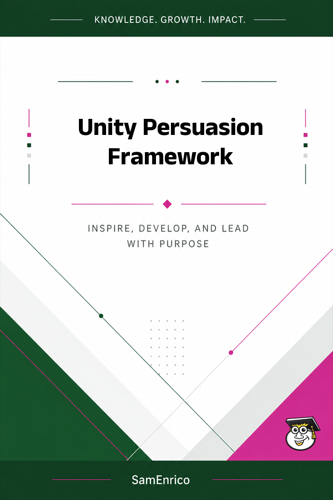
Unity Persuasion Framework eBook
Build shared identity to create deep influence and
Build shared identity to create deep influence and loyalty.
Formats
Free sample
Chapter 1: The Loyalty Lie--–- Every leader I have ever met believes a lie. Not a small lie, not a harmless lie, but a lie that has cost them millions of dollars, thousands of hours, and the quiet devotion of people who once wanted to follow them. The lie sounds so reasonable, so embedded in every business book and leadership seminar, that no one questions it. Here it is: If you offer the right incentives, build the right argument, and present it with enough charisma, people will do what you want.This is the Transactional Fallacy. It assumes that human behavior is a math problem—input A (discount, bonus, logical proof) leads to output B (action, compliance, sale).
And for a brief moment, it works. The customer buys during the 20% off sale. The employee hits the quarterly target for the bonus. The voter shows up for the candidate who promised tax relief. But then something happens.
The discount expires, and the customer leaves. The bonus is paid, and the employee stops pushing. The tax cut passes, and the voter forgets your name.You have purchased compliance. You have not earned loyalty. And the difference between those two words is the difference between a career of exhausting transaction and a life of effortless influence.The Moment I Understood I Had Been Lying to Myself I once worked with a CEO named Diane.
She ran a mid-sized software company with four hundred employees and a customer base that included several Fortune 500 firms. By every external metric, she was successful. Revenue grew 15 percent year over year. Employee turnover was below industry average. Customer satisfaction scores hovered around 85 percent.
Diane was proud of these numbers, and she had every right to be.But Diane had a problem she could not name. Her best people kept leaving. Not in large numbers—just one or two a year. But they were always the right ones: the senior engineer who had built the core product, the head of sales who had opened the largest accounts, the marketing director who had turned the brand around. Each time, Diane did everything right.
She offered more money. She promised more flexibility. She laid out the logical case for staying. And each time, the person smiled, thanked her, and walked out the door anyway.The exit interviews were maddeningly consistent. "It's not about the money," they said.
"I just didn't feel like I belonged anymore." Diane heard those words and translated them into what she understood: We need a better retention bonus. She was speaking Transactional, and they were speaking Identity. She never heard them because she was too busy solving the wrong problem.The breaking point came when her head of product, a woman named Sarah who had been with the company for eleven years, gave notice on a Tuesday. Diane did what she always did. She offered a 30 percent raise.
She offered a sabbatical. She offered to let Sarah work from anywhere. Sarah declined everything. And then she said something Diane could not dismiss."Diane," Sarah said, "do you remember when we used to stay late on Fridays and order pizza and argue about product direction until midnight? Do you remember when you knew every engineer's kid's name?
Do you remember when a bug made us all angry because it was our bug, not just a ticket in a system? I don't feel that anymore. I don't think you do either. I think you're running a spreadsheet, not a company. And I don't want to be a row in your spreadsheet."Diane called me the next day.
She was not crying, but she was close. "I don't understand," she said. "I did everything right. I paid them well. I gave them autonomy.
I never micromanaged. Why did they leave?" I asked her a question that stopped her cold: "When was the last time someone on your team did something for you that you couldn't pay them for?" She was silent for a long time. Then she said, "I don't think anyone ever has."That was the lie. Diane had spent fifteen years building a machine that produced compliance. She had never built a tribe that produced loyalty.
She thought the machine was broken because it needed better parts. The truth was that she had been building the wrong machine from the start.The 92 Percent vs. The 33 Percent Let me take you to a different kind of workplace. It is not an office. It is a parking lot outside a football stadium in Manchester, England.
The year is 2008. A team of social psychologists has designed an experiment that will reveal something uncomfortable about human nature. They hire an actor. The actor dresses in plain clothes—a neutral shirt, nothing that signals group membership. The actor walks across the parking lot and, in full view of bystanders, trips and falls.
He winces. He groans. He needs help.Here is what happens: 33 percent of bystanders stop to help.Then the experiment changes. The actor puts on a jersey. Not just any jersey—a Manchester United jersey.
He walks across the same parking lot, falls the same way, makes the same sounds. Now he is wearing the colors of the home team. He is, in a trivial but meaningful way, one of them. Here is what happens now: 92 percent of bystanders stop to help.No words were exchanged. No logical arguments were offered.
No discount was presented. No authority figure demanded action. A piece of fabric changed behavior more dramatically than any persuasion technique ever could. And if you think this is just about football fandom, you are missing the point entirely. The same effect has been replicated across dozens of contexts: military units, corporate departments, political parties, even arbitrarily assigned groups in laboratory experiments where people are told they are "overestimators" or "underestimators" based on a coin flip.The mechanism is not the jersey.
The mechanism is shared identity. When someone is "one of us," our brain literally changes how it processes their presence. The stranger in the Manchester United jersey is not a stranger anymore. He is an extension of the self. Helping him feels like helping yourself.
Ignoring him would feel like ignoring a family member.This is not metaphor. This is neuroscience.The Anatomy of a "We"Let me show you what happens inside the human brain when shared identity activates. You have a region called the ventromedial prefrontal cortex, or vm PFC. It is involved in valuation—deciding how much something matters to you. When you see a stranger, your vm PFC lights up modestly.
When you see a family member, it lights up intensely. But here is the strange part: when you see someone who shares a salient identity with you—a fellow fan, a teammate, even someone wearing the same color shirt in an arbitrary experiment—your vm PFC lights up almost as much as it does for family. Your brain literally categorizes that person as closer to self than to other.At the same time, your amygdala—the threat detection center—quiets down. When you encounter someone from an out-group, your amygdala activates. You become more vigilant, more guarded, more likely to see threat.
But when shared identity is activated, the amygdala settles. You become more trusting, more generous, more likely to give the…
This is the end of the free sample. Get the eBook to keep going. Buy now
About this book
Details
- Author
- Garrison James
- Publisher
- SamEnrico
- Language
- English
- Genre
- Non-Fiction, Self-Help, Group Dynamics
- Released
- 2026-06-06
- Pages (approx.)
- 133
- Available as
- eBook, Audiobook

Read better in the ZLOADR app
Your eBooks on your phone or tablet. Sign in with your SamEnrico account and start reading.
More by Garrison James
 The Delegation Skill GuideGarrison James$11.99
 Values And Mission Alignment Startup Foundation CourseGarrison James$11.99
 Team Conflict Anger ManagementGarrison James$11.99
 The Vitamin D SAD GuideGarrison James$11.99
 The Waltz of Vienna: Empress Sisi and the Golden Age of Austro-Hungarian SplendorGarrison James$11.99
 Understanding Tricho Odonto Onycho Dermal SyndromeGarrison James$17.99
 OKR Linked Business PlanGarrison James$12.99
 Customer Persona Remote GuideGarrison James$12.99
 How to Start a Drag Scraper Business (Beginners Guide)Garrison James$11.99
 ArboricultureGarrison James$11.99
You may also like
 Twelve Step Program Traditions Explained GuideCranford Ariana$11.99
 Group Conversation DynamicsPeak Berenice$11.99
 AA Preamble and TraditionsWakefield Belle$11.99
 Group TM MeditationGates Delsie$11.99
 Brainstorming Rules OverhaulDeleon Robbi$11.99
 Reading Room Energy GuideForsythe Lissette$11.99
 Meeting Etiquette for NewcomersBuford Lina$11.99
 Loneliness Group Activities GuideBrackett Asia$11.99
 Assertiveness in Group SettingsGoebel Candida$11.99
 Signal Group Chat AnxietyGalbraith Lael$11.99
 The Twelve Traditions GuideKenny Ute$11.99
 AA Preamble and Traditions ExplainedNgo Tarah$11.99