
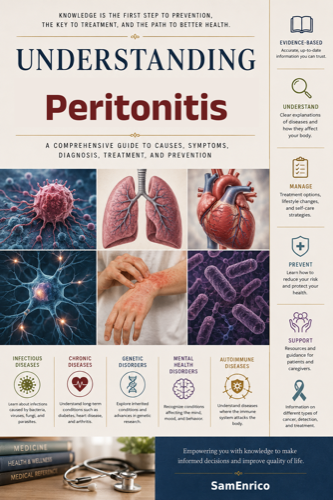
Understanding Peritonitis
This disease publication, published by SamEnrico,
This disease publication, published by SamEnrico, covers Understanding Peritonitis
Formats
About this book
Free sample
Chapter 1: The Inner Battlefield...–- The human abdomen is a paradox. It houses the most vulnerable organs in the body—the intestines, liver, pancreas, and spleen—yet it lacks the bony armor that protects the brain, heart, and lungs. Instead, nature designed a different defense system: a shimmering, translucent membrane called the peritoneum. This membrane is the largest and most complex serous surface in the human body, covering a surface area roughly equivalent to that of the skin. When it works silently, as it does in health, no one ever thinks about it.
But when it fails—when inflammation ignites across its delicate surface—the result is one of the most lethal conditions a clinician will ever face.The Peritoneum: More Than Just a Sack Most medical students first encounter the peritoneum as a frustrating diagram to memorize for anatomy exams: parietal layer here, visceral layer there, greater omentum hanging like an apron, mesenteries suspending the small bowel. But this reductionist view misses the essential truth. The peritoneum is not merely a passive sack that holds the abdominal organs. It is a dynamic, living, immunologically active organ in its own right, constantly surveilling the abdominal cavity and mounting rapid responses to any threat.The peritoneum consists of two continuous layers. The parietal peritoneum lines the inner surface of the abdominal wall.
It is innervated by somatic nerves—the same nerves that supply the overlying skin. This is why parietal peritoneal irritation produces sharp, well-localized pain. A patient with a perforated ulcer directly under the anterior abdominal wall can point with one finger to the exact spot of maximum tenderness. The visceral peritoneum, in contrast, covers the abdominal organs and is innervated by autonomic nerves—the same nerves that sense stretch and distension but cannot localize precisely. Visceral peritoneal irritation produces dull, poorly localized pain, often referred to distant sites such as the shoulder or back.Between these two layers lies the peritoneal cavity, a potential space that in health contains only 50 to 100 milliliters of clear, straw-colored, sterile lubricating fluid.
This fluid is not simple transudate. It is a carefully regulated environment rich in proteins, immunoglobulins, complement factors, and macrophages.…
This is the end of the free sample. Get the eBook to keep going. Buy now
Contents
- Chapter 1
- Chapter 2
- Chapter 3
- Chapter 4
- Chapter 5
- Chapter 6
- Chapter 7
- Chapter 8
- Chapter 9
- Chapter 10
- Chapter 11
- Chapter 12
Details
- Author
- Boudreau Kandi
- Publisher
- SamEnrico
- Language
- English
- Genre
- Non-Fiction, Informative, Educational
- Released
- 2026-06-02
- Pages (approx.)
- 154
- Available as
- eBook, Audiobook

Read better in the ZLOADR app
Your eBooks on your phone or tablet. Sign in with your SamEnrico account and start reading.
More by Boudreau Kandi
 HRT Starting Dose Protocols WorkbookBoudreau Kandi$11.99
 The Commuter Anger Prevention PlanBoudreau Kandi$11.99
 Geothermal Energy InvestmentBoudreau Kandi$11.99
 Office Chair Lower Back SolutionBoudreau Kandi$11.99
 The Ghost Squad: Spain's Shadowy Police Corruption RingBoudreau Kandi$11.99
 Lagos Pop Up Marketing on InstagramBoudreau Kandi$12.99
 Stripe Billing Portal SetupBoudreau Kandi$12.99
 How to Become a Sprayer OperatorBoudreau Kandi$11.99