
Non-FictionInformativeEducational
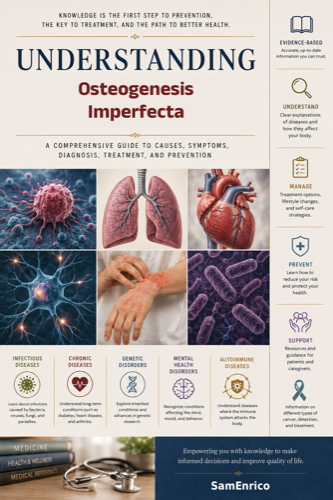
Understanding Osteogenesis Imperfecta
This disease publication, published by SamEnrico,
This disease publication, published by SamEnrico, covers Understanding Osteogenesis Imperfecta
Formats
About this book
Free sample
Chapter 1: The Hidden Architecture--The human skeleton is a marvel of evolutionary engineering. Two hundred and six bones, each precisely shaped, strategically placed, and continuously remodeled, support our weight, protect our organs, and enable movement. Under a microscope, healthy bone reveals an intricate latticework—a honeycomb of mineralized collagen fibers that achieves an almost impossible balance between strength and lightness. It is stronger than steel on a pound-for-pound basis, yet flexible enough to absorb impact. This is not an accident of nature.
It is the result of a protein called Type I collagen, the most abundant protein in the human body, which serves as the molecular scaffolding upon which bone mineral crystallizes.Now imagine that scaffolding is flawed. Imagine the steel rebar inside a concrete building is not solid steel but brittle cast iron, riddled with microscopic cracks from the moment it was poured. The building may still stand. It may look normal from the outside. But the first time a heavy wind blows, or a truck rumbles down the adjacent street, the cracks propagate.
The building does not fall—not all at once—but it fractures in ways that no amount of exterior paint can hide.This is osteogenesis imperfecta. Not a disease of "soft bones" or "weak bones," as it is often described, but a disease of flawed architecture. The bones of a person with OI contain the same mineral content as anyone else's. They are not deficient in calcium. They are not waiting for a vitamin supplement to solve them.
What they lack is the quality of the collagen matrix that gives bone its resilience. When a child with OI fractures a femur rolling over in bed, it is not because the bone was too weak for the task. It is because the collagen fibers that should have absorbed the gentle torsional stress were already compromised, already frayed, already waiting for a trigger that would have been inconsequential in a typical skeleton.This chapter is about that architecture—not the bones themselves, but the hidden molecular world that builds them. To understand OI, you must first understand collagen. To understand…
This is the end of the free sample. Get the eBook to keep going. Buy now
Contents
- Chapter 1
- Chapter 2
- Chapter 3
- Chapter 4
- Chapter 5
- Chapter 6
- Chapter 7
- Chapter 8
- Chapter 9
- Chapter 10
- Chapter 11
- Chapter 12
Details
- Author
- Goad Margherita
- Publisher
- SamEnrico
- Language
- English
- Genre
- Non-Fiction, Informative, Educational
- Released
- 2026-06-02
- Pages (approx.)
- 151
- Available as
- eBook, Audiobook

Read better in the ZLOADR app
Your eBooks on your phone or tablet. Sign in with your SamEnrico account and start reading.
More by Goad Margherita
 PCOS Yoga Poses GuideGoad Margherita$11.99
 MBSR For Caregivers Burnout CourseGoad Margherita$11.99
 Sunset Visualization Evening RelaxGoad Margherita$11.99
 Workplace Stress Eating FixGoad Margherita$11.99
 The Sir Alexander Fleming PenicillinGoad Margherita$11.99
 The Battle of Kadesh: Ramses II's Gambit - What If Egypt Had Lost?Goad Margherita$11.99
 Staff Frontend EngineerGoad Margherita$11.99
 Canadian Graduate Home Child Care PilotGoad Margherita$12.99
 A Beginners Guide to Formula Student (Volume 1)Goad Margherita$11.99
You may also like
 Hong Kong Handover 1997Dunn Johnnie$11.99
 Zumba For Postnatal Recovery CourseNeal Christian$11.99
 Zumba for BeginnersLadner Nikia$11.99
 YouTube Comment Mining GuideHumes Pandora$12.99
 Worry Box MeditationCarlin Rudy$11.99
 Workplace Stress MeditationNguyen Lynn$11.99
 Workplace Stress and Sleep RepairHawley Ivory$11.99
 Workplace Perfectionism CureDelaney Jeffry$11.99
 Workplace Injustice Anger GuideWallen Isabelle$11.99
 Work Addiction and Burnout LinkGreenwood Ester$11.99
 Women in Yoga and WellnessBeattie Galina$11.99
 Women in Stand Up ComedyChun Evangeline$11.99