
Non-FictionInformativeEducational
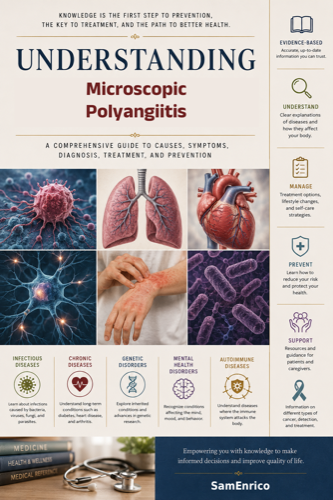
Understanding Microscopic Polyangiitis eBook
This disease publication, published by SamEnrico,
by Orosco Nery
This disease publication, published by SamEnrico, covers Understanding Microscopic Polyangiitis
Formats
Free sample
Chapter 1: A Silent Storm...--The email arrived at 3:47 PM on a Tuesday. Sarah, a 48-year-old elementary school teacher and mother of two teenagers, had been waiting for this message for ten days—ever since the kidney biopsy. She had watched her inbox obsessively, refreshing every hour, hoping for answers that would explain the fatigue that had turned climbing a flight of stairs into an expedition, the unexplained weight loss that had her students asking if she was sick, and the strange bruise-like spots that had appeared on her ankles and then mysteriously vanished. When she finally opened the email, the subject line read only: "Biopsy Results." The body contained a single sentence: "Your kidney biopsy shows pauci-immune crescentic glomerulonephritis; please call our office to schedule an urgent appointment with nephrology."Sarah did not know what any of those words meant. She did not know that "pauci-immune" would become one of the most important words of her life.
She did not know that "crescentic" had nothing to do with the moon and everything to do with the shape of scar tissue compressing the filtering units of her kidneys. And she certainly did not know that she had just received a diagnosis of Microscopic Polyangiitis—a disease she had never heard of, a disease so rare that most doctors would never diagnose a single case in their entire careers, a disease that had, silently and without warning, been attacking the smallest blood vessels throughout her body.This chapter is for Sarah. It is for you. Whether you are holding this book because you or someone you love has just received this diagnosis, because you are a medical professional seeking to understand the patient experience, or because you are simply trying to make sense of a body that has turned against itself, this chapter will give you something essential: a clear, honest, and compassionate understanding of what Microscopic Polyangiitis actually is. Not the scary version you might find in a twenty-year-old medical textbook.
Not the oversimplified version that leaves you with more questions than answers. The real version—grounded in the best available science, translated into language that respects your intelligence without assuming your medical degree, and organized so that you can return to it again and again as you build your knowledge.Let us begin at the beginning: with the name itself.Breaking Down the Name: What "Microscopic Polyangiitis" Actually Means Medical names are often terrifying precisely because they are incomprehensible. "Microscopic Polyangiitis" sounds like something out of a science fiction novel—a technical, cold, almost mechanical term that seems designed to distance patients from their own bodies. But every part of that name describes something real, something specific, and something you can understand. Let us take the name apart, word by word, like a mechanic examining the components of an engine.
Once you understand what each piece means, the name becomes not a source of fear but a map of exactly what is happening inside you.Microscopic. This word tells you the size of the blood vessels involved. Your body contains an astonishing network of blood vessels—arteries, veins, and capillaries that, if laid end to end, would circle the Earth more than twice. Most of these vessels are invisible to the naked eye, and it is the smallest among them—the capillaries, the arterioles, the venules—that MPA attacks. These microscopic vessels are only one cell layer thick, which makes them incredibly efficient at exchanging oxygen, nutrients, and waste between your blood and your tissues.
But that same thinness also makes them vulnerable. When inflammation strikes these tiny vessels, they can leak, rupture, or close off entirely. That is why MPA can affect so many different organs: microscopic blood vessels are everywhere. They line the filtering units of your kidneys. They wrap around the air sacs of your lungs.
They supply oxygen to your nerves, your skin, your digestive tract, and every other tissue in your body. When the enemy is invisible and everywhere, the damage can seem random. But understanding that MPA targets microscopic vessels helps explain why the disease can appear in the kidneys of one patient, the lungs of another, and the nerves of a third—and why some patients experience all three.Poly. This is the Greek prefix meaning "many." It tells you that the disease does not strike a single isolated blood vessel. Instead, it is widespread, multifocal, involving many vessels in many locations.
Think of it as the difference between a single broken pipe in your basement and a dozen broken pipes scattered throughout your house. If MPA affected only one blood vessel, your symptoms would be localized to whatever organ that vessel supplied. But because it is poly, because it involves many vessels, the symptoms can be bewilderingly diverse—fatigue here, skin spots there, ankle swelling somewhere else. This poly- nature is one reason MPA is so often misdiagnosed early on, dismissed as everything from a viral syndrome to stress to simple aging.Angiitis. This word comes from the Greek "angeion" (vessel) and the suffix "-itis" (inflammation).
Angiitis simply means inflammation of blood vessels. That is it. At its core, MPA is a disease of inflammation—the same process that makes a sprained ankle swell and turn red, but happening inside your blood vessels. Inflammation is not inherently evil; it is your immune system's primary weapon against infection and injury. But in MPA, that weapon has misfired.
Your immune system has begun treating your own blood vessels as if they were invading pathogens. It attacks them with the same ferocity it would reserve for a dangerous bacteria or virus. The result is vessel wall damage, leakage, narrowing, and sometimes complete destruction.Putting it all together: Microscopic Polyangiitis is a disease of widespread inflammation affecting the smallest blood vessels throughout your body. That is the definition. It is precise, it is descriptive, and it is the foundation upon which everything else in this book is built.A Brief History: How We Learned to See This Disease Every disease has a story, and MPA's story is one of slow recognition, painful misclassification, and eventual clarity.
Understanding this history matters not because you need to pass a test, but because it explains why some older doctors or medical texts might still use confusing or outdated terminology—and why the modern understanding of MPA is actually quite recent.The first descriptions of what we now recognize as MPA appeared in the medical literature in the 1940s and 1950s. At that time, physicians were just beginning to use the newly invented technique of biopsy—taking small tissue samples from living patients and examining them under microscopes. When they looked at the kidneys of patients who had died from what was then called "periarteritis nodosa" or "polyarteritis nodosa" (PAN), they noticed something puzzling. Some patients had inflammation in medium-sized arteries, which matched the classic description of PAN. But other patients had inflammation only in the microscopic vessels—the glomeruli (the filtering units of the kidneys), the capillaries—and their medium arteries were completely normal.
Yet both groups had similar clinical presentations: kidney failure, skin rashes, nerve damage.In 1948, a physician named Davson published a paper suggesting that there might…
This is the end of the free sample. Get the eBook to keep going. Buy now
About this book
Details
- Author
- Orosco Nery
- Publisher
- SamEnrico
- Language
- English
- Genre
- Non-Fiction, Informative, Educational
- Released
- 2026-05-11
- Pages (approx.)
- 157
- Available as
- eBook, Audiobook

Read better in the ZLOADR app
Your eBooks on your phone or tablet. Sign in with your SamEnrico account and start reading.
More by Orosco Nery
 Hybrid Work Conflict GuideOrosco Nery$11.99
 Viber Group Chat Overload GuideOrosco Nery$11.99
 OCD Ritual InterruptOrosco Nery$11.99
 Travel with Baby SleepOrosco Nery$11.99
 Teacher Self Esteem GuideOrosco Nery$11.99
 The Timbuktu Codex Heist: Guardians of the Golden ManuscriptsOrosco Nery$11.99
 Artificial Insemination Technician (Livestock)Orosco Nery$11.99
 Space Economy Capital GuideOrosco Nery$12.99
 Content Quality Review AI GuideOrosco Nery$12.99
 How to Start a Cereal Breakfast Foods Business (Beginners Guide)Orosco Nery$11.99
You may also like
 Hong Kong Handover 1997Dunn Johnnie$11.99
 Zumba For Postnatal Recovery CourseNeal Christian$11.99
 Zumba for BeginnersLadner Nikia$11.99
 YouTube Comment Mining GuideHumes Pandora$12.99
 Worry Box MeditationCarlin Rudy$11.99
 Workplace Stress MeditationNguyen Lynn$11.99
 Workplace Stress and Sleep RepairHawley Ivory$11.99
 Workplace Perfectionism CureDelaney Jeffry$11.99
 Workplace Injustice Anger GuideWallen Isabelle$11.99
 Work Addiction and Burnout LinkGreenwood Ester$11.99
 Women in Yoga and WellnessBeattie Galina$11.99
 Women in Stand Up ComedyChun Evangeline$11.99