
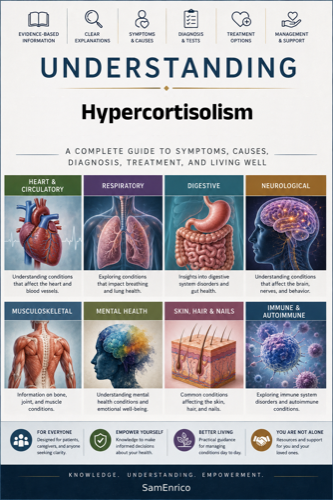
Non-FictionInformativeEducational
Understanding Hypercortisolism eBook
This condition publication, published by SamEnrico
This condition publication, published by SamEnrico, covers Understanding Hypercortisolism
Formats
Free sample
Chapter 1: The Silent Saboteur...--Every human being carries within them a finely calibrated chemical orchestra. When it plays in harmony, we wake refreshed, face challenges with resilience, heal from injuries, and sleep peacefully when the day is done. But when one instrument—a single hormone—begins to play too loudly, too constantly, and without rest, the entire symphony descends into chaos. That hormone is cortisol, and when it is allowed to run unchecked, it becomes a silent saboteur, dismantling health from the inside while the victim is often told they are simply stressed, lazy, or depressed.This book is about understanding that sabotage—and, more importantly, how to stop it.Cortisol is not inherently evil. In fact, you cannot live without it.
Produced by the adrenal glands, two small pyramid-shaped organs perched atop your kidneys, cortisol is the body’s primary glucocorticoid. Its jobs are as diverse as they are vital. Cortisol helps regulate glucose metabolism, ensuring that your brain and muscles have fuel during fasting or intense activity. It modulates the immune system, preventing it from overreacting to minor threats. It maintains blood pressure by sensitizing blood vessels to other hormones like norepinephrine.
It governs the sleep-wake cycle, rising naturally in the early morning hours to wake you and falling to near-zero at midnight so you can rest. And during moments of acute danger—a car swerving toward you, a sudden fall, a physical threat—cortisol surges to mobilize energy, sharpen focus, and prioritize survival over digestion, reproduction, and growth.This is the stress response, and it is one of evolution’s most elegant designs. Short-term, high-dose cortisol saves lives.But what happens when that elegant design breaks? What happens when cortisol remains high not for minutes or hours, but for months or years? The answer is a medical condition known as hypercortisolism—biochemical excess of cortisol—and its visible, physical manifestation, Cushing syndrome.
The saboteur is no longer saving your life. It is slowly, systematically, destroying it.The Double-Edged Sword: Understanding Cortisol’s Dual Nature To understand hypercortisolism, one must first appreciate cortisol’s legitimate, necessary roles. This section provides the foundation upon which the rest of the book is built, because only by knowing what cortisol should do can one recognize what it should not do.Metabolism and Energy Regulation. Cortisol is a catabolic hormone, meaning it breaks down stored compounds to release energy. In the liver, it stimulates gluconeogenesis—the production of new glucose from amino acids and fats.
In adipose tissue, it promotes lipolysis, releasing free fatty acids into the bloodstream. In muscle, it encourages protein breakdown to supply amino acids for glucose production. Under normal conditions, these actions are balanced by anabolic hormones like insulin and growth hormone. But when cortisol is excessive, this balance tips catastrophically toward breakdown. Muscle wastes.
Fat redistributes abnormally. Blood sugar rises uncontrollably.Immune Modulation. Cortisol suppresses inflammation. This is why glucocorticoid medications like prednisone are powerful treatments for autoimmune diseases, asthma, and allergic reactions. Cortisol prevents immune cells from releasing inflammatory cytokines, reduces the permeability of blood vessels, and stabilizes lysosomal membranes.
But chronic excess suppresses the immune system to the point of vulnerability. Infections become more frequent and more severe. Wounds heal slowly. Even minor cuts can become problematic.Cardiovascular Support. Cortisol enhances the vasoconstrictor effects of catecholamines like epinephrine and norepinephrine, helping maintain blood pressure.
It also promotes fluid retention through mineralocorticoid receptor activation. In excess, however, this leads to hypertension that is often resistant to standard medications, left ventricular hypertrophy, and accelerated atherosclerosis.Circadian Rhythm Governance. Cortisol follows a distinct diurnal pattern. It peaks around 6-8 AM, providing the energy and alertness needed to start the day. It gradually declines throughout the afternoon, reaching its nadir between midnight and 2 AM.
This rhythm is set by the suprachiasmatic nucleus of the hypothalamus and is synchronized with light exposure. Loss of this rhythm—characterized by high midnight cortisol—is one of the earliest and most sensitive markers of hypercortisolism.When patients first learn they have hypercortisolism, many express confusion. “Isn’t cortisol just the stress hormone?” they ask. “I’ve been under a lot of stress, so isn’t this normal?” This confusion is understandable but dangerous. Chronic psychological stress does elevate cortisol, but usually within a narrow range—perhaps 10-20% above baseline.
In true hypercortisolism, cortisol levels can be two, three, five, or even ten times normal. The difference is not one of degree but of kind. Stress-related cortisol elevations are a whisper; hypercortisolism is a scream.Defining the Enemy: Hypercortisolism vs. Cushing Syndrome One of the most common sources of confusion in both medical literature and patient communities is the distinction between two terms: hypercortisolism and Cushing syndrome. Throughout this book, we will use these terms with precision, and readers are encouraged to do the same.Hypercortisolism refers exclusively to the biochemical state of cortisol excess as measured in blood, urine, or saliva.
It is a laboratory diagnosis. A patient has hypercortisolism if their late-night salivary cortisol is elevated, if their 24-hour urinary free cortisol is above the reference range, or if they fail to suppress their serum cortisol after a 1mg dexamethasone suppression test. Hypercortisolism can exist with or without physical symptoms.Cushing syndrome refers to the collection of physical signs and symptoms that result from chronic cortisol excess. These include central obesity, moon face, buffalo hump, violaceous striae, easy bruising, proximal muscle weakness, osteoporosis, hypertension, glucose intolerance, and cognitive dysfunction. A patient has Cushing syndrome when they manifest these features.
Almost all patients with Cushing syndrome have hypercortisolism, but not all patients with hypercortisolism have Cushing syndrome.This distinction is not merely academic. It has profound clinical implications. Consider two hypothetical patients:Patient A has a visible moon face, purple stretch marks across her abdomen, easy bruising, and profound muscle weakness. Her urinary cortisol is only 1.5 times the upper limit of normal. She has Cushing syndrome with relatively mild biochemical elevation.
She requires treatment.Patient B has no visible Cushingoid features. She is not overweight. She has no striae, no bruising, normal muscle strength. But she has an incidental adrenal nodule found on a CT scan performed for an unrelated issue, and her dexamethasone suppression test shows failure to suppress with a cortisol of 3.2 mcg/d L. She has biochemical hypercortisolism without clinical Cushing syndrome.
Whether she requires treatment is a matter of controversy—a topic we will explore in depth in Chapter 11.Throughout this book, we will use the term Mild Autonomous Cortisol Secretion (MACS) for patients like Patient B: biochemical hypercortisolism with metabolic complications (hypertension, diabetes, osteoporosis) but without the classic cosmetic features of Cushing syndrome. The term “subclinical Cushing’s” is outdated and imprecise; we will reserve it only for the rare patient with biochemical hypercortisolism and no clinical manifestations at all.The Harvey Cushing Legacy: A Historical Foundation Every field of medicine has its founding figures—individuals whose curiosity, persistence, and insight transformed mystery into understanding. For hypercortisolism, that figure is Dr. Harvey Cushing, a neurosurgeon whose name now graces the most common endogenous form of the disease: Cushing’s disease.Born in 1869 in Cleveland, Ohio, Cushing trained at Harvard Medical School and Johns Hopkins Hospital before becoming the first full-time professor of surgery…
This is the end of the free sample. Get the eBook to keep going. Buy now
About this book
Details
- Author
- Schwarz Enriqueta
- Publisher
- SamEnrico
- Language
- English
- Genre
- Non-Fiction, Informative, Educational
- Released
- 2026-06-03
- Pages (approx.)
- 160
- Available as
- eBook, Audiobook

Read better in the ZLOADR app
Your eBooks on your phone or tablet. Sign in with your SamEnrico account and start reading.
More by Schwarz Enriqueta
 Self Doubt In Ministry GuideSchwarz Enriqueta$11.99
 Media Streaming PreferencesSchwarz Enriqueta$11.99
 Anger and Property DamageSchwarz Enriqueta$11.99
 The Visual Distraction EliminatorSchwarz Enriqueta$11.99
 Low Carb For IBS ReliefSchwarz Enriqueta$11.99
 Sociopathy Versus Psychopathy DefinedSchwarz Enriqueta$11.99
 Digital Nomad RetirementSchwarz Enriqueta$11.99
 70 Percent Rule DelegationSchwarz Enriqueta$11.99
 The Last Kingpin: How a Quiet Neighborhood Became a Cartel HubSchwarz Enriqueta$11.99
 Ravana's Lament: The Fall of the Ten-Headed KingSchwarz Enriqueta$11.99
 A Collector's Handbook to the Cadillac 370aSchwarz Enriqueta$11.99
 How to Produce a Skid-steer LoaderSchwarz Enriqueta$11.99
You may also like
 Hong Kong Handover 1997Dunn Johnnie$11.99
 Zumba For Postnatal Recovery CourseNeal Christian$11.99
 Zumba for BeginnersLadner Nikia$11.99
 YouTube Comment Mining GuideHumes Pandora$12.99
 Worry Box MeditationCarlin Rudy$11.99
 Workplace Stress MeditationNguyen Lynn$11.99
 Workplace Stress and Sleep RepairHawley Ivory$11.99
 Workplace Perfectionism CureDelaney Jeffry$11.99
 Workplace Injustice Anger GuideWallen Isabelle$11.99
 Work Addiction and Burnout LinkGreenwood Ester$11.99
 Women in Yoga and WellnessBeattie Galina$11.99
 Women in Stand Up ComedyChun Evangeline$11.99