
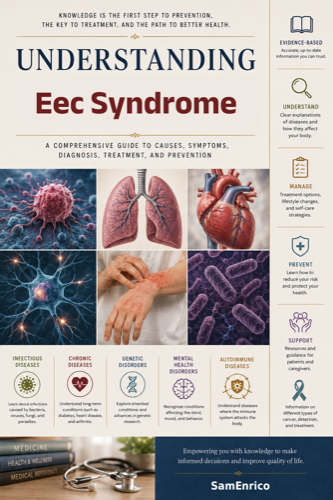
Non-FictionInformativeEducational
Understanding Eec Syndrome eBook
This disease publication, published by SamEnrico,
by Loper Shonda
This disease publication, published by SamEnrico, covers Understanding Eec Syndrome
Formats
Free sample
Chapter 1: The Diagnosis Earthquake...--The phone rang at 2:47 on a Tuesday afternoon, and nothing in my life was ever the same again. I remember the exact second because I had just finished folding a basket of baby onesies—tiny white cotton squares with cartoon elephants on the chest. My daughter, Emma, was nine weeks old. She was sleeping in the bassinet beside the sofa, her split left hand resting on her chest like a small, pink starfish missing two rays. I had stopped staring at that hand weeks ago, or so I told myself.
But the truth was, I stared at it every single day. I just no longer cried when I did.The voice on the other end belonged to Dr. Patricia Okonkwo, a clinical geneticist at the university hospital two hours away. We had driven there eight days earlier, my husband Mike clutching the steering wheel so tightly his knuckles went white, while I sat in the back seat next to Emma's car seat, watching her breathe. The appointment had lasted four hours.
They had measured her head circumference three times, photographed her hands and feet from every angle, shone lights in her eyes, and finally drawn two small vials of blood for what they called "whole exome sequencing." I had no idea what that meant then. I knew only that they were looking for something, and that whatever they found would attach itself to my daughter like a second shadow."There's no easy way to say this," Dr. Okonkwo began, and I felt the temperature in the room drop twenty degrees. "Emma has a genetic condition called EEC syndrome. It stands for Ectrodactyly-Ectodermal Dysplasia-Clefting."I wrote the letters on a scrap of paper—E-E-C—and stared at them as if they might rearrange themselves into something less frightening.
They did not."What does that mean?" I whispered. Mike was still at work. I was alone with a sleeping baby and a doctor's voice coming through a speaker."It means," Dr. Okonkwo said carefully, "that Emma was born with a mutation in a gene called TP63. This gene acts like an architect during pregnancy, telling cells whether to become skin, or limbs, or the roof of the mouth.
The mutation causes a range of physical differences. You've already seen the hand involvement. There may be others."My mind latched onto the word "architect" because my father had been an architect, and I understood blueprints. I understood that a single line drawn in the wrong place could turn a bedroom into a hallway, a staircase into a dead end. But a human being was not a house.
You could not demolish a human being and start over."What kind of other differences?" I asked.The list that followed took nearly twenty minutes to recite. Dr. Okonkwo spoke in the careful, measured tone of someone who had delivered difficult news many times before. She told me about the possibility of a cleft lip or palate—neither of which Emma had shown signs of at birth, but which could still appear in milder forms. She told me about dental abnormalities: missing teeth, small teeth, teeth that came in late or not at all.
She told me about sparse hair, brittle nails, skin so dry it cracked and bled in winter. She told me about the eyes—lacrimal duct obstruction that meant Emma might never cry tears, photophobia that would make sunlight feel like needles, and something called limbal stem cell deficiency that I could not begin to understand but that I would later come to know as the single greatest threat to her vision.And then she told me about the sweating.Or rather, she told me about the lack of it."The medical term is anhidrosis," she said. "Emma's sweat glands either didn't form or don't function. She cannot cool herself the way other people can. If she gets too hot, she could suffer heat stroke very quickly.
You'll need to be vigilant about this for her entire life."I looked out the window. It was February in Minnesota. The temperature outside was fourteen degrees Fahrenheit, and a thin layer of ice coated the glass. Heat stroke seemed like a problem for another season, another version of myself who had read enough books to know what questions to ask next.But I had not read any books. That was the problem.
That was why I would eventually write this one.The Silence After the Diagnosis For three days after that phone call, I did not tell anyone. Not Mike—not yet, because I wanted to find the right words and I was not sure they existed. Not my mother, who would cry and then apologize for crying, which would make me cry, and then we would both be crying and no one would be doing anything useful. Not the women in my online mother's group, who posted about diaper rashes and sleep regressions and whose babies all had ten fingers and ten toes and futures that seemed, from where I sat, impossibly bright and uncomplicated.Instead, I sat in the dark at 3 AM during Emma's night feeds and typed fragments into the search bar on my phone. "EEC syndrome." "TP63 mutation." "Ectrodactyly ectodermal dysplasia clefting prognosis." The results were terrifying, then confusing, then terrifying again.
I found medical journals with words I could not pronounce. I found a Wikipedia page that was eight paragraphs long and cited no sources after 2009. I found a single blog written by a mother in Ohio whose teenage son had EEC, and I read every post three times, weeping with relief at the photographs of a boy who played baseball and went to prom and had friends who called him by name, not by diagnosis.But mostly, I found nothing.I found nothing because there was nothing. No comprehensive guide for parents like me. No roadmap for the first year, the first surgery, the first day of school.
No explanation of what an IEP was or how to get one. No list of questions to ask an ophthalmologist who had never heard of limbal stem cell deficiency. No one to tell me that the inability to sweat was not just about hot days but about fevers, about car seats in the summer sun, about a five-minute walk from the parking lot to the grocery store.I found nothing because EEC syndrome was rare—so rare that Dr. Okonkwo had told me there were fewer than five hundred people in the entire United States living with it. Fewer than five hundred.
In a country of three hundred and thirty million."We are alone in this," I whispered to Emma at 4 AM, her warm body curled against my chest. "But I am going to learn everything there is to know, and then I am going to write it down so that no mother ever has to sit in the dark like this again."This book is that promise kept.What This Chapter Will Teach You Before we go any further, let me be clear about what this chapter is and what it is not.This chapter is an introduction to EEC syndrome—what it is, what causes it, how it got…
This is the end of the free sample. Get the eBook to keep going. Buy now
About this book
Details
- Author
- Loper Shonda
- Publisher
- SamEnrico
- Language
- English
- Genre
- Non-Fiction, Informative, Educational
- Released
- 2026-06-02
- Pages (approx.)
- 157
- Available as
- eBook, Audiobook

Read better in the ZLOADR app
Your eBooks on your phone or tablet. Sign in with your SamEnrico account and start reading.
More by Loper Shonda
 Jet Lag Hypnosis RecoveryLoper Shonda$11.99
 Healing Touch WorkbookLoper Shonda$11.99
 Sugar Addiction and Fatigue HandbookLoper Shonda$11.99
 Social Anxiety School SurvivalLoper Shonda$11.99
 Cortisol and Chronic Pain GuideLoper Shonda$11.99
 Echoes of the Void: The Aboriginal Sky Stories That Foretold Black HolesLoper Shonda$11.99
 The Alchemist's Legacy: The Secret Formula of ImmortalityLoper Shonda$11.99
 How to Become a Rack-room WorkerLoper Shonda$11.99
 Bookkeeping Website GuideLoper Shonda$12.99
 Africa Logistics Provider GuideLoper Shonda$12.99
 English Elm HarvestingLoper Shonda$11.99
You may also like
 Hong Kong Handover 1997Dunn Johnnie$11.99
 Zumba For Postnatal Recovery CourseNeal Christian$11.99
 Zumba for BeginnersLadner Nikia$11.99
 YouTube Comment Mining GuideHumes Pandora$12.99
 Worry Box MeditationCarlin Rudy$11.99
 Workplace Stress MeditationNguyen Lynn$11.99
 Workplace Stress and Sleep RepairHawley Ivory$11.99
 Workplace Perfectionism CureDelaney Jeffry$11.99
 Workplace Injustice Anger GuideWallen Isabelle$11.99
 Work Addiction and Burnout LinkGreenwood Ester$11.99
 Women in Yoga and WellnessBeattie Galina$11.99
 Women in Stand Up ComedyChun Evangeline$11.99