
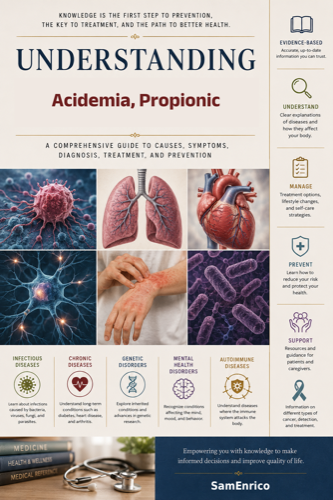
Non-FictionInformativeEducational
Understanding Acidemia, Propionic eBook
This disease publication, published by SamEnrico,
by Fenner Eda
This disease publication, published by SamEnrico, covers Understanding Acidemia, Propionic
Formats
Free sample
Chapter 1: The Poisoned Wellspring--The first forty-eight hours of life are supposed to be a blur of joy, exhaustion, and wonder. In hospital maternity wards across the world, new parents count fingers and toes, marvel at tiny yawns, and wait anxiously for the moment they can take their perfect baby home. For the parents of a child with neonatal-onset Propionic Acidemia (PA), those first two days are the last moments of a life they expected. Then, without warning, the world collapses. What follows is not a gradual decline but a catastrophic cascade—a silent meltdown that transforms a seemingly healthy newborn into a critically ill patient fighting for survival.This chapter is about that collapse.
It is about the poisoned wellspring that lies hidden within every cell of a child with PA, waiting for the first feeding to awaken it. But more than that, this chapter is about recognition. Because understanding what happens during a metabolic crisis—why the body turns against itself, what the warning signs are, and how rapid intervention changes outcomes—is the first and most important step toward saving a child's life.We will walk through the pathophysiology of metabolic decompensation in clear, accessible terms. We will name the four dangerous amino acids that trigger the crisis. We will explain why ammonia is such a potent neurotoxin and why elevated levels demand immediate action.
We will discuss newborn screening—what it can do and what it cannot. We will explore the differential diagnosis and explain why PA is often mistaken for sepsis. And we will do all of this with one guiding principle: knowledge is the antidote to fear.The Story We Hear Too Often Every metabolic specialist has heard some version of this story. A baby is born at full term, with a healthy birth weight, Apgar scores of eight and nine, and no obvious abnormalities. The baby breastfeeds or takes formula in the delivery room.
The parents are told everything looks perfect. They take photographs. They send announcements. They begin to imagine a future.Then, sometime between the second and fourth day of life, the baby changes. It starts subtly.
The baby is "sleepier than usual" or "just a little fussy." A nurse notices the baby is not feeding as vigorously as before. Perhaps the baby has vomited once or twice. These are the kinds of things that happen to newborns, the parents are told. "It's probably nothing. Let's keep an eye on it."But it is not nothing.
Over the next few hours, the sleepiness deepens into something that looks more like a coma. The baby becomes limp—what doctors call hypotonia. The breathing becomes rapid and deep, almost panting, as if the baby has just run a race while lying completely still. The skin may take on a dusky or mottled appearance. And then, in the worst cases, the baby begins to have seizures or stops breathing entirely.By the time the medical team recognizes that this is not a routine infection or a benign feeding problem, the baby is already in full metabolic crisis.
The clock is ticking. Every hour of delay increases the risk of permanent brain injury or death.This is the story that brings families to this book. And while we cannot erase that trauma, we can ensure that no family ever feels alone in it again.The Perfect Storm: Protein, Enzymes, and Toxins To understand what goes wrong in a baby with PA, we first need to understand what goes right in a healthy newborn. When a baby without PA eats a meal of breast milk or formula, the protein in that meal is broken down in the stomach and small intestine into its simplest building blocks: amino acids. Twenty different amino acids are used by the human body.
Some are used to build new proteins for growth and repair. Some are burned directly for energy. Others are converted into different molecules that the body needs—neurotransmitters, hormones, enzymes, and countless other biochemicals.The entire process is orchestrated by enzymes, which are tiny molecular machines inside every cell. Each enzyme performs one specific chemical reaction, and it performs that reaction with remarkable speed and precision. The system runs continuously, quietly, without any noticeable effort.
The baby grows. The baby thrives. The parents never think about amino acids or enzymes at all.In a baby with Propionic Acidemia, however, there is a critical flaw in this system. Specifically, the baby's body lacks a functional version of an enzyme called Propionyl-Co A Carboxylase, or PCC. This enzyme lives inside the mitochondria—the power plants of the cell—and its job is to take a molecule called propionyl-Co A and convert it into another molecule called methylmalonyl-Co A.That might sound like a minor chemical step, but it is absolutely essential.
Propionyl-Co A is produced primarily from the breakdown of four specific amino acids: isoleucine, valine, methionine, and threonine. It is also produced from the breakdown of certain fatty acids and cholesterol. In a healthy person, propionyl-Co A is quickly converted to methylmalonyl-Co A and then to succinyl-Co A, which enters the citric acid cycle to produce energy. The entire process takes seconds.But when PCC is deficient or absent, propionyl-Co A cannot be converted. Instead, it accumulates.
And as it accumulates, it spills over into alternative chemical pathways that were never meant to handle it. The result is a cascade of toxic metabolites.The primary toxins that accumulate in PA are:Propionic acid itself — a simple organic acid that directly acidifies the blood and tissues3-hydroxypropionate — another organic acid that interferes with mitochondrial function Methylcitrate — a metabolite that inhibits multiple enzymes in the citric acid cycle and the urea cycle Propionylglycine — a conjugate formed when propionyl-Co A combines with the amino acid glycine These are not harmless byproducts. They are cellular poisons. They interfere with the mitochondria, the power plants of the cell, causing energy failure in the brain, heart, and other organs. They inhibit the urea cycle, which is the body's system for removing nitrogen waste, leading to hyperammonemia.
They cause direct inflammation in the brain, triggering cerebral edema and seizures. They disrupt the normal functioning of the liver, the pancreas, and the immune system.This is the poisoned wellspring: a hidden metabolic defect that turns the very food meant to nourish the baby into a stream of cellular toxins.The Four Culprit Amino Acids Not all amino acids are dangerous for a baby with PA. Most are handled normally. But four specific amino acids are the direct precursors to propionyl-Co A. Those four are:Isoleucine Valine Methionine Threonine These are not exotic or rare amino acids.
They are abundant in almost all natural proteins. Breast milk contains them. Standard infant formula contains them. Meat, eggs, dairy, legumes, nuts, seeds, and many whole grains contain them. Even many vegetables contain them in smaller amounts.For a baby with PA, every gram of natural protein is a measured dose of potential toxins.
This creates a fundamental paradox that will appear throughout this book: the baby needs protein to grow, build new tissues, make neurotransmitters, and support immune function, but the baby cannot tolerate the amount of protein that normal growth…
This is the end of the free sample. Get the eBook to keep going. Buy now
About this book
Details
- Author
- Fenner Eda
- Publisher
- SamEnrico
- Language
- English
- Genre
- Non-Fiction, Informative, Educational
- Released
- 2026-05-09
- Pages (approx.)
- 133
- Available as
- eBook, Audiobook

Read better in the ZLOADR app
Your eBooks on your phone or tablet. Sign in with your SamEnrico account and start reading.
More by Fenner Eda
 Fecal Transplant GuideFenner Eda$11.99
 Hospice Admission GriefFenner Eda$11.99
 The Nun Who LevitatedFenner Eda$11.99
 Warm Up For Strength TrainingFenner Eda$11.99
 The TM Morning Reset GuideFenner Eda$11.99
 Metta Digital Detox GuideFenner Eda$11.99
 Growing Up in a FEMA TrailerFenner Eda$11.99
 Hypnic Jerk GuideFenner Eda$11.99
 Saved for Wishlist Only RuleFenner Eda$11.99
 The Vanishing Billionaire: The Mysterious Disappearance of Jimmy HoffaFenner Eda$11.99
 The Spice Kings of Lisbon: Portugal's Golden Age of TradeFenner Eda$11.99
 The Road Builders: Rome's Arteries of EmpireFenner Eda$11.99
You may also like
 Hong Kong Handover 1997Dunn Johnnie$11.99
 Zumba For Postnatal Recovery CourseNeal Christian$11.99
 Zumba for BeginnersLadner Nikia$11.99
 YouTube Comment Mining GuideHumes Pandora$12.99
 Worry Box MeditationCarlin Rudy$11.99
 Workplace Stress MeditationNguyen Lynn$11.99
 Workplace Stress and Sleep RepairHawley Ivory$11.99
 Workplace Perfectionism CureDelaney Jeffry$11.99
 Workplace Injustice Anger GuideWallen Isabelle$11.99
 Work Addiction and Burnout LinkGreenwood Ester$11.99
 Women in Yoga and WellnessBeattie Galina$11.99
 Women in Stand Up ComedyChun Evangeline$11.99