
Non-FictionInformativeEducational
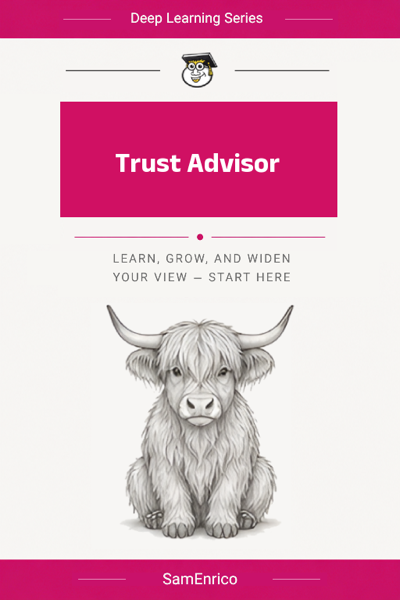
Trust Advisor eBook
A Coursebook on Trust Advisor
by Falls Noelia
A Coursebook on Trust Advisor
Formats
Free sample
Chapter 1: The Invisible Currency...--What if I told you that your technical expertise—the skill you have spent a decade perfecting, the credential hanging on your wall, the advanced certification you paid nine thousand dollars for—is now worth roughly the same as a reliable internet connection?Not zero. But rapidly approaching commodity status.Here is the uncomfortable truth that the top one percent of advisors have already figured out: In an age where artificial intelligence can generate a financial plan in seven seconds, where a You Tube tutorial can teach a junior accountant what used to take three years to learn, and where price-comparison tools have turned every professional service into a bidding war—the only thing that cannot be automated, outsourced, or reverse-engineered is trust.Trust is the invisible currency of the advisory world. It does not appear on your balance sheet. It does not show up in your CRM. You cannot deposit it in a bank.
And yet, without it, you have nothing. Without it, your fifty-page slide deck is noise. Your thirty years of experience is a footnote. Your Harvard MBA is a line item. Your client will smile, nod, and then hire someone else.Or worse—they will hire you, but they will never actually listen to you.This book is called Trust Advisor for a very specific reason.
It is not The Technical Expert Who Also Happens to Be Nice. It is not The Person Who Knows the Most About Tax Law. It is Trust Advisor. Because the title you earn from your clients is not determined by your degree. It is determined by one question they ask themselves silently, every single time you interact:Do I trust this person with something that matters to me?If the answer is yes, price becomes negotiable.
Timeline becomes flexible. Competing offers become irrelevant. If the answer is no, nothing else you do will ever matter.The Day I Learned That Being Right Was Wrong Let me tell you a story.Early in my career, I was the smartest person in every room I entered. Or at least, I believed I was. I had the spreadsheets to prove it.
I had the data models. I had the fifty-three-page market analysis that I had stayed up until 2:00 AM perfecting. I was prepared. I was precise. I was, by every objective measure, correct.I was also failing.There was a client—let us call him David.
David ran a mid-sized manufacturing company. He was stressed, sleep-deprived, and under immense pressure from his board to turn around a declining profit margin. He had hired me to help him restructure his supply chain. I had spent three weeks building what I believed was a flawless recommendation.I walked into the conference room. I shook his hand.
I opened my laptop. And then I talked for forty-five minutes.I showed him charts. I showed him regression analyses. I showed him case studies of other manufacturers who had implemented similar strategies. I showed him cost projections, timeline estimates, risk matrices, and contingency plans.
It was, objectively, a masterpiece of analytical rigor.When I finished, David looked at me. He did not look inspired. He looked exhausted."So?" I said.He sighed. "So... I don't know.
It all makes sense. But I don't know."That was it. I don't know.I walked out of that meeting convinced that David was the problem. He was indecisive. He was not analytical enough.
He did not appreciate the depth of my work. I told myself that story for three weeks. Then David fired me. Not with drama. Not with anger.
Just a quiet email: "We have decided to go in a different direction. Thank you for your time."I was devastated. But more than that, I was confused. How could the objectively correct answer lose to... nothing?It took me six months to understand what had actually happened.
David did not fire me because my analysis was wrong. He fired me because I had never actually listened to him. I had never asked him what he was afraid of. I had never asked him what kept him awake at 3:00 AM. I had never asked him what he had already tried and why it had failed.
I had never asked him, "What would success feel like, not just look like?"I had treated him like a problem to be solved, not a person to be understood.And in doing so, I had violated the first and most important rule of trust: Trust is not about being right. Trust is about being present.Why This Book Exists Here is what the market has already figured out: Technical knowledge is cheap.Think about it. Thirty years ago, if you wanted to understand tax law, you had to hire a tax attorney. Twenty years ago, you had to buy a thousand-dollar textbook. Ten years ago, you had to take an expensive course.
Today, you can ask Chat GPT, "Explain the difference between a Roth IRA and a traditional IRA in the simplest possible terms," and receive a perfectly adequate answer in four seconds.The same is true for financial modeling. For legal research. For marketing strategy. For supply chain optimization. For data analysis.
For almost every technical skill that used to define professional expertise.Does this mean that experts are obsolete? No. It means that the baseline of expertise has shifted. What used to be a competitive advantage is now table stakes. You must be technically competent just to enter the game.
But technical competence alone will never win it.The game is now won or lost on trust.Trust is the variable that determines whether a client:Shares the full truth with you or hides the messy parts Calls you before a crisis or after it has already exploded Defends you to their boss or throws you under the bus Pays your fee without complaining or fights every line item Stays with you for a decade or switches to your competitor next quarter In other words, trust is the difference between being a vendor and being a partner. Between being replaceable and being essential. Between being a commodity and being an asset.This book is called Trust Advisor because it is a coursebook. It is not meant to be read once and placed on a shelf. It is meant to be worked.
Each chapter contains a framework, a case study, a self-assessment, and a drill. You will practice. You will fail. You will practice again. And over time, you will rewire the way you show up in every client interaction.The twelve chapters of this book are organized into four parts:Part I: The Architecture of Trust (The Mindset)Chapters 1 through 3 establish the foundational framework.
You will learn the Trust Equation, which breaks trust down into four measurable variables. You will learn how to manage your own ego—the single biggest killer of trust. And you will learn the five-stage arc of every trust-based relationship.Part II: The Five Skills of the Trust Advisor (The Toolkit)Chapters 4 through 7 teach the specific behaviors that build trust: deep listening, partnering instead of expert-ing, taking strategic risks, and handling high-pressure moments with improvisation.Part III…
This is the end of the free sample. Get the eBook to keep going. Buy now
About this book
Details
- Author
- Falls Noelia
- Publisher
- SamEnrico
- Language
- English
- Genre
- Non-Fiction, Informative, Educational
- Released
- 2026-05-04
- Pages (approx.)
- 147
- Available as
- eBook, Audiobook

Read better in the ZLOADR app
Your eBooks on your phone or tablet. Sign in with your SamEnrico account and start reading.
More by Falls Noelia
 MBSR for Fibromyalgia WorkbookFalls Noelia$11.99
 Teen Self Esteem and Public SpeakingFalls Noelia$11.99
 MBSR For Trauma SurvivorsFalls Noelia$11.99
 Ayurvedic Anxiety Relief GuideFalls Noelia$11.99
 Navigating Sexual Orientation DisclosureFalls Noelia$11.99
 Frostbound: The Trolls Who Built the MountainsFalls Noelia$11.99
 China to Ghana Sea Freight DropshippingFalls Noelia$12.99
 Customer Feedback Analysis GuideFalls Noelia$12.99
 How to Start a Cement Made of Dolomite Business (Beginners Guide)Falls Noelia$11.99
 Understanding Methylenetetrahydrofolate Reductase DeficiencyFalls Noelia$17.99
You may also like
 Hong Kong Handover 1997Dunn Johnnie$11.99
 Zumba For Postnatal Recovery CourseNeal Christian$11.99
 Zumba for BeginnersLadner Nikia$11.99
 YouTube Comment Mining GuideHumes Pandora$12.99
 Worry Box MeditationCarlin Rudy$11.99
 Workplace Stress MeditationNguyen Lynn$11.99
 Workplace Stress and Sleep RepairHawley Ivory$11.99
 Workplace Perfectionism CureDelaney Jeffry$11.99
 Workplace Injustice Anger GuideWallen Isabelle$11.99
 Work Addiction and Burnout LinkGreenwood Ester$11.99
 Women in Yoga and WellnessBeattie Galina$11.99
 Women in Stand Up ComedyChun Evangeline$11.99