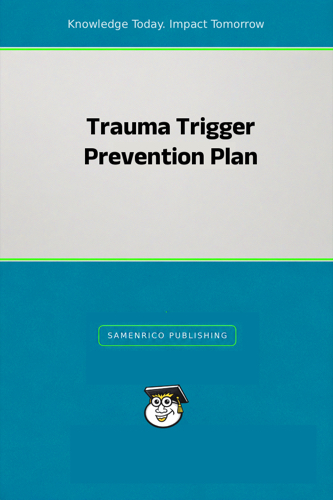
Trauma Trigger Prevention Plan eBook
Build lifestyle habits that reduce overall trigger
Build lifestyle habits that reduce overall trigger sensitivity.
Formats
Free sample
Chapter 1: The Avoidance Trap--Most people who live with chronic triggering believe they are doing the right thing. They avoid the crowded grocery store. They screen their phone calls. They rehearse conversations fifteen times in the shower to prevent being caught off guard. They decline invitations, change their routes, and organize their entire lives around the simple, desperate goal of not being set off.
And every single time they do this, their brain learns a dangerous lesson: that thing you just avoided was absolutely worth avoiding.This is the avoidance trap, and it is the single most misunderstood mechanism in trauma recovery.Let me say this as directly as possible. If you have been avoiding your triggers because you believe you are protecting yourself, you are not wrong in the short term. Avoidance does prevent immediate explosions. It does lower your anxiety in the moment. It does feel like safety.
But what you have not been told is that every act of avoidance strengthens the neural pathway of fear in your brain. You are not healing. You are teaching your amygdala to scream louder the next time.The science behind this is unforgiving but also liberating. Your brain is plastic, meaning it changes with use. The neural circuits that fire together wire together.
Every time you avoid a trigger, two things happen simultaneously. First, you feel temporary relief, which is reinforcing. Second, your brain logs a file that says, "We survived that situation by running away. Running away works. Keep that strategy handy." Over weeks and months, the avoidance behavior becomes automatic, and your window of tolerance shrinks.
Things that used to be mildly annoying become catastrophic. Your world gets smaller. Your trigger list gets longer. And you are left wondering why you feel worse despite trying so hard to feel safe.This book offers a radically different path. Not trigger management, which is the art of surviving a flashback in real time.
But trigger desensitization, which is the science of building daily lifestyle habits that reduce the volume of the alarm bell permanently. You will not be asked to confront your worst trauma without preparation. You will not be told to "just face your fears" like some motivational speaker who has never felt their chest cave in from a panic attack. Instead, you will learn a systematic, body-first protocol that begins not with exposure but with sleep, food, movement, and environmental hygiene. You will build a foundation so strong that when you eventually do climb the exposure ladder in the final section of this book, your nervous system will be ready, not flooded.But before we go anywhere, we need to dismantle one of the most pervasive and damaging myths in popular trauma culture: the idea that all avoidance is bad.The distinction that will save your sanity Here is where most trauma books get it wrong.
They read the research on avoidance and fear conditioning and conclude that avoidance is always harmful. Then they tell you to stop avoiding, which sends you into a shame spiral when you inevitably cannot. The truth is more nuanced, and getting this distinction right is the difference between this book collecting dust on your nightstand and this book changing your life.There are two kinds of avoidance. Healing avoidance is when you skip a situation that could foster growth, connection, or mastery because you are afraid of how you might feel. This includes declining a dinner with friends you actually want to see, avoiding a conversation with your partner about something that matters, or staying home from a work event that could advance your career.
Healing avoidance shrinks your life. It reinforces the belief that you cannot handle discomfort. It is the avoidance that the research warns us about, and it is the primary target of this book.Protective avoidance is different. Protective avoidance is the temporary, strategic management of sensory and environmental inputs so that you have nervous system bandwidth for the challenges that actually matter. Turning off your phone notifications so you can focus on a difficult conversation is protective avoidance.
Leaving a loud, chaotic room to catch your breath before returning is protective avoidance. Not watching the news before bed because you know it will give you nightmares is protective avoidance. These are not signs of weakness. They are signs of wisdom. They are the difference between running from your life and curating your environment so you can show up fully for the parts of your life that matter.You will hear this distinction repeated throughout the book.
In Chapter 7, when we talk about environmental hygiene and creating a low-dopamine evening environment, you are engaging in protective avoidance. In Chapter 4, when you prioritize sleep over staying up late to scroll social media, that is protective avoidance. In Chapter 11, when you build an exposure ladder, you are specifically targeting healing avoidance. The rule is simple. Protective avoidance supports your nervous system so you can face what matters.
Healing avoidance protects you from discomfort at the cost of shrinking your world. One is a tool. The other is a trap.The difference between management and desensitization Most people who pick up a book about triggers are looking for better coping skills. They want to know what to do when the flashback hits. They want grounding techniques, breathing exercises, and scripts for talking themselves down from the ledge.
These are important, and they have their place, but they are not what this book is about.Trigger management is what you do during a fire. Trigger desensitization is what you do to fireproof your house.Management skills are reactive. They assume the trigger has already occurred, and your only job is to survive it without hurting yourself or anyone else. Deep breathing, cold water on the face, naming five things you can see, calling a friend, taking a PRN medication. These strategies save lives in the moment, and I am not here to diminish them.
But they do not reduce the frequency or intensity of future triggers. They simply help you weather the storm you are already in.Desensitization is proactive. It is the slow, deliberate process of rewiring your brain so that the same stimulus no longer produces the same alarm response. This happens through a combination of lifestyle stabilization and graded exposure, both of which we will cover in detail. Desensitization does not feel like a heroic confrontation.
It feels like showing up, day after day, to small, manageable practices that change your biology from the ground up. It is not flashy. It is not dramatic. And it works better than any crisis management tool ever could.Here is the promise of this book. By the time you finish the twelve weeks outlined here, you will not need as many management skills because you will not be triggered as often or as intensely.
You will still have hard days. You will still feel sadness, anger, and fear because those are human emotions, not pathology. But the hair trigger, the catastrophic overreaction, the feeling of being hijacked by your own nervous system, that can change. Not through willpower. Through lifestyle architecture.What small lifestyle choices can actually do The word rewiring gets thrown around…
This is the end of the free sample. Get the eBook to keep going. Buy now
About this book
Details
- Author
- Reedy Sherell
- Publisher
- SamEnrico
- Language
- English
- Genre
- Non-Fiction, Self-Help, Prevention
- Released
- 2026-06-12
- Pages (approx.)
- 142
- Available as
- eBook, Audiobook

Read better in the ZLOADR app
Your eBooks on your phone or tablet. Sign in with your SamEnrico account and start reading.
More by Reedy Sherell
 Breast Health For Wheelchair UsersReedy Sherell$11.99
 Truck Blind Spot Rage PreventionReedy Sherell$11.99
 Postpartum Joy Finding GuideReedy Sherell$11.99
 Influence Techniques for Product DesignersReedy Sherell$11.99
 Fireplace Warmth MeditationReedy Sherell$11.99
 Startup Layoff RecoveryReedy Sherell$11.99
 Group Creativity for EngineersReedy Sherell$11.99
 The Republic of Letters: Florence’s Intellectual RevolutionReedy Sherell$11.99
 The First Flash of Glory: How a 19th-Century Photographer Captured Africa’s Olympic DreamsReedy Sherell$11.99
 How to Produce Cooling RacksReedy Sherell$11.99
 UK Export Sustainability WorkbookReedy Sherell$12.99
 Export Payment Dispute ResolutionReedy Sherell$12.99