
Non-FictionHealth & WellnessTrauma
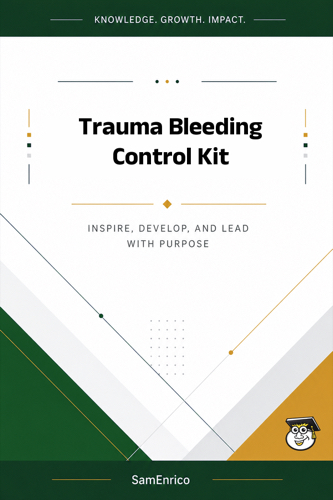
Trauma Bleeding Control Kit eBook
Lists tourniquets, hemostatic gauze, and chest sea
Lists tourniquets, hemostatic gauze, and chest seals for severe bleeding.
Formats
Free sample
Chapter 1: The Platinum Five--– The first time I watched someone bleed to death, I was standing three feet away with a tourniquet in my hand. I had been trained. I had the equipment. I had the authority to act. But I hesitated.
I was twenty-three years old, a newly minted emergency medical technician on my first trauma rotation, and the patient was a construction worker who had slipped on wet rebar and driven a piece of angle iron through his femoral artery. The blood was bright red. It was spurting. It was pooling on the concrete floor in a circle the size of a dinner plate. And I stood there, frozen, because in that moment, the fifteen hours of classroom training dissolved into nothing.
The instructor's voice faded. The Power Point slides vanished. All that remained was the primal, paralyzing scream of my own brain: Don't make it worse. Don't hurt him. Don't be wrong.The senior paramedic, a woman named Diane who had been running calls since before I was born, stepped around me without a word.
She knelt in the blood. She applied a tourniquet high on the man's thigh. She cranked the windlass until the spurting stopped. She wrote "T 0943" on his forehead with a purple marker she kept in her vest pocket. The whole thing took twenty-two seconds.
The man survived. Diane looked up at me and said something I have never forgotten: "The only thing that dies from hesitation is the patient."That was fifteen years ago. In the years since, I have trained thousands of people in bleeding control—military medics, law enforcement officers, schoolteachers, security guards, office managers, and parents. I have watched them struggle with the same hesitation I felt. I have seen them fumble with tourniquets they have never unpackaged.
I have heard them ask the same question, over and over: "Am I really going to need this?" The answer is yes. Not maybe. Not possibly. Yes. Because the mathematics of bleeding are relentless, and the window for action is smaller than almost anyone realizes.This chapter is not an introduction.
It is an urgent call to understand something that most people spend their entire lives not knowing: that you have approximately five minutes from the moment an artery is severed to the moment the brain dies. Not thirty minutes. Not the time it takes for an ambulance to arrive. Not the time it takes for a surgeon to scrub in. Five minutes.
That is the Platinum Five. And in that window, you are the only person who can make a difference.The Fluid That Makes You Human To understand why bleeding kills so quickly, you must first understand what blood actually does. Most people think of blood as a kind of hydraulic fluid—something that moves the parts around. This is dangerously incomplete. Blood is not a lubricant.
It is a transportation system, a communication network, a climate control device, and a defense force all wrapped into one remarkable fluid.Consider the numbers. The average adult human body contains approximately five liters of blood. That is about the volume of two large soda bottles. Within those five liters float approximately 25 trillion red blood cells. Each red blood cell carries approximately 270 million molecules of hemoglobin.
Each hemoglobin molecule can bind four molecules of oxygen. Do the multiplication, and you begin to grasp the staggering efficiency of this system: every minute, at rest, your body consumes approximately 250 milliliters of oxygen. Every molecule of that oxygen is delivered by blood.Now consider what happens when that delivery system fails. The brain, which accounts for only two percent of the body's mass, consumes twenty percent of its oxygen. Without oxygen, brain cells begin to die in as little as sixty seconds.
After three minutes, the damage is irreversible. After five minutes, brain death is essentially certain. This is not a gradual decline. It is a cliff.The body has some compensatory mechanisms. When blood volume drops, the heart rate increases to maintain pressure.
Blood vessels constrict in the periphery—the hands and feet—to shunt remaining blood to the core organs. This is why patients in shock feel cold and look pale. Their bodies are literally turning off the heat to the extremities to keep the brain and heart alive. But these mechanisms have limits. The average adult can lose approximately fifteen percent of blood volume (about 750 milliliters) before vital signs begin to destabilize.
At twenty percent loss (one liter), the heart begins to race and blood pressure drops. At thirty percent loss (1.5 liters), the patient becomes confused, lethargic, and unable to stand. At forty percent loss (two liters), the patient loses consciousness. At fifty percent loss (2.5 liters), the heart stops.An arterial bleed does not give the body time to compensate. The femoral artery, at rest, carries approximately 300 to 400 milliliters of blood per minute.
A complete transection of the femoral artery can empty the entire blood volume in three to five minutes. The carotid artery in the neck carries approximately 250 milliliters per minute. The brachial artery in the upper arm carries approximately 100 milliliters per minute. Every artery has its own flow rate, and every arterial bleed has its own clock.Arterial Versus Venous: The Crucial Distinction Not all bleeding is created equal. If you take only one thing from this chapter—besides the urgency of the five-minute window—it must be the ability to distinguish arterial from venous bleeding at a glance.
This distinction determines your entire response.Arterial blood is under pressure. The heart pumps with enough force to push blood to the tips of your toes and the crown of your head. When an artery is cut, the pressure differential between the inside of the vessel and the outside environment is enormous. The blood does not ooze. It does not flow.
It spurts. It jets. It pulses with every heartbeat, shooting in arcs that can reach three to five feet. The color is bright red, almost fluorescent—the scarlet of oxygenated blood fresh from the lungs. This is the "arterial spray" that forensic investigators recognize and that witnesses describe as "fountains of blood."Venous blood, by contrast, is under low pressure.
The veins are not directly connected to the pumping force of the heart; blood moves through them primarily by the squeezing action of surrounding muscles and a system of one-way valves. When a vein is cut, the blood flows steadily but does not spurt. The color is dark red, almost maroon—the color of blood that has given up its oxygen to the tissues. A large vein like the femoral vein can still cause fatal bleeding, but the timeline is longer: fifteen to twenty minutes, sometimes more. This is still an emergency, but it is not the five-minute killer.Capillary bleeding is the slow oozing from the tiny vessels that connect arteries to veins.
A scraped knee is capillary bleeding. A razor cut is capillary bleeding. These injuries are painful but not life-threatening. The body's clotting system can handle them easily.Why does this distinction matter? Because a venous bleed allows time for a measured response.
You can apply direct pressure. You can elevate the limb. You can wait for EMS. An arterial bleed allows no…
This is the end of the free sample. Get the eBook to keep going. Buy now
About this book
Details
- Author
- Broyles Gabriela
- Publisher
- SamEnrico
- Language
- English
- Genre
- Non-Fiction, Health & Wellness, Trauma
- Released
- 2026-06-09
- Pages (approx.)
- 138
- Available as
- eBook, Audiobook

Read better in the ZLOADR app
Your eBooks on your phone or tablet. Sign in with your SamEnrico account and start reading.
More by Broyles Gabriela
 NDA Abstraction AI WorkflowBroyles Gabriela$11.99
 Ra Sun God GuideBroyles Gabriela$11.99
 Corporate Executive ConfidenceBroyles Gabriela$11.99
 Building Mastery SkillBroyles Gabriela$11.99
 Anger Management for Military PersonnelBroyles Gabriela$11.99
 Mindfulness For BurnoutBroyles Gabriela$11.99
 Music Memorization PalaceBroyles Gabriela$11.99
 Abyssal Plain Solo HandbookBroyles Gabriela$11.99
 The Selkie's Lament: A Love Cursed by the TidesBroyles Gabriela$11.99
 The Frozen Sky: A Balloonist’s Love and the Last Flight to AntarcticaBroyles Gabriela$11.99
 Echoes of the Moon: The Apollo 11 Secret TapesBroyles Gabriela$11.99
 The Dancer's Guide to Bandari DanceBroyles Gabriela$11.99
You may also like
 Hong Kong Handover 1997Dunn Johnnie$11.99
 Zumba For Postnatal Recovery CourseNeal Christian$11.99
 Zumba for BeginnersLadner Nikia$11.99
 YouTube Comment Mining GuideHumes Pandora$12.99
 Worry Box MeditationCarlin Rudy$11.99
 Workplace Stress MeditationNguyen Lynn$11.99
 Workplace Stress and Sleep RepairHawley Ivory$11.99
 Workplace Perfectionism CureDelaney Jeffry$11.99
 Workplace Injustice Anger GuideWallen Isabelle$11.99
 Work Addiction and Burnout LinkGreenwood Ester$11.99
 Women in Yoga and WellnessBeattie Galina$11.99
 Women in Stand Up ComedyChun Evangeline$11.99