
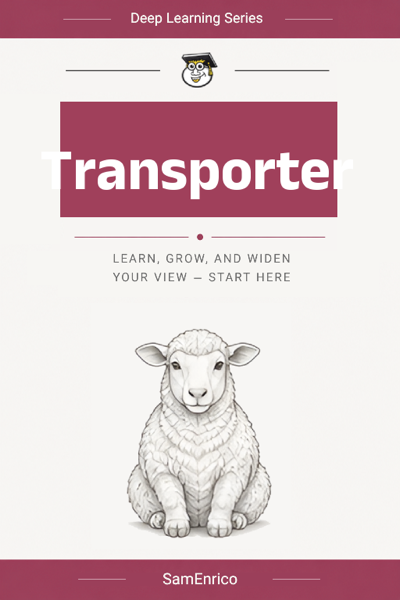
Non-FictionInformativeEducational
Transporter eBook
A Coursebook on Transporter
A Coursebook on Transporter
Formats
Free sample
Chapter 1: The Embedded Mile...--The ship was called the Ever Given, and on March 23, 2021, it did something that should have been impossible. A vessel the height of the Great Pyramid of Giza, loaded with 18,300 containers holding everything from IKEA furniture to Nike sneakers to the components of five thousand washing machines, turned sideways in the Suez Canal and stuck there. For six days.I remember watching the news coverage from my apartment, half-fascinated and half-horrified. The camera angles made it look like a child had dropped a toy boat in a bathtub. But the numbers told a different story.
That single sideways wedge was holding 9billionintradehostage.Foreveryhourthe∗Ever Given∗blockedthecanal,theglobaleconomylost9 billion in trade hostage. For every hour the *Ever Given* blocked the canal, the global economy lost 9billionintradehostage.Foreveryhourthe∗Ever Given∗blockedthecanal,theglobaleconomylost400 million. Ships began diverting around the Cape of Good Hope, adding two weeks to their journeys. Container rates, already volatile, went vertical. And somewhere in a warehouse in Ohio, a manager realized that the pallet of electronic components she needed for tomorrow's production line was sitting on that ship, motionless, in the Egyptian desert.That manager had done everything right.
She had ordered early. She had chosen a reliable carrier. She had paid for expedited handling. None of it mattered, because the world had just remembered a truth we spend most of our energy forgetting: transportation is the circulatory system of modern life, and when it stops, everything stops.This book is about that system. Not the glossy, consumer-facing version—the "two-day shipping" promise or the "track your package" map—but the hidden, gritty, beautiful, terrifying machine that moves 90 percent of everything you own from where it is made to where you are standing.
I call it "The Embedded Mile," a concept I will return to throughout this book. Every product you touch contains, embedded in its price, the accumulated cost of every kilometer it traveled, every border it crossed, every hand that lifted it, every gallon of fuel burned, and every risk taken along the way. A five-dollar t-shirt from a discount retailer has probably crossed two oceans and four national borders. The plastic bottle of water you buy at the airport contains, in its price, the energy equivalent of filling that bottle one-quarter full with diesel—just to move it from the spring to the shelf.The people who run this system are invisible. The trucker driving through a blizzard at three in the morning so that the grocery store has bread by dawn.
The warehouse picker walking twelve miles per shift in a building the size of fifteen football fields, retrieving items so that your online order arrives in one box instead of three. The port crane operator sitting forty meters above the deck of a container ship, lowering a spreader bar onto a container with millimeter precision, guided by nothing but experience and two small mirrors. And yes, the dispatcher on the phone at 2 a.m., trying to find a replacement driver when the original call-out has a family emergency.These people are heroes. But as we will see in Chapter 4, they are also fallible. The same fatigue that makes a trucker a hero can become the cause of a catastrophic load shift.
The same pressure to hurry that makes a warehouse picker efficient can lead to improperly declared dangerous goods. In this book, we will hold both truths together: transportation is a miracle of human coordination, and it is also a system that breaks in predictable ways when humans cut corners.By the time you finish this chapter, you will understand why the shipping container is the most important invention you have never thought about, why your grandparents lived in a world of scarcity while you live in a world of abundance, and why a volcano in Iceland once grounded your Valentine's Day roses. More importantly, you will begin to see The Embedded Mile everywhere—in the price of your coffee, the delivery date of your next package, and the empty shelves that appear when the invisible machine coughs.Let us begin.The Flat World and the Full World In 2005, the journalist Thomas Friedman published a best-selling book called The World Is Flat. His argument was compelling: technology—the internet, fiber optics, workflow software—had leveled the playing field for global commerce. A programmer in Bangalore could write code for a company in Boston.
A customer service agent in Manila could answer calls from London. The world, Friedman argued, had become flat because information traveled instantly and without friction.He was not wrong about technology. But he was incomplete.Because while information travels at the speed of light, things do not. A container ship moves at twenty-three knots—about twenty-six miles per hour. A train moves at forty miles per hour loaded, slower if it is carrying hazardous materials.
A truck moves at fifty-five to sixty-five miles per hour, but only if traffic permits, only if the driver has hours left on their log, only if the roads are not closed by snow or protest. A single kilogram of freight traveling from Shanghai to Chicago takes thirty-four days on a ship, three days to cross the port, five days on a train, and one day on a truck—forty-three days total, during which that kilogram exists in a liminal space, neither made nor consumed, just moving.I call this reality the Full World. It is full of friction. Full of gravity. Full of weather, pirates, customs inspectors, broken axles, mislabeled pallets, and drivers who fall asleep at the wheel.
It is full of the physical limits of steel, rubber, and human endurance. And it is full of a problem that software alone cannot solve: the fact that moving a physical object from one place to another requires energy, time, and risk.The tension between the Flat World and the Full World is the central drama of modern transportation. The Flat World says, "This transaction should take three clicks and happen instantly." The Full World says, "No, it takes forty-three days and a million decisions by a thousand people, and if any one of them fails, your package is late."This book is for people who want to understand the Full World. Not because the Flat World is unimportant—technology will appear in almost every chapter of this book, from GPS to TMS to blockchain—but because the Flat World has become so seductive that we have forgotten the physical reality underneath it. We click "buy now" and expect the box to appear.
When it does, we feel nothing. When it does not, we feel everything.That is the invisibility paradox, and we will return to it again and again.Before the Box: The World of Broken Logistics To understand how extraordinary our current transportation system is, we must first understand how terrible it used to be.Before the standardized shipping container—before the box—global trade was a nightmare of inefficiency, theft, and delay. Imagine a dock in New York Harbor in 1955. A ship arrives from Europe carrying loose crates, barrels, sacks, and pallets of varying sizes. Longshoremen—union workers with iron hooks and iron backs—unload each item individually, carrying it down a gangplank to the…
This is the end of the free sample. Get the eBook to keep going. Buy now
About this book
Details
- Author
- Rosenbaum Karol
- Publisher
- SamEnrico
- Language
- English
- Genre
- Non-Fiction, Informative, Educational
- Released
- 2026-05-09
- Pages (approx.)
- 157
- Available as
- eBook, Audiobook

Read better in the ZLOADR app
Your eBooks on your phone or tablet. Sign in with your SamEnrico account and start reading.
More by Rosenbaum Karol
 Mindful Listening MBSR WorkbookRosenbaum Karol$11.99
 The Lake Meditation WorkbookRosenbaum Karol$11.99
 The Difficult Conversation with Co ParentsRosenbaum Karol$11.99
 Teen Self Esteem and SleepRosenbaum Karol$11.99
 Ayurvedic Pranayama BreathingRosenbaum Karol$11.99
 The Sneaker Moguls: How Black Entrepreneurs Built a Billion-Dollar EmpireRosenbaum Karol$11.99The Sneaker Moguls: How Black Entrepreneurs Built a Billion-Dollar EmpireRosenbaum Karol$11.99
 Schedule Coordination AI GuideRosenbaum Karol$12.99
 Brazil Returns and Refund ManagementRosenbaum Karol$12.99
 How to Start a Cement Made of Silica and Siliceous Business (Beginners Guide)Rosenbaum Karol$11.99
 Understanding Methyl Mercury Antenatal InfectionRosenbaum Karol$17.99
You may also like
 Hong Kong Handover 1997Dunn Johnnie$11.99
 Zumba For Postnatal Recovery CourseNeal Christian$11.99
 Zumba for BeginnersLadner Nikia$11.99
 YouTube Comment Mining GuideHumes Pandora$12.99
 Worry Box MeditationCarlin Rudy$11.99
 Workplace Stress MeditationNguyen Lynn$11.99
 Workplace Stress and Sleep RepairHawley Ivory$11.99
 Workplace Perfectionism CureDelaney Jeffry$11.99
 Workplace Injustice Anger GuideWallen Isabelle$11.99
 Work Addiction and Burnout LinkGreenwood Ester$11.99
 Women in Yoga and WellnessBeattie Galina$11.99
 Women in Stand Up ComedyChun Evangeline$11.99