
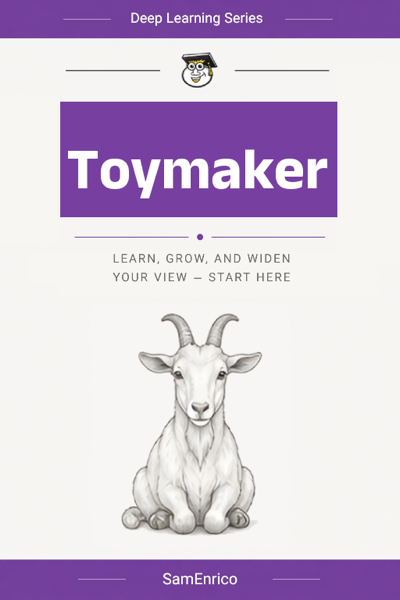
Non-FictionInformativeEducational
Toymaker eBook
A Coursebook on Toymaker
A Coursebook on Toymaker
Formats
Free sample
Chapter 1: The World Awaits...--The moment you decide to make a toy, you join a lineage that stretches back to the dawn of human civilization. Before there were written languages, before there were cities or kings or coins, there were toys. A small clay animal on wheels, discovered in an ancient Egyptian tomb. A wooden doll with movable limbs, buried with a Greek child thousands of years ago. A carved stone animal, small enough to fit in a child's hand, found in the ruins of a prehistoric settlement.
These were not mass-produced commodities. They were gifts of love, crafted by hand, passed from parent to child, from grandparent to grandchild. They were proof that even in the hardest times, adults made time for play.You are about to become part of this story.This book is not a history lesson, though history will inform everything you do. It is not a design textbook, though design is at its core. It is not a business manual, though business realities will shape your success.
This book is all of these things and none of them. It is a coursebook for the aspiring toy maker—a guide to the craft, the industry, and the art of creating objects that bring joy to children.Whether you dream of stitching plush animals in a home studio, designing the next global toy phenomenon for a major corporation, or building a business around handcrafted wooden puzzles, this chapter is where your journey begins.Why Toys Matter More Than You Think Toys are not trivial. In a world that often dismisses play as the opposite of work, toys are dismissed as the opposite of serious tools. But this framing is wrong. Toys are the tools of childhood.
They are how children learn to grip, to stack, to balance, to cause an effect, to imagine a world different from the one they see. They are how children practice being adults—cooking in a play kitchen, driving a toy car, caring for a doll. They are how children process emotions, work through fears, and build the mental models that will guide them for the rest of their lives.A well-designed toy is not a distraction from development. It is a catalyst for development.Consider the simple wooden block. A child picks it up—developing fine motor control.
She stacks it on another block—learning balance and gravity. She knocks it down—discovering cause and effect. She uses it as a pretend phone, a car, a cookie—practicing symbolic thinking. She shares it with a friend—learning social skills. All of this from a cube of wood.
No screen. No batteries. No instructions. Just a shape and a child's imagination.This is the power you hold as a toy maker. You are not creating objects.
You are creating opportunities for growth, connection, and joy.A Billion-Dollar Playground The global toy industry is enormous. In 2023, the worldwide toy market was valued at over $120 billion, and it continues to grow. From small specialty shops selling artisanal wooden toys to multinational corporations producing millions of plastic action figures, the industry spans an extraordinary range of scales, materials, and markets.Understanding this landscape is your first task as an aspiring toy maker. Where do you see yourself fitting in? Do you dream of creating high-end designer toys for adult collectors?
Educational toys for preschool classrooms? Soft, huggable plush animals for babies? Interactive electronic toys that respond to a child's touch? Board games that bring families together around a table on a rainy afternoon?Each segment of the toy industry has its own language, its own design requirements, its own manufacturing processes, its own safety standards, and its own market dynamics. A plush toy maker needs expertise in fabrics, patterns, and stitching.
A mechanical toy designer needs knowledge of gears, linkages, and motors. A wooden toymaker needs skills in joinery, shaping, and non-toxic finishes. A toy entrepreneur needs business acumen alongside design skills.The most successful toy makers understand not only their craft but also the context in which their toys will be used and sold. They know who their customer is—not just the child who will play with the toy, but the parent, grandparent, or gift-giver who will purchase it. They understand that safety is not a constraint but a foundation.
They know that a beautiful toy that cannot be manufactured affordably is a museum piece, not a product.A Journey Through Time The history of toy making is the history of human creativity itself. Long before factories and assembly lines, parents and craftspeople made toys by hand from the materials available to them: wood, clay, cloth, stone, bone.In ancient Egypt, children played with clay animals on wheels and wooden dolls with strands of clay beads for hair. In ancient Greece, children had rattles shaped like pigs and dolls with movable limbs. In ancient Rome, children played with hoops, tops, and small clay figures. These toys were not mass-produced, but they were widespread—evidence that across cultures and centuries, adults understood that children needed to play.The Industrial Revolution transformed everything.
Mass production made toys affordable for middle-class families for the first time in history. Germany emerged as the center of toy manufacturing in the 19th century, producing everything from tin soldiers to wooden building blocks. The famous Nuremberg toy industry exported around the world.The 20th century brought new materials that revolutionized what toys could be. Plastics—first celluloid, then Bakelite, then ABS, PVC, and polypropylene—were inexpensive, lightweight, and could be molded into virtually any shape. The post-World War II economic boom saw the rise of the modern toy industry as we know it.
Lego introduced its interlocking brick system in 1949. Mattel introduced Barbie in 1959. Hasbro followed with G.I. Joe in 1964. These companies built global brands around toys that could be manufactured consistently and marketed powerfully.The late 20th and early 21st centuries brought electronics into toys.
Talking dolls appeared in the 1980s. Handheld electronic games dominated the 1990s. Interactive robots and app-connected playsets define the current era. Today, a toy might include a computer more powerful than the one that guided the Apollo missions.Yet handcrafted toys have never disappeared. In fact, they have experienced a renaissance.
Parents increasingly seek out sustainable, non-toxic, and heirloom-quality alternatives to mass-produced plastic toys. The modern toy maker can work at any point along this spectrum, from digital designer for a major corporation to independent artisan selling at craft fairs. There is room for everyone.The Many Languages of Toys Toys can be classified in multiple ways: by material, by function, by age range, or by play pattern. Understanding these classifications helps you position your work and communicate with manufacturers, retailers, and customers.By material, toys fall into several categories:Soft toys include plush animals, cloth dolls, and fabric-based toys. They rely on fabrics, stuffing, and stitching.
They are typically huggable, quiet, and safe for very young children. The soft toy maker must understand textiles, pattern-making, and sewing techniques.Wooden toys range from simple blocks to intricate puzzles and vehicles. They offer durability, natural aesthetics, and tactile warmth. The wooden toymaker needs skills in joinery, shaping, and non-toxic finishing.Plastic toys are the most common…
This is the end of the free sample. Get the eBook to keep going. Buy now
About this book
Details
- Author
- Schwartz Angela
- Publisher
- SamEnrico
- Language
- English
- Genre
- Non-Fiction, Informative, Educational
- Released
- 2026-06-02
- Pages (approx.)
- 137
- Available as
- eBook, Audiobook

Read better in the ZLOADR app
Your eBooks on your phone or tablet. Sign in with your SamEnrico account and start reading.
More by Schwartz Angela
 One Hour Meeting Rule GuideSchwartz Angela$11.99
 Blue Zone Community BelongingSchwartz Angela$11.99
 Food Addiction Apps for RecoverySchwartz Angela$11.99
 The Goal Setting Weight GuideSchwartz Angela$11.99
 Conversation Starters for Any SituationSchwartz Angela$11.99
 The Visionary Economist: John E. Jackson and the Rise of Black Wall StreetSchwartz Angela$11.99
 Startup Founder Depression HandbookSchwartz Angela$12.99
 Ghana Customer Support GuideSchwartz Angela$12.99
 Understanding Wheat HypersensitivitySchwartz Angela$17.99
 How to Start a Barge Rental or Leasing BusinessSchwartz Angela$11.99
You may also like
 Hong Kong Handover 1997Dunn Johnnie$11.99
 Zumba For Postnatal Recovery CourseNeal Christian$11.99
 Zumba for BeginnersLadner Nikia$11.99
 YouTube Comment Mining GuideHumes Pandora$12.99
 Worry Box MeditationCarlin Rudy$11.99
 Workplace Stress MeditationNguyen Lynn$11.99
 Workplace Stress and Sleep RepairHawley Ivory$11.99
 Workplace Perfectionism CureDelaney Jeffry$11.99
 Workplace Injustice Anger GuideWallen Isabelle$11.99
 Work Addiction and Burnout LinkGreenwood Ester$11.99
 Women in Yoga and WellnessBeattie Galina$11.99
 Women in Stand Up ComedyChun Evangeline$11.99