
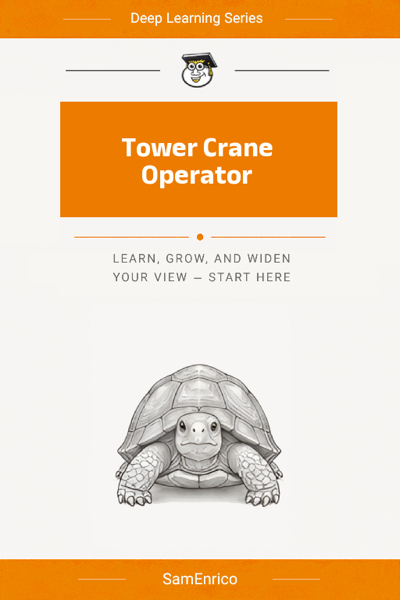
Non-FictionInformativeEducational
Tower Crane Operator eBook
A Coursebook on Tower Crane Operator
A Coursebook on Tower Crane Operator
Formats
Free sample
Chapter 1: The Lever and the Lives...--–- The alarm cut through the pre-dawn silence of the job site like a razor. For most of the city, it was just another Tuesday. For Eddie Vasquez, a fourth-year apprentice climbing the first hundred feet of a freestanding tower crane, the alarm meant one thing: the morning inspection had found something wrong, and his day was about to get complicated before it even began.Eddie stopped on the ladder, one hand wrapped around the cold steel rung, the other clutching his tool bag. Below him, the site was waking up. Portable lights flickered off as the eastern sky turned from black to purple.
A concrete truck rumbled somewhere beyond the plywood fence, and he could hear the distant clatter of the morning safety huddle forming in the job trailer. Above him, the cab of the Potain MD 560 waited—glass windows still dark, the jib stretching out empty against the dissolving stars. Twenty-two stories below, the city's first commuter trains were already shuttling people who would never look up and wonder who was lifting their steel, their glass, their entire world into place.That was the part nobody told you about when you first walked into the union hall. They told you about the pay. They told you about the benefits, the pension, the job security.
They showed you videos of cranes lifting massive prefabricated units, time-lapse footage of skylines growing like corn in July. What they didn't tell you—what no video could capture—was the weight of it. Not the literal weight of a twenty-ton steel column swinging through the air, though that was considerable. No, the other weight. The one that settled into your chest the first time you looked down from the cab and saw the tiny yellow hard hats moving like ants directly underneath your load path.
The one that whispered, "If you make a mistake, people die. Not someday. Not maybe. Today."That was the truth of tower crane operation. And that was why Eddie was still climbing, even though the alarm meant something was wrong.
Because mistakes got found in the inspection. Because lives depended on it. Because that alarm was not an inconvenience. It was a promise kept.Two minutes later, Eddie pulled himself into the cab, wiped the condensation from the inside of the windshield, and reached for the logbook. The entry from the night shift was short, written in the cramped block letters of a man who had learned to write on a grease-stained napkin: "RCI showing overshoot on swing brake.
Check before lift."Eddie sighed, pulled out his flashlight, and began the day's first real work.This book is for Eddie. And for you. Because whether you are standing at the bottom of a 200-foot tower crane looking up for the first time, or you are a veteran operator with twenty years of seat time who wants to finally get certified, you need to understand one thing before you turn another page: Tower crane operation is not a job. It is a profession. And like every profession—medicine, law, aviation—it has a body of knowledge, a set of ethical obligations, and a price of admission that cannot be paid in dollars alone.That price is attention.
Relentless, unforgiving, sometimes exhausting attention. Attention to physics. Attention to load charts. Attention to the rigger who didn't sleep well last night and might have misidentified the center of gravity on a prefab wall panel. Attention to the wind that just shifted fifteen degrees and added two thousand pounds of force to a load you thought was safely within limits.
Attention to the signal person whose hand signal you didn't quite see because the sun was in your eyes and now you're not sure if "hoist" meant "hoist slow" or "hoist fast" and you only have about one second to decide.That is what this book will teach you. Not just the mechanics of levers and cables, but the discipline of attention. The habit of seeing what others miss. The courage to say "no" when the general contractor is yelling at you to make one more lift before lunch, and your gut is telling you the wind is too high.Let's start at the very beginning.The Crane That Built the World The first tower cranes did not look like the machines you see today on skyscrapers in Dubai, New York, or Shanghai. They looked like wooden wheels turned sideways, powered by men walking inside them like hamsters.
The ancient Greeks called them "tympanum" cranes, and they were used not for building skyscrapers—the skyscrapers of antiquity were mostly temples, which rarely exceeded four stories—but for lifting stone blocks onto ships and, eventually, onto the great arches and aqueducts of the Roman Empire.The Romans, who were to civil engineering what modern financiers are to compound interest, figured out something critical: a crane could be made taller by adding a wooden mast, and more powerful by adding a counterweight. By the first century AD, Roman cranes on the Temple of Jupiter Optimus Maximus were lifting stone blocks weighing over fifty tons. They did this without steel cables, without hydraulics, without electricity. They did it with muscle, with hemp rope, and with an understanding of the lever that would not be written down until Archimedes put it to paper centuries earlier.Archimedes famously said, "Give me a lever long enough and a fulcrum on which to place it, and I shall move the world." The tower crane is that promise made real. Every time you sit in the cab, you are holding that lever.
And the world you are moving is not the planet—it is the smaller world of the job site, the neighborhood, the city that will one day be defined by the building you helped raise.The modern tower crane, as we know it, was born in Europe between the two World Wars. German engineers, rebuilding a devastated continent, realized that the old methods of using derricks and gin poles were too slow, too dangerous, and too labor-intensive. They needed a machine that could rise with the building, that could be assembled from the ground up, and that could be operated by one person sitting in a glass cab with a full view of the lift.The result was the "tower crane" as a distinct category: a vertical mast, a horizontal jib, a counter-jib, and a cab mounted on a slewing unit that allowed the entire assembly to rotate 360 degrees. By the 1950s, tower cranes had spread to North America, Japan, and Australia. By the 1970s, they were the undisputed king of high-rise construction.
Today, the tallest tower cranes reach over 1,500 feet, lift over 100 tons, and cost more than most single-family homes.But the machine is only half the story. The other half is the person in the cab.More Than a Lever Puller Let me tell you about a day that changed everything for me. I was twenty-three years old, fresh out of my apprenticeship, and had been operating a tower crane for about six months. It was a small job—a six-story medical office building in a suburban town. Nothing like…
This is the end of the free sample. Get the eBook to keep going. Buy now
About this book
Details
- Author
- Rosser Christen
- Publisher
- SamEnrico
- Language
- English
- Genre
- Non-Fiction, Informative, Educational
- Released
- 2026-05-11
- Pages (approx.)
- 158
- Available as
- eBook, Audiobook

Read better in the ZLOADR app
Your eBooks on your phone or tablet. Sign in with your SamEnrico account and start reading.
More by Rosser Christen
 Navigating Vaccine and Health Choice TalksRosser Christen$11.99
 Mindfulness For Sleep RecoveryRosser Christen$11.99
 MBSR for PTSD GuideRosser Christen$11.99
 Ayurvedic Skin Care GuideRosser Christen$11.99
 Teen Self Esteem MindfulnessRosser Christen$11.99
 The Star Keepers of Axum: Africa's Celestial ArchitectsRosser Christen$11.99
 Understanding Metaphyseal Dysplasia Pyle TypeRosser Christen$17.99
 Inventory Alert Automation SystemRosser Christen$12.99
 Ghana Logistics Last Mile DeliveryRosser Christen$12.99
 Ultimate Handbook Guide to Xiaoshan : (China) Travel GuideRosser Christen$11.99
You may also like
 Hong Kong Handover 1997Dunn Johnnie$11.99
 Zumba For Postnatal Recovery CourseNeal Christian$11.99
 Zumba for BeginnersLadner Nikia$11.99
 YouTube Comment Mining GuideHumes Pandora$12.99
 Worry Box MeditationCarlin Rudy$11.99
 Workplace Stress MeditationNguyen Lynn$11.99
 Workplace Stress and Sleep RepairHawley Ivory$11.99
 Workplace Perfectionism CureDelaney Jeffry$11.99
 Workplace Injustice Anger GuideWallen Isabelle$11.99
 Work Addiction and Burnout LinkGreenwood Ester$11.99
 Women in Yoga and WellnessBeattie Galina$11.99
 Women in Stand Up ComedyChun Evangeline$11.99