
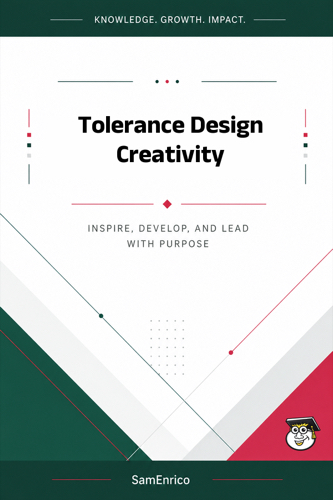
Tolerance Design Creativity
Use wider tolerances creatively to reduce manufact
by Beers Maxima
Use wider tolerances creatively to reduce manufacturing costs.
Formats
About this book
Free sample
Chapter 1: The Fear Factory--–- Most engineers will never admit this, but the majority of tolerances they specify are not based on physics, math, or even experience. They are based on fear.I learned this lesson the hard way, standing in a sweltering machine shop in Cleveland, watching a $75,000 milling machine chew through a block of 6061 aluminum. The part was a simple mounting bracket — four holes, two locating pins, and a flat face. Nothing special. But on the drawing, tucked into the lower right-hand corner, was a block tolerance of ±0.005 inches.
That innocent-looking number had just turned a five-minute job into a forty-five-minute ordeal. The machinist was taking light passes, measuring after each one, shaking his head. "Who drew this?" he asked me. "Did they think we're making pacemakers?"I was the one who drew it. And I had no good answer.That moment — watching money evaporate with every pass of the end mill — was the beginning of a decade-long obsession.
Why do engineers over-specify tolerances? What drives us to demand precision we do not need? And most importantly, how much money are we collectively throwing away because we are too afraid to ask, "What if we made this looser?"This chapter answers those questions. It exposes the psychological, cultural, and institutional forces that turn reasonable engineers into precision zealots. It introduces the single most important tool for breaking that habit — the Red Pen Audit — and it provides the economic framework that proves, beyond any doubt, that looser is almost always cheaper.The Anatomy of a Fear-Based Tolerance Let me tell you about a bracket.
Not a specific bracket from a specific company — although I could name a dozen — but a representative bracket, the kind that exists in every factory, every assembly line, every product you have ever touched.This bracket holds a sensor to a frame. The sensor detects whether a door is closed. That is its entire job. The bracket could be stamped from 2 mm steel with holes punched in it, and it would work perfectly for the life of the product. But the engineer who…
This is the end of the free sample. Get the eBook to keep going. Buy now
Contents
- Chapter 1
- Chapter 2
- Chapter 3
- Chapter 4
- Chapter 5
- Chapter 6
- Chapter 7
- Chapter 8
- Chapter 9
- Chapter 10
- Chapter 11
- Chapter 12
Details
- Author
- Beers Maxima
- Publisher
- SamEnrico
- Language
- English
- Genre
- Non-Fiction, Self-Help, Tolerance Analysis
- Released
- 2026-06-11
- Pages (approx.)
- 147
- Available as
- eBook, Audiobook

Read better in the ZLOADR app
Your eBooks on your phone or tablet. Sign in with your SamEnrico account and start reading.
More by Beers Maxima
 Temporomandibular ReleaseBeers Maxima$11.99
 The Vascular ED GuideBeers Maxima$11.99
 Full Time WholesalingBeers Maxima$11.99
 Listening to UnderstandBeers Maxima$11.99
 Restructuring Anger for CaregiversBeers Maxima$11.99
 Weekend Batch Work MethodBeers Maxima$11.99
 Gaming for First RespondersBeers Maxima$11.99
 Kamikaze Winds: The Mongol Storm That Failed (1274 & 1281)Beers Maxima$11.99
 The Siege of Ludlow Castle: A Yorkist Gambit in the Wars of the RosesBeers Maxima$11.99
 A Collector's Handbook to the Alfa Romeo Giulia SpiderBeers Maxima$11.99
 The Essential Guide to North AmericaBeers Maxima$11.99
 Co-Founder Soft Skills Assessment WorkbookBeers Maxima$12.99