
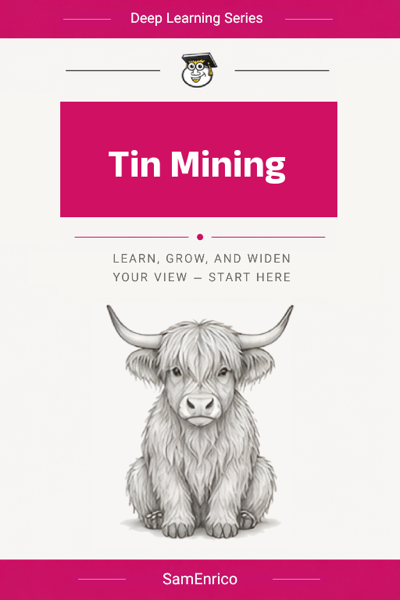
Non-FictionInformativeEducational
Tin Mining eBook
A Coursebook on Tin Mining
A Coursebook on Tin Mining
Formats
Free sample
Chapter 1: The Invisible Cornerstone...--The smartphone in your pocket contains over forty different elements pulled from every corner of the periodic table and every corner of the globe. Lithium from the salt flats of Bolivia or the hard-rock mines of Australia. Cobalt from the copper belts of the Democratic Republic of Congo. Rare earths from the clay pits of southern China. Gold, silver, and palladium from mines on every continent.
These are the celebrated minerals—the ones that appear in headlines, the ones that spark geopolitical maneuvering, the ones that make investors rich or ruin them. They are the diva metals, demanding attention, inspiring documentaries, and driving legislative hearings.But there is another metal inside that phone. You have probably never thought about it. It does not have a glamorous name or a volatile price chart that makes the financial pages. It is not classified as a "critical mineral" by most governments, though that is slowly changing.
Yet without this metal, that phone would be a collection of disconnected components—a battery that could not deliver power to the processor, a screen that could not receive signals from the logic board, a charging port that would crumble at the first insertion. Every electrical connection, every solder joint, every tiny bridge between silicon and circuit board depends on this single element.That element is tin.This is not a humble brag. Tin is genuinely unassuming. It is soft enough to be cut with a knife. It has a low melting point—barely above the temperature of a hot kitchen oven.
It does not rust. It does not react with most foods or chemicals. It is almost impossible to poison yourself with it. These are not the characteristics of a metal that changes the world. But they are precisely the characteristics that have made tin indispensable for five thousand years, from the swords of pharaohs to the solar panels that will power the twenty-second century.This book is about that journey.
It is the story of a metal that has never been the star but has always been essential—the best supporting actor in the drama of human technology. It is a story that begins with a geological accident, continues through the rise and fall of empires, passes through the lungs of miners who died so that others could live connected lives, and ends, if we are wise, with a future in which nothing is wasted and everything is reused.Before we can understand where tin is going, we must understand what it is. And before we can understand what it is, we must travel back to a time before recorded history, to the moment when a human being first discovered that copper, by itself, was not enough.The Birth of an Age The Neolithic period—the New Stone Age—was exactly what its name suggests: an age of stone. Human beings had learned to shape flint, obsidian, and chert into blades, scrapers, and arrowheads. They had domesticated animals and plants.
They had built permanent settlements and, in a few remarkable places, monumental architecture. But their tools, their weapons, and their symbols of power were made of rock. Rock is abundant. Rock is durable. Rock is also brittle, heavy, and impossible to reshape once broken.Then, sometime around 6200 BCE—though the date varies by region and by the caution of archaeologists—someone discovered that certain greenish-blue stones, when heated to extreme temperatures in a charcoal fire, produced a strange reddish-orange liquid that cooled into a hard, shiny, and remarkably malleable solid.
That was copper. For the first time, humans could create a material that did not exist naturally. They could pour it into molds. They could hammer it into thin sheets. They could re-melt broken tools and cast new ones.
This was not just a technological advance; it was a conceptual revolution. Matter was no longer fixed. It could be transformed.Copper was superior to stone in almost every way. It did not shatter when struck. It could be sharpened repeatedly.
It could be shaped into hooks, needles, and awls that would have been impossible to carve from flint. But copper had one serious limitation. Pure copper is soft. A copper axe will cut wood, but it will also dull quickly, and after heavy use, it will bend. A copper sword will kill, but it will also deform when it strikes bone or another blade.
The first metallurgists quickly discovered that copper weapons and tools required constant maintenance—hammering, re-sharpening, sometimes even re-casting.Then came the second great discovery, likely accidental. Someone—we will never know who or where—melted copper ore that contained a greenish-black mineral that was not copper at all. When the metal cooled, it was different. Harder. More resistant to bending.
It held an edge longer. It rang when struck. This was not pure copper. It was an alloy of copper and something else. That something else was tin.The tin-bronze alloy, typically containing five to twelve percent tin and the remainder copper, transformed the soft, workable copper into a metal with a hardness and strength that rivaled low-carbon steel.
Bronze could be cast into complex shapes—swords with integral hilts, helmets that fit the curve of a skull, cauldrons that could hang over a fire without cracking. Bronze tools could fell forests, carve timbers, and till heavy soils. Bronze weapons could pierce leather and bronze armor. An army with bronze weapons would annihilate an army with copper tools.The Bronze Age had begun.The First Global Supply Chain The problem with bronze was not its properties but its ingredients. Copper was relatively common.
Surface deposits of copper ore—bright green malachite, blue azurite, red cuprite—could be found scattered across the ancient world, from Cyprus (which gave its name to the metal) to the Sinai Peninsula to the mountains of Anatolia and the Balkans. Tin was different. Tin was rare.Very rare.Today, the average concentration of tin in the Earth's continental crust is about two parts per million. That is two grams of tin for every metric ton of rock. Copper, by comparison, averages fifty-five parts per million.
Gold is rarer—about four parts per billion—but gold can be found in pure, visible nuggets. Tin almost never appears in pure form. It is locked inside cassiterite, a dense, dark, reddish-brown to black mineral that resembles nothing so much as a lump of coal or a piece of dried blood. Cassiterite is heavy—about seven times denser than water—so it tends to accumulate in stream beds and river gravels, but the individual crystals are small, scattered, and easily overlooked.To make bronze on any significant scale, you needed to find tin, extract it from its ore, transport it to copper-producing regions, and alloy it with copper. This required trade.
Long-distance trade. The kind of trade that builds ships, establishes ports, creates merchant classes, and funds empires.The tin trade of the Bronze Age was the first globalized supply chain in human history. Tin from the mountains of Afghanistan—the ancient sources near what is now the Tajikistan border—traveled overland through Persia and Mesopotamia to the cities of Sumer and Akkad. Tin from the Erzgebirge mountains on the…
This is the end of the free sample. Get the eBook to keep going. Buy now
About this book
Details
- Author
- Christian Yael
- Publisher
- SamEnrico
- Language
- English
- Genre
- Non-Fiction, Informative, Educational
- Released
- 2026-06-02
- Pages (approx.)
- 150
- Available as
- eBook, Audiobook

Read better in the ZLOADR app
Your eBooks on your phone or tablet. Sign in with your SamEnrico account and start reading.
More by Christian Yael
 Sports Charity Fraud Cases HandbookChristian Yael$11.99
 Binge Relapse Prevention PlanChristian Yael$11.99
 Flow for MusiciansChristian Yael$11.99
 The Chain Breaking Eating GuideChristian Yael$11.99
 High Conflict Divorce SurvivalChristian Yael$11.99
 The Bridge Spies: How Engineers Outwitted Napoleon's EmpireChristian Yael$11.99
 Understanding Western Equine EncephalitisChristian Yael$17.99
 Depressed Founder WorkbookChristian Yael$12.99
 How to Start a Bleaching of Jeans Business (Beginners Guide)Christian Yael$11.99
You may also like
 Hong Kong Handover 1997Dunn Johnnie$11.99
 Zumba For Postnatal Recovery CourseNeal Christian$11.99
 Zumba for BeginnersLadner Nikia$11.99
 YouTube Comment Mining GuideHumes Pandora$12.99
 Worry Box MeditationCarlin Rudy$11.99
 Workplace Stress MeditationNguyen Lynn$11.99
 Workplace Stress and Sleep RepairHawley Ivory$11.99
 Workplace Perfectionism CureDelaney Jeffry$11.99
 Workplace Injustice Anger GuideWallen Isabelle$11.99
 Work Addiction and Burnout LinkGreenwood Ester$11.99
 Women in Yoga and WellnessBeattie Galina$11.99
 Women in Stand Up ComedyChun Evangeline$11.99