
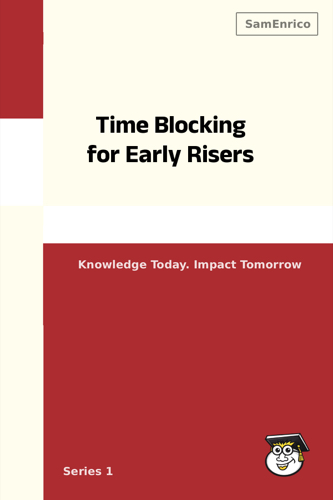
Time Blocking for Early Risers eBook
Capitalizes on morning productivity hours.
Capitalizes on morning productivity hours.
Formats
Free sample
Chapter 1: The 4,000-Hour Heist–- Let me tell you something that no productivity guru will admit in their keynote speeches, their Instagram reels, or their $1,999 online courses.You are not lazy.You are not undisciplined.And you are certainly not “too busy.”You are, however, being robbed. Every single morning. And the thief is not your boss, your children, your inbox, or your commute. The thief is a story you have been told so many times that you now tell it to yourself without thinking. The story goes like this: “I don’t have enough time.”It is a lie.
And it is costing you roughly 4,000 hours of your life.Let me show you the math. Then let me show you how to take those hours back.The Most Expensive Belief in the Modern World Walk into any office, any coffee shop, any school pickup line, and say the words “I’m so busy.” Watch what happens. Heads nod. Eyes widen with recognition. Someone will inevitably one-up you with a story about their 14-hour day, their back-to-back meetings, their overflowing inbox.
We have turned busyness into a badge of honor, a competitive sport, a proxy for importance.But here is the uncomfortable truth that Laura Vanderkam proved in her groundbreaking work 168 Hours: the most successful people in the world are not the ones who have more time. They are the ones who see time differently. Vanderkam asked hundreds of busy professionals to track their weeks in fifteen-minute increments. The data was unambiguous. People who claimed they worked 70 or 80 hours per week were almost never accurate.
The actual number was usually closer to 50 or 55. The rest of the time was not “busy.” It was fragmented. Distracted. Reactive.In other words, they weren't out of time. They were out of alignment.The problem is not that your days are too short.
The problem is that your mornings are too chaotic. And chaos is expensive.Consider the average knowledge worker’s morning. They wake up to an alarm, often hitting snooze once or twice. They reach for their phone within the first sixty seconds—checking email, Slack, Instagram, news, weather, texts. They scroll for ten, fifteen, sometimes twenty minutes before they even stand up.
They make coffee. They stare into the refrigerator. They shower. They dress. They might glance at their to-do list, but by then, the first email has already arrived, the first Slack notification has already pulled them in, and the day is no longer theirs.By 9:00 AM, they have already made dozens of decisions—none of them strategic.
By 10:00 AM, their cognitive reservoir is already depleted. By 5:00 PM, they cannot remember what they actually accomplished.This is not a time management problem. This is a time architecture problem. And the solution begins with one radical reframe.The Window You Have Been Ignoring Between the hours of approximately 5:00 AM and 7:30 AM, something remarkable happens in most households and most workplaces. Nothing.No emails arrive that cannot wait.
No meetings are scheduled. No children are awake (or if they are, they are not yet demanding). No Slack notifications ping. No phone calls come in. No urgent fires need extinguishing.This window—roughly 150 minutes—is the only reliably uninterrupted block of time in the entire twenty-four-hour day.
It is the one period when the world has not yet demanded anything from you. It is the one period when you can choose what to work on, rather than reacting to what others have sent your way.And most people waste it.They sleep through it. They scroll through it. They treat it as “pre-work” rather than “the work itself.” They fill it with low-value chores, morning routines that produce nothing, and a vague sense that they will “get started soon.”But here is the critical distinction that most books get wrong: You do not need to claim the entire 150-minute window. That is not sustainable, and it is not necessary.
What you need is a 90-minute slice of that window. Ninety minutes. That is all.Why ninety minutes?Because research on ultradian rhythms—the natural cycles of human energy and focus—shows that the brain can sustain deep, concentrated work for approximately ninety minutes before requiring a break. Because ninety minutes is long enough to make meaningful progress on a challenging task but short enough to protect from burnout. Because ninety minutes fits into the 5:00–7:30 AM window regardless of when you wake up.This 90-minute block is what we will call, throughout this book, your Power Hour.
(Yes, the name is slightly inaccurate. Ninety minutes is not an hour. Consider it aspirational branding. You will forgive me by Chapter 3.)Your Power Hour is the single most valuable real estate on your calendar. It is worth more than any ninety minutes in the afternoon.
It is worth more than any ninety minutes in the evening. It is worth more, I will argue, than any ninety minutes of your entire working day.Why? Because of energy, not time.Finite Time vs. Finite Energy Here is a sentence that will change how you think about productivity: You do not have an energy problem. You have a timing problem.Most people believe they lack the energy to do their most important work.
They blame their diet, their sleep, their stress levels, their genetics. And certainly, those factors matter. But the primary driver of low energy is not biological—it is architectural.Your energy follows a predictable pattern throughout the day. For the vast majority of people (approximately 80 percent of the population, according to chronobiology research), cognitive energy peaks in the morning, dips in the early afternoon, and rises slightly again in the late afternoon before declining into the evening. This is not a matter of willpower or motivation.
It is a matter of circadian rhythms, cortisol secretion, and body temperature cycles.When you schedule your most important work at 10:00 PM, you are not fighting laziness. You are fighting biology. And biology always wins.When you schedule your most important work at 5:30 AM, you are riding the wave of your natural neurological peak. Your working memory is at its most capacious. Your executive function is at its most agile.
Your ability to sustain focused attention is at its highest. The research is clear: the same cognitive task that takes ninety minutes in the morning can take two and a half hours in the afternoon. Not because the afternoon version of you is lazier, but because the afternoon version of you is operating with a depleted neurological system.Let me repeat that, because it is the central argument of this entire book: One hour of work during your Power Hour is worth roughly three hours of work during your afternoon slump.That is not hyperbole. That is neuroscience.In his book When: The Scientific Secrets of Perfect Timing, Daniel Pink synthesizes decades of research on daily energy patterns. The findings are remarkably consistent across cultures, professions, and age groups.
For the majority of people, the peak cognitive window occurs between approximately two and four hours after waking. For someone who wakes at 6:00 AM, that window is 8:00–10:00 AM. But here is the catch: those two to four hours after…
This is the end of the free sample. Get the eBook to keep going. Buy now
About this book
Details
- Author
- Lindquist Rupert
- Publisher
- SamEnrico
- Language
- English
- Genre
- Non-Fiction, Self-Help, Morning Routine
- Released
- 2026-06-05
- Pages (approx.)
- 135
- Available as
- eBook, Audiobook

Read better in the ZLOADR app
Your eBooks on your phone or tablet. Sign in with your SamEnrico account and start reading.
More by Lindquist Rupert
 Pet Ownership Relationship StressLindquist Rupert$11.99
 Amy Winehouse Back to BlackLindquist Rupert$11.99
 Meeting Block CompressionLindquist Rupert$11.99
 The Personal Brand Bio GuideLindquist Rupert$11.99
 Email Pomodoro IntegrationLindquist Rupert$11.99
 Congressional Campaign War StoriesLindquist Rupert$11.99
 Scripting for Pain ManagementLindquist Rupert$11.99
 The Ghost Fleet of Truk Lagoon: The Pacific’s Underwater GraveyardLindquist Rupert$11.99
 Shadows Over the Coral Sea: The Secret War of the Solomon IslandsLindquist Rupert$11.99
 How to Produce Dj SystemsLindquist Rupert$11.99
 Alfalfa For Fodder: Harvesting Timing, Cutting Height & QualityLindquist Rupert$11.99
 Brazil Social Security Number Use CourseLindquist Rupert$12.99
You may also like
 The Morning After ProtocolDavidson Fred$11.99
 Morning Walking MindfulnessMattos Catheryn$11.99
 Morning Walking MeditationHawley Marry$11.99
 Meditation for Morning AnxietyDahl Edgardo$11.99
 The Morning Body Scan EnergizerBarnard Karina$11.99
 Morning Dream CaptureMcnamara Rubie$11.99
 Morning Body AwarenessVarney Arlyne$11.99
 The Sexual Sobriety Morning RitualRojas Dorsey$11.99
 The Morning Commute Anxiety ReductionLewandowski Sharmaine$11.99
 Morning Routine DesignHussey Brunilda$11.99
 Mindful Mornings MBSR RoutineSilverman Dinorah$11.99
 The Morning Affirmation Ritual GuideShields Lenora$11.99