
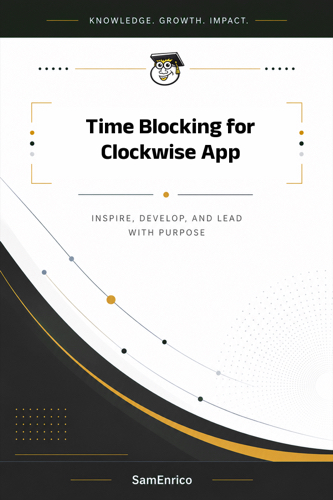
Time Blocking for Clockwise App eBook
Optimize your Google Calendar with Clockwise's foc
Optimize your Google Calendar with Clockwise's focus blocks.
Formats
Free sample
Chapter 1: The Calendar Lie--–- Every morning, millions of professionals open their to-do lists and feel a familiar surge of anxiety. Forty-seven tasks stare back at them—some urgent, some important, most vaguely defined. They spend ten minutes prioritizing, color-coding, and rearranging these items. Then they close the list and spend the rest of the day feeling guilty about everything they did not accomplish. The to-do list has become the most toxic productivity tool in modern work.
It promises control but delivers chaos. It offers clarity but breeds constant, low-grade anxiety. It pretends to be a plan but is actually just a wish list dressed in bullet points.The fundamental problem with the to-do list is not that it captures too little information. The problem is that it captures the wrong kind of information entirely. A to-do list records what you want to do.
It does not record when you will do it, where it fits in your day, or how long it will take. This omission is catastrophic because time is the only resource that truly matters. You cannot actually "do" a task. You can only schedule a block of time during which you hope to complete that task. The task itself is an abstraction.
The calendar block is reality.Consider the difference between writing "Finish quarterly report" on a to-do list and blocking 9:00 AM to 11:00 AM on your calendar for "Draft quarterly report financials." The first option is a vague intention floating in the ether. The second option is a commitment anchored to a specific time and place. When you look at your calendar at 8:55 AM, you do not ask yourself, "Should I work on the report now?" You already decided that yesterday, or last week, or whenever you made the block. The decision is made. The only question is execution.This is the Calendar-First Principle, and it will govern everything else in this book: If it is not on the calendar, it does not exist.
Not as a priority. Not as a commitment. Not as something you actually intend to do. The calendar is not merely a scheduling tool for meetings. It is the single source of truth for how you spend your finite, irreplaceable hours.
Everything else—your to-do list, your email inbox, your Slack messages, your project management software—is just raw material waiting to be processed into calendar blocks.The Illusion of Productivity The to-do list creates a dangerous psychological illusion. Every time you add an item to the list, you experience a small dopamine hit. You feel productive. You feel organized. You feel like you are making progress.
But you are not making progress. You are making a list. The gap between capturing a task and completing that task is where real productivity lives—or dies.Psychologists call this the mere-measurement effect. Simply asking people whether they intend to perform a behavior makes them more likely to perform it, even if they take no other action. To-do lists exploit this effect brilliantly.
You write down "Call client about contract renewal," and you immediately feel a sense of forward motion. But you have not called the client. You have not even scheduled time to call the client. You have merely recorded the idea that someday, somehow, you should probably call the client.This illusion becomes dangerous when it replaces actual planning. Research from Florida State University found that people who create detailed to-do lists without time-blocking are significantly less likely to complete their most important tasks than people who use time-based scheduling.
The reason is simple: the to-do list creates false closure. Your brain sees the item on the list and checks it off mentally, even before you have done the work. The list becomes a substitute for action rather than a precursor to it.Worse, the to-do list actively encourages reactivity rather than proactivity. When you have a long, unscheduled list of tasks, your brain defaults to whatever feels most urgent or easiest at the moment. You answer the email that just arrived because it is right there in your inbox.
You respond to the Slack message because the notification is blinking. You do the quick, low-value task because checking it off gives you a small reward. Meanwhile, the important, complex, high-value tasks—the ones that require focus, uninterrupted time, and cognitive effort—sit untouched at the bottom of the list.This is not a failure of willpower. It is a feature of how human attention works. The psychologist Roy Baumeister demonstrated decades ago that decision fatigue is real.
Every choice you make—what to work on, when to work on it, how long to spend—consumes a small amount of mental energy. By the time you have spent thirty minutes context-switching between tasks on your to-do list, you have exhausted the very cognitive resources you need to do the deep work that matters most.Why "Capture" Is Not Enough David Allen's Getting Things Done methodology changed how an entire generation thought about productivity. Allen's central insight—that your brain is for having ideas, not holding them—was revolutionary. He argued that you should "capture" every task, idea, and commitment in an external system so your mind can focus on execution rather than remembering.This was correct as far as it went. But it did not go far enough.
Capture without scheduling is just organized procrastination. You have moved the item from your brain to a list, but you have not moved it any closer to completion. The task still requires time, attention, and energy. The list does not provide any of those things.Allen himself acknowledged this limitation in later editions of his book, noting that the weekly review—where you process your captured items and decide what to do with them—is the most important part of the system. But even the weekly review, as traditionally taught, stops at categorization.
You label things as "Next Action," "Someday/Maybe," or "Defer." You do not necessarily put them on the calendar.This is where the Calendar-First Principle completes Allen's work. Capture is the first step, not the last. The full workflow looks like this:Capture everything that demands your attention (Allen's contribution).Clarify what each item requires (a call, an email, research, etc.).Estimate how long it will take (be brutally honest).Schedule it on your calendar as a time block.Execute when the block arrives.Notice that step four is not "add it to a list." The list is a temporary holding pen, not a permanent home. Tasks live on the calendar. If a task is not worth scheduling, it is not worth doing.
That sounds harsh, but it is actually liberating. Most to-do lists are filled with low-value tasks that someone else could do, or that could be automated, or that simply do not need to be done at all. The calendar forces you to confront the opportunity cost of every commitment.Gary Keller, author of The One Thing, puts it even more bluntly: "You can do two things at once, but you cannot focus on two things at once." Keller argues that prioritization is not about making a list of ten things and numbering them one through ten. Prioritization is about…
This is the end of the free sample. Get the eBook to keep going. Buy now
About this book
Details
- Author
- Meeker Marlena
- Publisher
- SamEnrico
- Language
- English
- Genre
- Non-Fiction, Self-Help, Calendar Optimization
- Released
- 2026-06-11
- Pages (approx.)
- 160
- Available as
- eBook, Audiobook

Read better in the ZLOADR app
Your eBooks on your phone or tablet. Sign in with your SamEnrico account and start reading.
More by Meeker Marlena
 Attorney Anger Cognitive WorkMeeker Marlena$11.99
 Gobi Desert Camel ExpeditionMeeker Marlena$11.99
 Body Scan Meditation CollectionMeeker Marlena$11.99
 Mnemonic Room MethodMeeker Marlena$11.99
 Colombian Software Developer RemoteMeeker Marlena$11.99
 Atomic Habits For VisualizationMeeker Marlena$11.99
 Phentermine GuideMeeker Marlena$11.99
 The Last Breath of Hippocrates: A Doctor’s Race Against Time in the Plague of AthensMeeker Marlena$11.99
 The Iron Fists of Edo: Japan's Forgotten Martial Arts RevolutionMeeker Marlena$11.99
 How to Produce Network Security and Firewall DevicesMeeker Marlena$11.99
 How to Produce Aluminum BarsMeeker Marlena$11.99
 A Collector's Handbook to the Singer Bantam RoadsterMeeker Marlena$11.99