
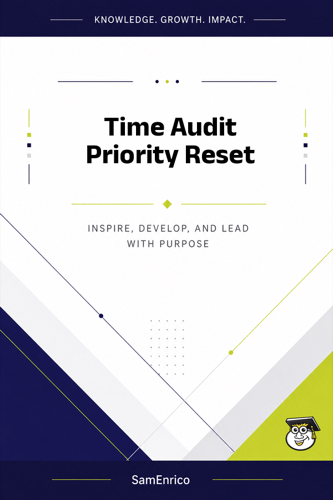
Time Audit Priority Reset eBook
Track your week then re-rank activities using Eise
Track your week then re-rank activities using Eisenhower to identify waste.
Formats
Free sample
Chapter 1: The Exhaustion Lie--–- You are tired. Not the good kind of tired—the satisfying ache after a day of meaningful work, the worn-out bliss of a body that has earned its rest. You are the other kind of tired. The hollow tired. The "I answered forty-seven emails and attended six meetings and somehow feel further behind than when I started" tired.
The kind of tired that climbs into bed with you at 10 PM, stares at the ceiling with you at 2 AM, and greets you again at 6:30 AM before the alarm has even had the decency to go off.This book is not for people who are lazy. You are not lazy. Lazy people do not feel guilty about being lazy. Lazy people do not lie awake at night replaying the day's undone tasks. Lazy people do not cancel dinner with friends because they are "too swamped" and then spend that evening scrolling through their phone in a fog of low-grade anxiety.
Lazy people are, paradoxically, much happier than you are right now.This book is for the exhausted strivers. The conscientious overfunctioners. The people who have built entire careers on being reliable, responsive, and endlessly available—only to discover that reliability is a trap, responsiveness is a drain, and availability is the enemy of impact.Here is the lie that has been sold to you, packaged in the language of productivity, professionalism, and good citizenship: If you are busy, you are valuable. If you are exhausted, you are virtuous. If your calendar is full, your life has meaning.The lie has a name.
It is called Busyness Culture, and it is the most successful con of the modern workplace. It convinces you that motion equals progress, that effort equals results, and that exhaustion is the price of admission to the club of people who matter.This chapter is going to rip that lie apart. Not gently. Not politely. We are going to take the Busyness Culture narrative, hold it up to the light, and watch it dissolve into what it has always been: a coping mechanism for people who have confused noise with signal, activity with achievement, and suffering with success.The Paradox That Will Haunt You Until You Fix It Let me describe a week.
See if it sounds familiar.You wake up. You check your phone before your feet hit the floor—just to "make sure nothing exploded overnight." Nothing has exploded. But there are fourteen emails, three Slack messages, and a calendar notification for a meeting that could have been an email but is instead a thirty-minute video call that will run forty-five. You scroll through the emails. You reply to five of them because they feel urgent.
You flag the other nine as "unread" so you will remember to deal with them later. Later, of course, never comes.You get to work—or open your laptop at the kitchen table, because the line between office and home has been erased like a chalk drawing in the rain. You have a to-do list. It is long. It is always long.
You have been maintaining this to-do list for years, and you have never, not once, seen the bottom of it. The list is not a tool for getting things done. The list is a monument to your own inadequacy, and you add three new items to it every day.You attend meetings. Some of them are useful. Most of them are not.
One meeting is a status update that could have been a shared document. Another is a "quick sync" about a project that no one has clearly defined. A third is a recurring check-in that everyone dreads but no one has the courage to cancel. You leave each meeting with a new set of action items—which is to say, more things to add to the list that will never see the bottom.You answer more emails. You put out a fire that someone else started.
You handle a request from your boss that is "urgent" but, upon closer inspection, is urgent only because your boss waited until the last minute to think about it. You eat lunch at your desk—or you forget to eat lunch entirely, because somewhere along the way you internalized the idea that taking thirty minutes to nourish yourself is a sign of weakness.By 5 PM, you have done… what, exactly? You are exhausted. You have been moving all day. But when you try to name what you accomplished, the list is thin.
You responded to people. You attended their meetings. You solved their problems. You kept the machinery of other people's priorities running smoothly. But your own priorities—the strategic project, the creative work, the conversation with your spouse, the exercise you swore you would start this month—remain untouched.You tell yourself you will get to them tomorrow.
Tomorrow becomes next week. Next week becomes never.This is the paradox: You work more hours than ever, yet your most important goals remain untouched. You feel busy. You feel exhausted. You feel important, in the way that a firefighter feels important while running into a burning building.
But the fire is not your fire. The building is not your building. You are running into flames that other people started, putting out fires that should never have been lit, and calling yourself a hero for doing work that is, objectively, meaningless.The paradox has a name. It is called The Busyness Trap, and you are standing in it right now.The Difference Between Motion and Progress Here is the most important distinction you will learn in this entire book. Write it down.
Tattoo it on your forearm. Carve it into the desk where you waste so much time pretending to work.Motion is not progress. Activity is not achievement. Effort is not results.Motion is what you do when you want to feel productive without actually producing anything of value. Motion is reorganizing your filing system.
Motion is color-coding your calendar. Motion is researching productivity apps instead of using them. Motion is answering low-stakes emails because the dopamine hit of "clearing" an inbox feels better than the uncomfortable struggle of doing something hard.Motion is safe. Motion is comfortable. Motion allows you to say, "I worked so hard today" while having nothing to show for it except a clean inbox and a sore back from sitting.Progress, by contrast, is uncomfortable.
Progress is the novel you actually write, not the notebook you buy to plan the novel. Progress is the difficult conversation you have with your partner, not the mental rehearsal you run through while washing dishes. Progress is the strategic plan you present to your boss, not the endless research you do to avoid presenting it. Progress is the workout you complete, not the gym membership you pay for and never use.The cruel irony is that motion feels like progress. Your brain cannot tell the difference in the moment.
Both release dopamine. Both reduce anxiety temporarily. Both give you the satisfying sensation of "doing something." But motion leaves you in the same place you started, while progress moves you forward.The Busyness Trap is the gravitational pull toward…
This is the end of the free sample. Get the eBook to keep going. Buy now
About this book
Details
- Author
- Spain Leonida
- Publisher
- SamEnrico
- Language
- English
- Genre
- Non-Fiction, Self-Help, Time Audit
- Released
- 2026-06-10
- Pages (approx.)
- 133
- Available as
- eBook, Audiobook

Read better in the ZLOADR app
Your eBooks on your phone or tablet. Sign in with your SamEnrico account and start reading.
More by Spain Leonida
 Parental Anger Physical Aggression StopSpain Leonida$11.99
 Stress Spiral Interruption ManualSpain Leonida$11.99
 Self Hypnosis for Focus HabitsSpain Leonida$11.99
 Mindfulness for Beginner TeachersSpain Leonida$11.99
 The Secret Mapmaker: Al-Mas'udi and the Lost Chronicles of AmericaSpain Leonida$11.99
 Golden Arches vs. Red Sign: The Secret War of McDonald's and Burger KingSpain Leonida$11.99
 Nonprofit Fundraising ComplianceSpain Leonida$12.99
 Community Analytics DashboardSpain Leonida$12.99
 Understanding Deafness Skeletal Dysplasia Lip GranulomaSpain Leonida$17.99
 How to Become a JanitorSpain Leonida$11.99
 Head Start Administrative AssistantSpain Leonida$11.99
You may also like
 Calendar Zero MethodEspino Esta$11.99
 Time Auditing for BlockersRafferty Jack$11.99
 Parent Time Audit GuideToledo Earlean$11.99
 Remote Work Time Audit GuideBradbury Winnie$11.99
 Weekly Calendar AuditSwank Veola$11.99
 Remote Time Audit GuideWhitten Lashawna$11.99
 Time Auditing for Better BlocksLozano Jillian$11.99
 Time Audit And ResetHimes Carl$11.99
 Time Audit and BlockingBradford Dorthy$11.99
 The Time Auditing Tracking GuideStreet Chauncey$11.99
 The Parent Time Tracking WorksheetLemmon Erminia$11.99