
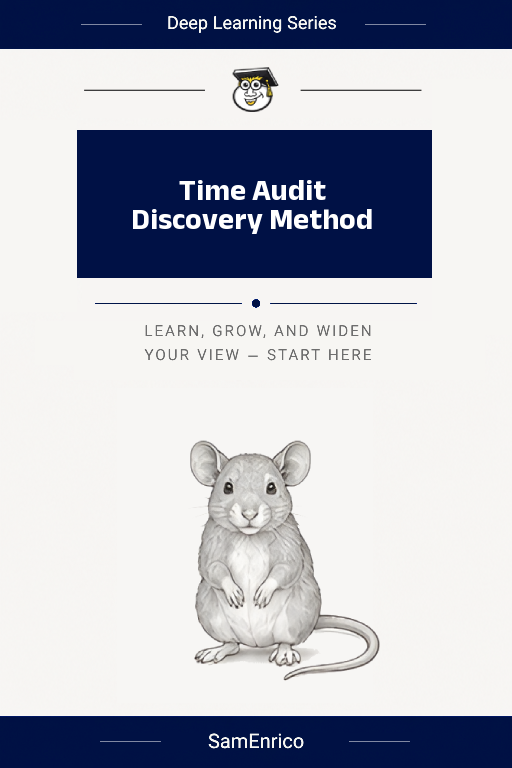
Non-FictionProfessional's Cheat Sheet
Time Audit Discovery Method eBook
Track your actual time use for one week to identif
Track your actual time use for one week to identify time block opportunities.
Formats
Free sample
Chapter 1: The Perception Trap--–- Take a guess. Right now, without checking any clocks or logs, estimate how many hours you spent last week on work that actually mattered. Not the hours you sat at your desk. Not the hours you spent in meetings or answering emails. The hours where you made meaningful progress on something important to your career, your business, or your life.Got a number?
Good. Now double it. Whatever you just estimated, double it. That is probably closer to the amount of time you wish you had spent. The actual number is likely much, much smaller.This is not a guess.
This is what the data shows across thousands of professionals who have done the hard work of tracking their time second by second. The average knowledge worker believes they spend about five hours per day on focused, meaningful work. The actual number, measured by automated tracking tools like Rescue Time and Toggl, is closer to two hours and forty-eight minutes. That is a gap of more than two hours per day. Eleven hours per week.
Nearly five hundred hours per year.Those five hundred hours are not lost to laziness. They are lost to something far more insidious: the perception trap.Why Your Brain Lies About Time The perception trap is not a moral failing. It is not a lack of discipline or a sign that you are secretly lazy. It is a hardwired feature of human cognition, and until you understand how it works, you will keep falling into it no matter how many productivity systems you try.Here is what cognitive psychologists have known for decades: the human brain does not measure time objectively. It measures time subjectively, based on attention, emotion, and cognitive load.
When you are engaged in a difficult, high-focus task, your brain works hard. That hard work feels like a long time. So you overestimate how long you spent on deep work. When you are engaged in shallow, low-focus tasks like checking email or scrolling social media, your brain barely registers the effort. Those tasks feel like they take no time at all.
So you underestimate them dramatically.This is not a small effect. In a study published in the Journal of Experimental Psychology, researchers asked participants to perform a series of tasks while periodically estimating how much time had passed. For low-focus tasks, participants underestimated duration by an average of forty-three percent. A seven-minute email check felt like four minutes. A fifteen-minute social media scroll felt like eight.
For high-focus tasks, participants overestimated duration by an average of thirty-seven percent. A forty-five minute session of deep writing felt like nearly seventy minutes.The result is a systematic distortion in how you remember your day. The hard stuff feels long, so you think you did more of it than you actually did. The easy stuff feels short, so you think you did less of it than you actually did. And because memory is not a video recording but a reconstruction based on these subjective feelings, your memory of yesterday is not a record of what happened.
It is a story your brain told itself to make sense of fragmented impressions.That story is wrong. And you have been making decisions based on that wrong story for your entire adult life.The Planning Fallacy and the Optimism Bias The perception trap has a close cousin, and together they form a one-two punch that destroys productivity. That cousin is the planning fallacy, a concept first identified by Nobel laureate Daniel Kahneman and his partner Amos Tversky.The planning fallacy describes our consistent, predictable tendency to underestimate how long tasks will take while simultaneously overestimating our own ability to complete them efficiently. Ask someone how long it will take to write a report, and they will give you an answer based on the best-case scenario: no interruptions, perfect focus, all the necessary information at hand. Ask them how long the last three reports took, accounting for interruptions, distractions, and the usual chaos of the workday, and the number will be significantly higher.
But we almost never ask that second question. We ask the first question, get the optimistic answer, and build our schedules around a fantasy.The planning fallacy is not a minor quirk. It is a systematic bias that shapes entire organizations. In a famous study of large infrastructure projects, Kahneman found that ninety percent of projects exceeded their estimated timelines, with an average overrun of seventy-two percent. The Sydney Opera House was projected to take six years and cost seven million dollars.
It took fourteen years and cost one hundred two million dollars. The planners were not incompetent. They were human. And humans are systematically overconfident about how long things take.You are no different. When you look at your calendar and think you have plenty of time to finish that project, you are probably wrong.
When you tell yourself you will finally get to that important task "as soon as things calm down," you are lying. Things will never calm down. The chaos is not an interruption to your real life. The chaos is your real life. And your planning fallacy keeps you from accounting for it.The perception trap makes you misremember the past.
The planning fallacy makes you miscalculate the future. Together, they ensure that you never have an accurate picture of the present. You are navigating your life with a broken compass and a faded map, wondering why you keep getting lost.Why To-Do Lists Make Everything Worse Given these two cognitive biases, it is worth asking why the most popular productivity tool in the world is the to-do list. The to-do list is, on its face, a collection of intentions. It is a list of things you hope to do, arranged in an order you find pleasing.
It has no relationship whatsoever to actual time. You can write "finish quarterly report" on a to-do list, and the list will not remind you that finishing the quarterly report takes four hours and you have only ninety minutes before your next meeting. The list will not tell you that you spent twenty-two minutes checking email before starting the report, or that you lost another fifteen minutes finding the right file, or that you spent ten minutes reading the news while the report loaded.The to-do list is a map without scale. It tells you where you want to go but not how far away anything is. And because of the planning fallacy, you consistently underestimate how far away everything is.
So you put ten items on your to-do list, each of which takes an hour, and you schedule them into a four-hour afternoon. Then you feel like a failure when you only complete three of them. But you were not a failure. You were a human being with a normal brain making a normal prediction error. The failure was not in your execution.
The failure was in your planning.There is a second problem with to-do lists that is even more damaging. To-do lists create what psychologists call attention residue. When you have an unfinished task on your mind, it occupies mental bandwidth even when you are not…
This is the end of the free sample. Get the eBook to keep going. Buy now
About this book
Details
- Author
- Gates Rossana
- Publisher
- SamEnrico
- Language
- English
- Genre
- Non-Fiction, Professional's Cheat Sheet
- Released
- 2026-05-26
- Pages (approx.)
- 141
- Available as
- eBook, Audiobook

Read better in the ZLOADR app
Your eBooks on your phone or tablet. Sign in with your SamEnrico account and start reading.
More by Gates Rossana
 The Nun Who Walked Across IndiaGates Rossana$11.99
 Data Leak FAQ Customer DocumentsGates Rossana$11.99
 Fermented Foods for Gut HealthGates Rossana$11.99
 Nightmare Tips GuideGates Rossana$11.99
 The Restful Alertness StateGates Rossana$11.99
 Dean AchesonGates Rossana$11.99
 Acupuncture For Long COVIDGates Rossana$11.99
 Reformation German Princes Alliance ManualGates Rossana$11.99
 Finance Team Year End CrunchGates Rossana$11.99
 The Blockbuster Brawl: How the 2018 Paul Goldschmidt Trade Redefined BaseballGates Rossana$11.99
 The Glass Ceiling of Olympus: How the First Woman Astronaut Faced the World’s StareGates Rossana$11.99
 The Alchemists of Byzantium: Secrets of Fire and GoldGates Rossana$11.99
You may also like
 Hong Kong Handover 1997Dunn Johnnie$11.99
 Zumba For Postnatal Recovery CourseNeal Christian$11.99
 Zumba for BeginnersLadner Nikia$11.99
 YouTube Comment Mining GuideHumes Pandora$12.99
 Worry Box MeditationCarlin Rudy$11.99
 Workplace Stress MeditationNguyen Lynn$11.99
 Workplace Stress and Sleep RepairHawley Ivory$11.99
 Workplace Perfectionism CureDelaney Jeffry$11.99
 Workplace Injustice Anger GuideWallen Isabelle$11.99
 Work Addiction and Burnout LinkGreenwood Ester$11.99
 Women in Yoga and WellnessBeattie Galina$11.99
 Women in Stand Up ComedyChun Evangeline$11.99