
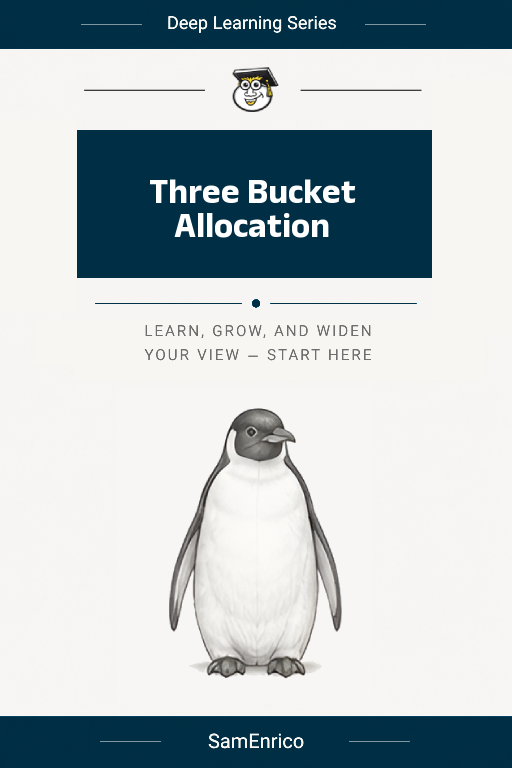
Non-FictionProfessional's Cheat SheetAllocationPrioritization
Three Bucket Allocation eBook
Split budget into must-have (70 percent), nice-to-
by Koontz Bibi
Split budget into must-have (70 percent), nice-to-have (20 percent), and experimental (10 percent).
Formats
Free sample
Chapter 1: The 70% Cage--Most people believe they know how much they need to survive. They are wrong.Not wrong by a little—wrong by a margin that keeps them trapped for decades. Ask the average person what their essential monthly expenses are, and they will rattle off a number: rent, utilities, groceries, gas, insurance, maybe a phone bill. Then ask them to actually open their bank account and track every dollar for thirty days. The number they give you will be off by twenty, thirty, sometimes forty percent.
Not because they are lying. Because they have never been forced to distinguish between what keeps them alive and what keeps them comfortable.This chapter is not about cutting your coffee budget. It is not about shaming you for ordering takeout or buying organic avocados. This chapter is about building a foundation so stable that you never have to think about whether you can afford to breathe. The 70% Must-Have bucket is the skeleton of your financial life.
Without it, everything else collapses. With it, you gain something most people never experience: the quiet confidence that your survival is not up for debate this month.The Definition That Changes Everything Before we can talk about percentages, we need a shared language. Throughout this book, when we say "after-tax income," we mean your gross income minus federal, state, FICA, and local taxes. That is it. We do not subtract 401(k) contributions.
We do not subtract health insurance premiums. We do not subtract gym memberships or charitable donations or anything else you have decided to automate. Those things come out of your 70% Must-Have bucket, not out of your income definition.Why does this matter? Because most people accidentally double-count their savings. They contribute to a 401(k) pre-tax, then feel like they are being "good," then spend the rest as if the 401(k) money never existed.
That is fine if your goal is to save for retirement. But the 70/20/10 system has a different goal: conscious allocation. Every dollar you earn, after taxes, gets a job. Some dollars go to survival. Some go to joy.
Some go to growth. None disappear into the fog of payroll deductions.So here is the formula for the rest of this book:After-tax income = Gross income – (federal income tax + state income tax + FICA + local taxes)Your 401(k) contribution, health insurance premium, and any other payroll deductions are then subtracted from your after-tax income as part of your 70% Must-Have bucket. You will see why in a moment.What Actually Belongs in the Must-Have Bucket?The Must-Have bucket contains exactly one category of expenses: the ones that would cause immediate, measurable harm to your life or the lives of your dependents if you stopped paying them tomorrow.This is a stricter definition than you might expect. Let us walk through it.Housing is a must-have. But the specific dollar amount you pay for housing is not automatically a must-have.
If you live in a three-bedroom house with a yard and a two-car garage, and you are a single person with no children, the portion of your rent that pays for the extra bedrooms and the garage is not a must-have. It is a nice-to-have that has snuck into your survival bucket. We will fix that later.Utilities are a must-have. Electricity, water, gas, heat. But premium cable?
No. The fastest available internet speed? No. The tiered spending rule from this chapter’s introduction applies here: the first 80% of what you spend on a category is must-have; the next 20% is nice-to-have; anything beyond is experimental or wasteful.Groceries are a must-have. But groceries mean basic, nutritious food that you prepare at home.
It does not mean pre-made meals from the deli counter. It does not mean expensive specialty items. It does not mean the organic, grass-fed, artisanal version of everything. If you live in a high-cost-of-living area, your grocery baseline will be higher. That is fine.
But be honest with yourself about what is nutrition and what is indulgence.Minimum debt payments are a must-have. This is non-negotiable. The minimum payment on your credit card, student loan, car loan, mortgage, or any other debt must be covered by your 70% bucket. Why? Because missing a minimum payment triggers fees, interest rate hikes, and credit score damage.
Those are immediate, measurable harms. However—and this is crucial—only the minimum payment lives here. Extra payments belong in Chapter 9’s debt acceleration strategy, which pulls from both the Nice-to-Have and Experimental buckets using the 80/15/5 temporary adjustment.Insurance is a must-have. Health insurance, auto insurance, renter's or homeowner's insurance. Life insurance if you have dependents.
Disability insurance if your income is essential to your household. But the most expensive policy with all the riders? No. Basic, adequate coverage for catastrophic events. That is the standard.Basic transportation is a must-have.
This means the cheapest reliable way to get to work, buy groceries, and access medical care. For some people, this is a bus pass. For others, it is a 15-year-old Honda Civic with no monthly payment. For a small number of people in rural areas, it is a newer car because reliable used cars are not available. The rule is not about the specific vehicle.
The rule is about the minimum cost to reliably fulfill the function.Essential healthcare is a must-have. This includes doctor visits, prescriptions, mental health care, dental checkups, and any ongoing treatment for chronic conditions. It does not include elective procedures, cosmetic treatments, or supplements not prescribed by a doctor.That is the complete list. Everything else—streaming services, dining out, hobbies, travel, gifts, premium versions of anything, clothing beyond basic necessity, gym memberships, entertainment—belongs in the 20% Nice-to-Have bucket or the 10% Experimental bucket.The 70% Cap as a Warning Light The 70% number is not arbitrary. It comes from decades of studying household budgets across income levels.
When essential expenses consume more than 70% of your after-tax income, two things happen. First, you have almost no margin for error. A single car repair, medical bill, or reduced work hour becomes a crisis. Second, you have no room for joy or growth. The 20% Nice-to-Have bucket shrinks to nothing, and the 10% Experimental bucket disappears entirely.
You become a machine that earns money and spends money on survival, with nothing left over for the life you actually want to live.The 70% cap is a warning light, not a guillotine. If your must-have expenses are 75% or 80%, you are not a failure. You are a person living in an expensive city, or carrying too much debt, or supporting dependents on a single income. The cap tells you something useful: your financial margin is thinner than it should be. You are at higher risk of a crisis.
And you will need to use the strategies in Chapter 5 to bring that number down over time.If your must-have expenses are 90% or higher, you are in survival mode. The 70/20/10 system will not work for you yet—not because the system is flawed, but because you need a different intervention first. Chapter 5 provides a six-month transition plan for exactly this situation. You will start with training wheels (75/15/10) while you plug leaks, negotiate bills, and build a small emergency buffer. You will get there.
But you need to know where you are starting.The Worksheet: Calculate Your True Must-Have Baseline Theory is useless without action.…
This is the end of the free sample. Get the eBook to keep going. Buy now
About this book
Details
- Author
- Koontz Bibi
- Publisher
- SamEnrico
- Language
- English
- Genre
- Non-Fiction, Professional's Cheat Sheet, Allocation, Prioritization
- Released
- 2026-06-01
- Pages (approx.)
- 159
- Available as
- eBook, Audiobook

Read better in the ZLOADR app
Your eBooks on your phone or tablet. Sign in with your SamEnrico account and start reading.
More by Koontz Bibi
 Water Recurring Dream GuideKoontz Bibi$11.99
 Logistics Tech Capital DeploymentKoontz Bibi$11.99Logistics Tech Capital DeploymentKoontz Bibi$11.99
 Loneliness Coffee Shop RitualKoontz Bibi$11.99
 Performance Review PrepKoontz Bibi$11.99
 Worth Beyond Work GuideKoontz Bibi$11.99
 The Burnout Prevention HandbookKoontz Bibi$11.99
 The Widowmaker PeakKoontz Bibi$11.99
 Hypnotic Confidence BuilderKoontz Bibi$11.99
 Antwerp Heist CopycatsKoontz Bibi$11.99
 The Last Broadcast: The Rise and Fall of the Pirate Radio RevolutionKoontz Bibi$11.99
 The Forgotten Silk Road of the Pacific: The Secret Voyages of Captain Chen YuKoontz Bibi$11.99
You may also like
 Hong Kong Handover 1997Dunn Johnnie$11.99
 Zumba For Postnatal Recovery CourseNeal Christian$11.99
 Zumba for BeginnersLadner Nikia$11.99
 YouTube Comment Mining GuideHumes Pandora$12.99
 Worry Box MeditationCarlin Rudy$11.99
 Workplace Stress MeditationNguyen Lynn$11.99
 Workplace Stress and Sleep RepairHawley Ivory$11.99
 Workplace Perfectionism CureDelaney Jeffry$11.99
 Workplace Injustice Anger GuideWallen Isabelle$11.99
 Work Addiction and Burnout LinkGreenwood Ester$11.99
 Women in Yoga and WellnessBeattie Galina$11.99
 Women in Stand Up ComedyChun Evangeline$11.99