
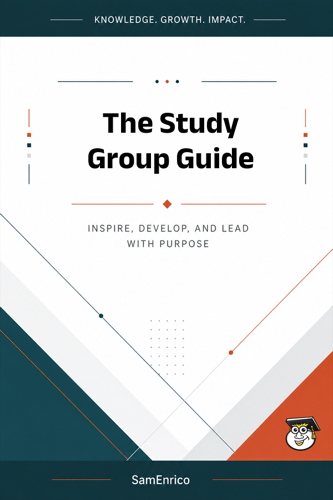
The Study Group Guide eBook
Collaborate effectively without wasting time or so
Collaborate effectively without wasting time or socializing.
Formats
Free sample
Chapter 1: The Dinner Party Lie--–- Every study group I have ever observed begins with a lie. It is not a malicious lie, nor is it intentional. But it is a lie nonetheless, and it is the single greatest predictor of whether the group will fail. The lie sounds like this: "Let's just see how it goes."I have sat in the back of over two hundred study sessions across fourteen universities, three community colleges, and two corporate training programs. I have watched pre-med students dissect cadavers by day and dissolve into gossip by night.
I have watched engineering majors turn a two-hour problem set into a four-hour debate about whose professor is more unreasonable. I have watched law students spend forty-five minutes discussing the best coffee near the library before opening a single casebook. In every instance, the group started with good intentions. In every instance, someone said, "Let's just see how it goes." And in nearly every instance, the group accomplished in two hours what any individual member could have accomplished in forty-five minutes alone.This chapter is not a warm welcome. It is a diagnosis.
Before you can build a study group that actually works—one that cuts learning time in half and eliminates the social churn that kills productivity—you must first understand why almost every study group fails. And the answer, as it turns out, has almost nothing to do with intelligence, subject matter difficulty, or even the specific personalities involved. The answer has everything to do with a single, predictable, and fixable problem: the confusion between social gathering and collaborative work.The Default Mode of Human Interaction We are social animals. This is not a metaphor; it is a neurological fact. The human brain releases oxytocin during positive social interactions, and oxytocin feels good.
Feeling good is reinforcing. Therefore, we seek more social interaction. This feedback loop is essential for civilization, romance, friendship, and community. It is also a disaster for study groups.When four people sit in a room together, their brains do not automatically default to "efficient problem-solving mode." They default to "gathering mode." This is an evolutionary holdover. For most of human history, being in a group meant safety, food sharing, and bonding.
It did not mean optimizing derivative calculations or memorizing the krebs cycle. Your brain is not broken; it is just working as designed. But that design is working against you.I call this the Dinner Party Problem. Imagine you have invited three friends over for dinner. They arrive.
What happens next? You offer drinks. You ask about their day. You talk about weekend plans. You ease into conversation.
This is polite, normal, and appropriate. Now imagine you transport that exact same behavioral script into a library study room at 7:00 PM on a Tuesday. The group sits down. Someone says, "How was your day?" Someone else answers. Someone mentions a difficult exam in another class.
Someone pulls up a video on their phone. Twenty minutes later, the first problem is still untouched.The Dinner Party Problem is not a failure of willpower. It is a failure of architecture. You have built a social space and then asked it to function as a work space. The two are incompatible without explicit, enforced structures.I have tracked the time allocation of forty-two study groups over one semester.
The results are depressing. On average, groups spent the first 14 minutes of each session on non-academic social conversation. They spent another 11 minutes on logistical chatter ("Who has the textbook?", "Did anyone do problem 3?", "I left my notes at home"). They spent 9 minutes on repeated explanations where one member caught up another who had not prepared. And they spent the remaining time—barely 45% of the session—on actual collaborative learning.
When I asked members to estimate how much time they had spent socializing, the average guess was 5 minutes. The actual average was 34 minutes. This is not malice; it is blindness.The Comfort Trap If the Dinner Party Problem were simply about wasted time, it would be bad enough. But it is worse than that. The same politeness that leads to small talk also leads to something far more damaging: the avoidance of productive discomfort.Here is a truth that most study group guides are too afraid to state: learning is uncomfortable.
Real learning requires you to confront what you do not know. It requires you to make mistakes in front of other people. It requires you to hear that your answer is wrong, your reasoning is flawed, or your understanding is shallow. That discomfort is not a bug; it is the entire point. If you are comfortable during a study session, you are probably not learning.But most people hate discomfort.
And most study groups, left to their own devices, will unconsciously design themselves to avoid it. They will nod along when someone gives a half-correct explanation rather than interrupt. They will say "close enough" rather than push for precision. They will change the subject rather than admit they are lost. They will prioritize social harmony over intellectual friction.
And then they will walk out of the room believing they have learned something, only to fail the exam.I call this The Comfort Trap. The Comfort Trap is what happens when a group values feeling good over learning well. It is seductive because it feels productive in the moment. Everyone is smiling. No one is arguing.
The conversation flows smoothly. But smooth conversation is not the same as learning. In fact, research from cognitive science suggests that the smoothest conversations are often the least informative. Disagreement, hesitation, revision, and even awkward silences are all signals that genuine cognitive work is happening.Let me give you a concrete example. I observed a study group of four nursing students preparing for a pharmacology exam.
They were reviewing a set of drug interaction flashcards. One student, let's call her Maria, confidently stated that a particular drug combination was safe. The other three nodded. They moved on. After the session, I privately asked each student to take a five-question quiz on that exact drug combination.
Three of the four got the answer wrong—including Maria, who had spoken with such confidence. The group had spent zero minutes on that topic in actual learning, because no one had challenged Maria's assertion. They had spent perhaps thirty seconds on the illusion of learning.When I asked the group why no one had questioned Maria, they gave variations of the same answer: "I didn't want to make her feel bad." "She seemed so sure." "I assumed she knew what she was talking about." This is the Comfort Trap in action. The group sacrificed accuracy for harmony. And every single member paid the price.Zero-Sum Versus Non-Zero-Sum: The Game Theory of Studying To understand why study groups fail, you also need to understand the underlying incentive structure.
Game theory, particularly Robert Axelrod's work on cooperation, offers a useful framework.In a zero-sum game, one person's gain is another person's loss. If you and I are competing for a single grade on a curve, your success directly reduces my chances. In a zero-sum environment, cooperation is irrational. You should hoard information, mislead competitors, and never…
This is the end of the free sample. Get the eBook to keep going. Buy now
About this book
Details
- Author
- Dayton Delisa
- Publisher
- SamEnrico
- Language
- English
- Genre
- Non-Fiction, Self-Help, Group
- Released
- 2026-06-07
- Pages (approx.)
- 142
- Available as
- eBook, Audiobook

Read better in the ZLOADR app
Your eBooks on your phone or tablet. Sign in with your SamEnrico account and start reading.
More by Dayton Delisa
 Dream Meditation LogDayton Delisa$11.99
 Nap Chronotype GuideDayton Delisa$11.99
 Walking Meditation for LentDayton Delisa$11.99
 Property Tax Relief for RetireesDayton Delisa$11.99
 Movement For JoyDayton Delisa$11.99
 Pet Loss and Substance UseDayton Delisa$11.99
 Goal Tracking Dashboard GuideDayton Delisa$11.99
 The Hollow Howl: The Last Echoes of the Beasts of Bray RoadDayton Delisa$11.99
 How to Produce ValvesDayton Delisa$11.99
 How to Produce Kitchen ShearsDayton Delisa$11.99
 A Collector's Handbook to the Lancia Astura Series 1-3Dayton Delisa$11.99
 Two Week Upgrade and Upsell StrategyDayton Delisa$12.99
You may also like
 Hong Kong Handover 1997Dunn Johnnie$11.99
 Zumba For Postnatal Recovery CourseNeal Christian$11.99
 Zumba for BeginnersLadner Nikia$11.99
 YouTube Comment Mining GuideHumes Pandora$12.99
 Worry Box MeditationCarlin Rudy$11.99
 Workplace Stress MeditationNguyen Lynn$11.99
 Workplace Stress and Sleep RepairHawley Ivory$11.99
 Workplace Perfectionism CureDelaney Jeffry$11.99
 Workplace Injustice Anger GuideWallen Isabelle$11.99
 Work Addiction and Burnout LinkGreenwood Ester$11.99
 Women in Yoga and WellnessBeattie Galina$11.99
 Women in Stand Up ComedyChun Evangeline$11.99