
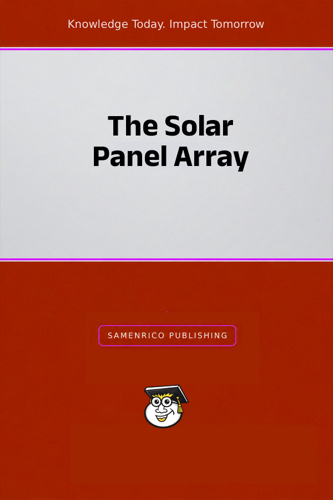
Non-FictionBiographyRenewable Energy
The Solar Panel Array eBook
Living on sunshine for a full year at sea.
Living on sunshine for a full year at sea.
Formats
Free sample
Chapter 1: The Diesel Hangover...–- The 5:00 AM generator wake-up call is a rite of passage no sailor asked for. I remember it vividly: Tahanea Atoll, French Polynesia, the kind of lagoon that belongs on a screensaver. I was asleep in the forward cabin of my 42-foot catamaran, hatches open to the warm trade wind, when a sound like a jackhammer having a seizure ripped through the anchorage. It was 5:47 AM. The boat next to us, a beautiful 50-foot aluminum sloop flying a Swiss flag, had fired up its diesel generator.
Within seconds, the scent of unburnt fuel and hot metal drifted across the water, curling through my open hatches like an unwelcome guest. My partner groaned and pulled a pillow over her head. I lay there, staring at the ceiling, and thought: There has to be another way.That morning, over coffee (brewed without electricity, using a manual grinder and a French press), I watched the Swiss couple through binoculars. They were running their generator to charge batteries, make water, and power a laptop. They would run it again at 6:00 PM.
Every single day. They were not bad people or bad sailors. They were simply trapped—anchored not just by their chain, but by a dependence on fossil fuels that dictated their schedule, their noise footprint, and their peace of mind. I made a decision that morning: I would never be that boat. I would figure out how to live on sunshine alone.What follows in this book is the result of that decision—seven years of trial and error, burned-out charge controllers, shattered panels, cloudy-day panic attacks, and ultimately, the quiet, profound joy of a full year at sea without once touching a fuel dock.
This chapter is the philosophical foundation of everything that comes after. It explains why we are addicted to diesel, what that addiction costs us (beyond money), and why a solar-powered life afloat is not just possible but vastly superior. If you are even considering a solar array for your boat, read this chapter first. The technical details matter, but your mindset matters more.The Invisible Anchor: Fuel Poverty at Sea Most sailors think of "range anxiety" as an electric car problem. It is not.
It is a human problem that has plagued sailors since the first diesel engine was bolted into a hull. But here is the cruel irony: sailors with diesel generators suffer from a worse form of range anxiety than electric vehicle drivers. An EV driver on land is never more than a few miles from a fast charger. A sailor in the South Pacific might be 1,500 nautical miles from the nearest fuel dock, with a generator that burns one gallon per hour and a fuel tank that holds 80 gallons. That is 80 hours of generator run time.
Over a three-week passage, you might run it two hours per day—but that requires perfect discipline, no emergencies, and no unexpected loads.This is what I call fuel poverty at sea. It is not about having enough money to buy diesel. It is about the psychological burden of rationing electricity because you do not know when you will next fill up. Fuel poverty manifests in dozens of small, degrading ways:You skip a shower because running the watermaker would drain the batteries below 50%.You hand-steer for two hours to save the autopilot's amp draw, even though your arms ache.You turn off your navigation lights at anchor (illegal and dangerous) because the LED bulbs still consume something.You refuse to lend a jump start to a fellow cruiser because your own reserve is too thin.You lie awake at night, doing mental math: If the wind generator puts out 8 amps for the next 10 hours, and the fridge cycles on for 15 minutes every hour...I have done all of these things. I have hand-steered across the Mona Passage (a notoriously rough stretch between Puerto Rico and the Dominican Republic) for six hours because I was afraid my autopilot would drain the batteries before dawn.
I have drunk warm water because running the watermaker felt like a luxury. I have watched a neighbor's bilge pump fail and their boat sit lower in the water because I did not have the spare amps to let them plug into my system.Fuel poverty is not a technical problem. It is a moral and psychological one. It makes you smaller, meaner, and more fearful. And it is entirely unnecessary.The Sound of Silence: What Solar Gives You That Diesel Cannot Let me describe the opposite experience.
On the same catamaran, two years later, after I had installed a 2.5 k Wp solar array (eight 320-watt rigid panels on a custom stainless arch over the stern, plus two flexible panels on the coachroof) and a 600 Ah lithium bank, we anchored in Fakarava, another Tuamotu atoll. The anchorage was crowded—20 boats, all sizes, all nationalities. At 5:30 AM, the generator symphony began. One by one, the diesels coughed to life. But not ours.
We slept in until 8:00 AM. We made coffee with an electric kettle (powered by the previous day's solar surplus). I turned on the watermaker and filled our tanks while the sun climbed. We ran the induction cooktop for pancakes. Our boat was silent.
Our neighbors, one by one, came over to ask: Are you sure your generator isn't broken?That is the moment I understood the real gift of solar. It is not just the money saved on diesel (though that is substantial—we calculated $3,400 in fuel not burned over 12 months). It is not just the environmental benefit (four metric tons of CO2 avoided). It is the silence. Silence is a resource, like fresh water or a good nights sleep.
In a world where engines, generators, and pumps never stop humming, silence is revolutionary.A solar-powered boat is a different kind of vessel. It does not announce itself. It does not wake up the atoll. It does not force you to plan your day around a two-hour charging window. You can wake up, look at the sky, and say: Today is cloudy.
I will skip the watermaker and bake bread instead. Or: Today is brilliant sunshine. I will wash all the bedding, run the watermaker for two hours, and charge every device on board. You are no longer a slave to the fuel gauge. You are a farmer of sunlight, and the harvest is predictable, generous, and renewable.Why Generators Became the Default (And Why That Default Is Broken)To understand why solar is the future, you must understand how we got trapped in the diesel past.
The recreational boating industry grew up in an era of cheap fossil fuels. From the 1960s through the early 2000s, diesel was abundant, relatively inexpensive, and taken for granted. Boat manufacturers designed vessels around the assumption that you would run a generator for a few hours each day. Watermakers, freezers, air conditioners, and entertainment systems were all built with the same assumption: shore power or generator, take your pick.The problem is that generators are terrible at their job. A typical marine diesel generator (say, a 5 k W Fischer Panda or Northern Lights) has an efficiency of around 20-25% when converting fuel to…
This is the end of the free sample. Get the eBook to keep going. Buy now
About this book
Details
- Author
- Ford Clifford
- Publisher
- SamEnrico
- Language
- English
- Genre
- Non-Fiction, Biography, Renewable Energy
- Released
- 2026-06-07
- Pages (approx.)
- 145
- Available as
- eBook, Audiobook

Read better in the ZLOADR app
Your eBooks on your phone or tablet. Sign in with your SamEnrico account and start reading.
More by Ford Clifford
 Receiving Empathy GuideFord Clifford$11.99
 Hackathon Planning Creativity GuideFord Clifford$11.99
 Migraine and Anxiety ConnectionFord Clifford$11.99
 Tribe Influencer StoryFord Clifford$11.99
 The Elderly Sibling TrapFord Clifford$11.99
 The Fatigue Stress ConnectionFord Clifford$11.99
 Blue Zone Garden CultivationFord Clifford$11.99
 Pilot Nap Cockpit GuideFord Clifford$11.99
 The Star Chasers of the Nile: Ancient Egypt's Celestial NavigatorsFord Clifford$11.99
 The Last Broadcast of Radio Luxembourg: The Secret Cold War Signals That Never StoppedFord Clifford$11.99
 Crowns and Chaos: The Unlikely Reign of Queen LiliʻuokalaniFord Clifford$11.99
 The Mineral Guide to MiniumFord Clifford$11.99
You may also like
 Hong Kong Handover 1997Dunn Johnnie$11.99
 Zumba For Postnatal Recovery CourseNeal Christian$11.99
 Zumba for BeginnersLadner Nikia$11.99
 YouTube Comment Mining GuideHumes Pandora$12.99
 Worry Box MeditationCarlin Rudy$11.99
 Workplace Stress MeditationNguyen Lynn$11.99
 Workplace Stress and Sleep RepairHawley Ivory$11.99
 Workplace Perfectionism CureDelaney Jeffry$11.99
 Workplace Injustice Anger GuideWallen Isabelle$11.99
 Work Addiction and Burnout LinkGreenwood Ester$11.99
 Women in Yoga and WellnessBeattie Galina$11.99
 Women in Stand Up ComedyChun Evangeline$11.99