
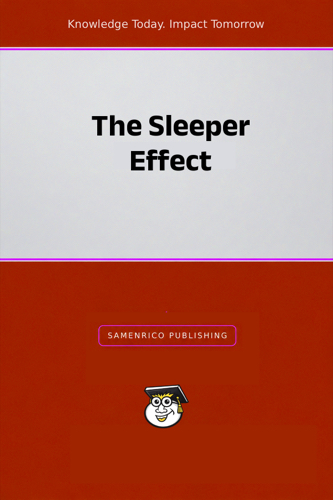
The Sleeper Effect Audiobook
Understand how low credibility sources can become
by Julian Zane
Understand how low credibility sources can become persuasive over time.
Formats
Free sample
Chapter 1: The Leaky Bucket--Every time you believe something that turns out to be false, you have probably asked yourself the same humiliating question: How did I fall for that? You might blame the liar. You might blame your own gullibility. You might even blame the algorithm that served you the lie in the first place. But almost certainly, you will not blame the real culprit: your own memory’s design flaw.Here is the uncomfortable truth that the advertising industry has known for decades, that political strategists exploit in every election cycle, and that you will likely forget again by next week: your brain is not a vault.
It is a leaky bucket. And the hole in that bucket is reserved specifically for the kind of information that could have protected you from persuasion.Think about the last time someone told you a shocking piece of news from a source you did not trust. Perhaps a friend forwarded a screenshot from a website you had never heard of, claiming that a celebrity had died. You rolled your eyes. You might have even typed back, “That’s fake, look at the URL.” You felt smart, skeptical, in control.
Then, three weeks later, you mentioned to someone else, “Did you hear that celebrity died?” You forgot the fake URL. You forgot the suspicious timestamp. You remembered only the claim. The bucket leaked.This is not a failure of intelligence. It is not a character flaw.
It is a predictable, replicable, and deeply exploitable feature of human memory. Psychologists call it the sleeper effect. And until you understand exactly how your memory leaks, you will continue to be persuaded by people you do not trust, by arguments you initially rejected, and by information you knew was false.The Forgotten Discovery of the 1950s In the early 1950s, Carl Hovland and Walter Weiss at Yale University were trying to understand something that troubled American military planners. During World War II, the United States Army had produced extensive propaganda films and written materials designed to boost soldier morale and persuade troops of the righteousness of the Allied cause. The army measured the immediate impact of these materials and found them effective.
Soldiers reported changed attitudes right after watching. But something strange happened weeks later. The attitudes did not just fade. In some cases, they increased among soldiers who had initially rejected the message. The army…
This is the end of the free sample. Get the Audiobook to keep going. Buy now
About this book
Details
- Author
- Julian Zane
- Publisher
- SamEnrico
- Language
- English
- Genre
- Non-Fiction, Business Brief, Persuasion
- Released
- 2026-06-07
- Pages (approx.)
- 134
- Available as
- eBook, Audiobook

Listen in the VoxFlicks app
Audiobooks and audio dramas wherever you go. Sign in with your SamEnrico account and press play.
More by Julian Zane
 Catherine Great Agricultural ReformJulian Zane$11.99
 Financial Stress for VeteransJulian Zane$11.99
 Workaholism Emotion GuideJulian Zane$11.99
 The Cairo Women's Court: Fighting for Justice in a Man's World (1940s)Julian Zane$11.99
 Regression Analysis Excel WorkbookJulian Zane$12.99
 How to Produce Audio EquipmentJulian Zane$11.99
 Construction Site SuperintendentJulian Zane$11.99