
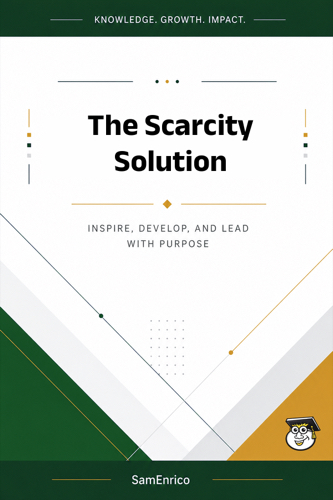
Non-FictionSelf-HelpResourcefulness
The Scarcity Solution eBook
How lack of resources leads to unexpected creative
by Dick Ardella
How lack of resources leads to unexpected creative gold mines.
Formats
Free sample
Chapter 1: The Constraint Paradox...--–- In 1960, a publisher named Bennett Cerf made a bet with one of his most difficult authors. The author was Theodor Geisel, better known to the world as Dr. Seuss. Cerf had noticed that Geisel’s books were becoming increasingly verbose. The Cat in the Hat used 225 distinct words.
How the Grinch Stole Christmas used even more. Cerf believed that Geisel could not write a compelling children’s book using only the 50 most common words in the English language. Geisel, who was both stubborn and competitive, took the bet. He locked himself in his studio. He emerged months later with a manuscript that would become Green Eggs and Ham.The book sold over 200 million copies.
It remains one of the best-selling children’s books of all time. And it was written under a constraint that most writers would consider absurd: fifty words. Not fifty thousand. Not five hundred. Fifty.
Geisel could not use the word “love.” He could not use “friend.” He could not use “sad,” “happy,” or “angry.” He had only the simplest building blocks of the English language, and from those blocks, he built a masterpiece.This is the Constraint Paradox.The Constraint Paradox states: severe limits do not diminish creativity. They amplify it. They force the brain to abandon familiar pathways and discover new ones. They eliminate the paralysis of infinite choice. And they transform a blank page from a source of terror into a solvable puzzle.Yet almost everything we are taught about creativity suggests the opposite.
We are told to brainstorm without limits. We are told to “think outside the box.” We are told that resources enable innovation—that more money, more time, and more talent inevitably lead to better results. These beliefs are not merely wrong. They are dangerously wrong. They are the reason that General Magic burned $200 million and built nothing.
They are the reason that Quibi raised $1.75 billion and died in six months. They are the reason that your own projects, teams, and organizations struggle to ship, launch, or finish.Abundance does not create. It paralyzes.This chapter will dismantle the myth of unlimited creativity. It will explain why your brain craves constraints, not freedom. It will introduce the Constraint Taxonomy, a framework for distinguishing generative constraints from destructive ones.
And it will give you the first tool in the Scarcity Solution toolkit: Lexical Limits, a method for imposing artificial scarcity on any creative or strategic problem.By the end of this chapter, you will never look at a blank page the same way again.The Lazy Brain: A Brief Lesson in Cognitive Science To understand why constraints work, you must first understand how your brain fails.The human brain is an energy-intensive organ. It consumes roughly twenty percent of your daily calories despite representing only two percent of your body mass. Evolution solved this energy problem with a simple hack: the brain defaults to the path of least resistance. When faced with a familiar problem, it reaches for a familiar solution. When faced with a novel problem, it reaches for the solution that most resembles a familiar one.
This is called cognitive fluency, and it is the enemy of creativity.Consider a simple experiment conducted by psychologists at the University of Toronto. Participants were given a creative problem-solving task and divided into two groups. The first group was told to “generate as many ideas as possible, without any limits.” The second group was told to “generate ideas using only the materials in this room.” The unlimited group produced more ideas on average. But when independent judges rated those ideas for originality and usefulness, the constrained group’s ideas scored significantly higher. The unlimited group produced predictable, conventional ideas.
The constrained group produced unexpected, innovative ones.Why? Because the unlimited group defaulted to familiar patterns. They wrote down the first things that came to mind, which were the first things that come to everyone’s mind. The constrained group, however, could not rely on familiar patterns. They had to invent new ones.
Their brains, forced off the beaten path, discovered territory that the unlimited group never saw.This is the “lazy brain” principle. Your brain is not lazy in the sense of avoiding work. It is lazy in the sense of avoiding novel work. It prefers the well-worn neural pathway to the overgrown one. Constraints function as a machete.
They clear the overgrowth by making the familiar pathway unavailable. When you cannot use the word “very,” you must find another adverb. When you cannot add a new feature, you must improve an existing one. When you cannot hire another person, you must rethink the workflow entirely.Dr. Seuss understood this intuitively.
He did not have fifty words. He had only fifty words. That scarcity eliminated every cliché, every easy rhyme, every predictable phrase. He could not write “I love green eggs and ham” because “love” was not on the list. He could not write “I am happy to eat them” because “happy” was not on the list.
He was forced to write “I do so like green eggs and ham” and “I am Sam. Sam I am.” Those constraints produced a rhythm, a playfulness, and a memorability that no amount of unlimited vocabulary could have matched.The Two Types of Constraints: Generative vs. Destructive Not all constraints are created equal. This is a critical distinction that most books on creativity get wrong. They treat constraints as uniformly good—the more limits, the better the result.
This is false. A constraint that removes essentials is destructive. A constraint that removes excess is generative. The difference is not the quantity of scarcity but its quality.Let me give you two examples, one of each.Generative constraint: In 1970, the Apollo 13 mission suffered an oxygen tank explosion that crippled the spacecraft. The three astronauts were trapped in the lunar module, which was designed to support two people for two days, not three people for four days.
The most immediate problem was carbon dioxide. The lunar module’s CO₂ scrubbers were failing, and the command module’s scrubbers had the wrong shape. Engineers on the ground were told: build a new scrubber using only what is on the spacecraft. They had plastic bags, duct tape, suit hoses, and a sock. Within hours, they solved the problem.
The astronauts came home alive. The constraint—use only what you have—removed excess (the ability to order new parts) while preserving essentials (the materials on hand). It was generative.Destructive constraint: In 2019, a software startup raised $50 million in Series B funding and immediately hired fifty new engineers. The founders believed that more engineers would produce more features, which would produce more customers. Instead, productivity collapsed.
The new engineers needed onboarding. The existing engineers needed to attend meetings. The codebase, once simple, became complex. The company shipped fewer features in the next twelve months than it had in the previous six. The constraint they imposed—more headcount—was destructive because it removed essentials (focus, autonomy, simplicity) while adding excess (coordination overhead, technical debt, communication lines).
They confused abundance with progress.The Constraint Taxonomy provides a simple way to distinguish between these two types. It has five categories:1.…
This is the end of the free sample. Get the eBook to keep going. Buy now
About this book
Details
- Author
- Dick Ardella
- Publisher
- SamEnrico
- Language
- English
- Genre
- Non-Fiction, Self-Help, Resourcefulness
- Released
- 2026-06-09
- Pages (approx.)
- 136
- Available as
- eBook, Audiobook

Read better in the ZLOADR app
Your eBooks on your phone or tablet. Sign in with your SamEnrico account and start reading.
More by Dick Ardella
 Best Case Worst Case PracticeDick Ardella$11.99
 Loneliness After Divorce GuideDick Ardella$11.99
 Assertiveness for VeterinariansDick Ardella$11.99
 The Catholic Reformation Art GuideDick Ardella$11.99
 The Vanishing of Dr. Andrew Murray: Kenya's First High-Profile Jury TrialDick Ardella$11.99
 How to Start a Optical Gun Sighting Equipment Business (Beginners Guide)Dick Ardella$11.99
 Understanding Pierre Marie Cerbellar AtaxiaDick Ardella$17.99
 American Basswood HarvestingDick Ardella$11.99
 JEE Physics Mechanics GuideDick Ardella$12.99
 Ecommerce VA Hiring GuideDick Ardella$12.99
You may also like
 Hong Kong Handover 1997Dunn Johnnie$11.99
 Zumba For Postnatal Recovery CourseNeal Christian$11.99
 Zumba for BeginnersLadner Nikia$11.99
 YouTube Comment Mining GuideHumes Pandora$12.99
 Worry Box MeditationCarlin Rudy$11.99
 Workplace Stress MeditationNguyen Lynn$11.99
 Workplace Stress and Sleep RepairHawley Ivory$11.99
 Workplace Perfectionism CureDelaney Jeffry$11.99
 Workplace Injustice Anger GuideWallen Isabelle$11.99
 Work Addiction and Burnout LinkGreenwood Ester$11.99
 Women in Yoga and WellnessBeattie Galina$11.99
 Women in Stand Up ComedyChun Evangeline$11.99