
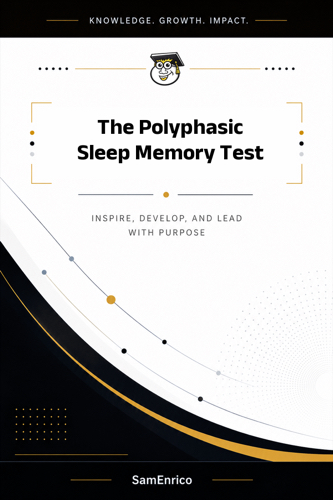
The Polyphasic Sleep Memory Test Audiobook
Evaluates if multiple short sleeps preserve memory
Evaluates if multiple short sleeps preserve memory function.
Formats
Free sample
Chapter 1: The Segmented Ancestor--–- It is two hours past midnight in a pre-industrial English cottage. The fire has dimmed to embers. Outside, the wind carries the smell of woodsmoke and damp earth. Inside, a married couple stirs from their first sleep. They do not reach for their phones—there are none.
They do not check the time—there is no clock. Instead, they lie quietly, then rise to stoke the fire. They talk softly about the children, the harvest, the argument they had three days ago that still sits between them. They might make love. They might pray.
After an hour or two of quiet wakefulness, they return to their straw mattress and slip into a second sleep, which will last until dawn.This was not an eccentric habit. It was the standard pattern of human sleep for most of recorded history. The historian Roger Ekirch, after examining more than five hundred diaries, court records, and medical texts spanning ancient Greece to nineteenth-century Europe, discovered that humans did not always aim for one solid block of eight hours. Instead, they practiced biphasic sleep: two segments separated by one to three hours of waking calm. The first sleep began around dusk.
The second sleep ended at dawn. The interval between was called the watch—a space for reflection, intimacy, or quiet work.Then everything changed. Streetlights, factory shifts, and the stern moralizing of the Industrial Revolution labeled segmented sleep as wasteful, even sinful. By 1920, the eight-hour block had become the new normal—not because biology demanded it, but because capitalism and electricity made it possible. And in that single transition, we lost something.
We lost the memory of a different way of resting. We lost the knowledge that sleep could be flexible. And we began to believe, with the fervor of a religious convert, that any sleep not contained within a single, unbroken night was either pathological or the fantasy of eccentrics.This book is going to challenge that belief. Not by dismissing the value of a good night's sleep—science is unequivocal that sleep is essential—but by asking a more precise, more useful question: Does the structure of sleep matter more than its total duration? Specifically, if you break sleep into multiple short naps across the day and night, do you preserve the one cognitive function that most defines your waking life?
Do you preserve memory?This chapter is the foundation. Before we can test whether polyphasic sleep harms or helps memory, we…
This is the end of the free sample. Get the Audiobook to keep going. Buy now
About this book
Details
- Author
- Hirsch Sherly
- Publisher
- SamEnrico
- Language
- English
- Genre
- Non-Fiction, Self-Help, Sleep Schedules
- Released
- 2026-06-07
- Pages (approx.)
- 148
- Available as
- eBook, Audiobook

Listen in the VoxFlicks app
Audiobooks and audio dramas wherever you go. Sign in with your SamEnrico account and press play.
More by Hirsch Sherly
 Email Interruption Management CourseHirsch Sherly$11.99
 Limitation As Liberation WorkbookHirsch Sherly$11.99
 Divorce and New Partner BlendingHirsch Sherly$11.99
 Sociology Essay GPT GuideHirsch Sherly$11.99
 The Great Colonial Races: How a Horse Rivalry United a Divided NationHirsch Sherly$11.99
 Energy Sector M&A GuideHirsch Sherly$12.99
 Wave Accountant CollaborationHirsch Sherly$12.99
 Understanding Placental AbruptionHirsch Sherly$17.99
 Astrophotography GuideHirsch Sherly$11.99
 How to Start a Operation of Irrigation Canals Business (Beginners Guide)Hirsch Sherly$11.99