
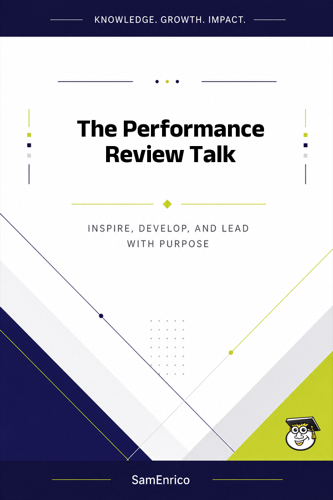
Non-FictionSelf-HelpManagement
The Performance Review Talk eBook
Conduct effective employee evaluations with clarit
by Roush Taisha
Conduct effective employee evaluations with clarity and fairness.
Formats
Free sample
Chapter 1: The Annual Terror--–- Every year, in offices across the world, a quiet dread begins to take hold. It starts as a low hum in late autumn, grows into a persistent anxiety by early winter, and reaches full-blown panic by the time the calendar turns to December. The source of this collective unease is not a looming layoff, a hostile takeover, or even the annual shareholder meeting. It is something far more mundane and yet far more personal: the performance review.The phone calls and emails I receive as a management consultant follow a predictable seasonal pattern. In November, the questions are tentative and theoretical.
“What do you think about 360-degree feedback?” a new client might ask. By January, the tone has shifted dramatically. “I have to do reviews next week,” a frantic manager confesses, “and I honestly don't know what to say to half my team. I've barely talked to them about performance all year.” By February, the damage reports arrive. “She quit,” another manager tells me.
“Three days after her review. Said she'd been waiting for the right moment. I had no idea.”This pattern is not an accident. It is the inevitable outcome of a system that is fundamentally broken—a system that almost everyone hates, that almost everyone knows is broken, and that almost everyone continues to use anyway. The performance review is the business world's most enduring and least effective ritual.
It is time to understand why.The Invention of a Monster The modern performance review was not designed by sadists or incompetents. It emerged from a perfectly reasonable set of organizational needs. In the mid-twentieth century, as corporations grew larger and more bureaucratic, managers needed a systematic way to evaluate employees for pay raises, promotions, and terminations. The solution was the annual performance appraisal: a once-a-year meeting where a manager would review an employee's past performance, assign a rating, and discuss areas for improvement.On paper, this made sense. In practice, it has never worked.The reasons are not mysterious.
Human memory is not a video recorder; it is a storyteller that edits, exaggerates, and invents. Human judgment is not a scientific instrument; it is a collection of biases and shortcuts that evolved to keep us safe on the savanna, not to evaluate spreadsheet accuracy. And human relationships are not built on annual feedback dumps; they are built on ongoing, low-stakes conversations that accumulate into trust or its opposite.Yet organizations continue to pour enormous resources into a process that decades of research have shown to be ineffective at best and actively harmful at worst. The Society for Human Resource Management estimates that American companies spend more than two billion dollars per year on performance review systems, software, and training. Add in the hours that managers and employees spend preparing for, conducting, and recovering from reviews, and the total cost rises into the tens of billions.For that investment, what do organizations get?
Anxiety. Resentment. Turnover. And virtually no measurable improvement in performance.The Three Wounds of the Annual Review After two decades of studying performance management systems and coaching thousands of managers through the review process, I have identified three specific ways that traditional annual reviews damage employees, managers, and organizations. I call them the Three Wounds of the Annual Terror.The Recency Wound The first wound is caused by recency bias: our tendency to give disproportionate weight to the most recent events when evaluating a longer period of time.Here is a simple experiment you can conduct with any group of managers.
Ask them to think about an employee they have supervised for at least two years. Then ask them to describe the employee's performance over the entire period. Finally, ask them what specific events from the first year they can recall without looking at notes.In hundreds of workshops, I have never seen a manager recall more than two or three specific events from twelve months ago. The typical manager's memory of an employee's performance is heavily weighted toward the last four to six weeks, with a few memorable highlights or lowlights from earlier in the year sprinkled in.This is not a character flaw. It is how human memory works.
We are not designed to store and recall twelve months of detailed behavioral data about each person we supervise. We are designed to remember what we ate for breakfast yesterday and whether that rustling in the bushes last week was a predator or just the wind.But performance reviews require precisely the kind of memory humans do not have. The result is a wound that cuts both ways. The employee who had a rough January but a strong December gets a higher rating than they deserve, which is unfair to their colleagues who were consistently solid all year. The employee who had a brilliant January but a rough December gets a lower rating than they deserve, which is unfair to them.
And the employee who committed an error in November—just weeks before the review—pays a penalty that far exceeds the actual impact of the mistake.The Surprise Wound The second wound is perhaps the most damaging to trust. The Surprise Wound occurs when an employee hears something in their performance review that they have never heard before.Research on this phenomenon is striking. In a study of more than five thousand employees across twenty organizations, researchers found that eighty-two percent of respondents reported receiving feedback in their annual review that had never been mentioned to them at any other time during the year. Eighty-two percent.Think about what that number means. The vast majority of employees are walking into review meetings and discovering, for the first time, that their manager has been dissatisfied with some aspect of their work for weeks or months.
They have not been given an opportunity to correct the behavior. They have not been given a chance to explain the circumstances. They have simply been observed, judged, and now sentenced—without ever having been told they were on trial.The emotional impact of this surprise is devastating. Employees report feeling betrayed, humiliated, and deeply confused. “If this was a problem,” they ask themselves, “why didn't you tell me sooner?
Why did you let me keep doing it wrong?” The implicit message the employee receives is not that their manager wants to help them improve. It is that their manager has been keeping a secret file of grievances and has now decided to spring it on them.No relationship survives that dynamic. Not in marriage, not in friendship, and certainly not in the inherently unequal relationship between a manager and an employee.The Abandonment Wound The third wound is inflicted after the review meeting ends. The Abandonment Wound is what happens when the goals, development plans, and action items that were so carefully discussed in the review are quietly forgotten by everyone except the employee.The data here is even more damning. Follow-up studies have consistently found that within thirty days of a performance review, fewer than one in four employees can accurately recall the specific development goals they agreed to with their manager.
Within ninety days, that number drops to less than one in ten.But here is the crucial detail: the employees are…
This is the end of the free sample. Get the eBook to keep going. Buy now
About this book
Details
- Author
- Roush Taisha
- Publisher
- SamEnrico
- Language
- English
- Genre
- Non-Fiction, Self-Help, Management
- Released
- 2026-06-07
- Pages (approx.)
- 137
- Available as
- eBook, Audiobook

Read better in the ZLOADR app
Your eBooks on your phone or tablet. Sign in with your SamEnrico account and start reading.
More by Roush Taisha
 Thunberg Oil Industry ShowdownRoush Taisha$11.99
 Sales Job Loss GuideRoush Taisha$11.99
 Crazy Eights IdeationRoush Taisha$11.99
 Virtual Team Building GuideRoush Taisha$11.99
 Creative Confidence for AnxietyRoush Taisha$11.99
 Carol Channing Hello DollyRoush Taisha$11.99
 ADHD Child Parent AngerRoush Taisha$11.99
 Ashen Crown: The Forgotten Eruption That Shaped EmpiresRoush Taisha$11.99
 The Last Stand of the Iron Lady: Thatcher vs. the MinersRoush Taisha$11.99
 Australian Cattle Dogs: Blue HeelersRoush Taisha$11.99
 A Collector's Handbook to the Sunbeam Rapier IiRoush Taisha$11.99
 Business Hours and Holiday Routing GuideRoush Taisha$12.99
You may also like
 Hong Kong Handover 1997Dunn Johnnie$11.99
 Zumba For Postnatal Recovery CourseNeal Christian$11.99
 Zumba for BeginnersLadner Nikia$11.99
 YouTube Comment Mining GuideHumes Pandora$12.99
 Worry Box MeditationCarlin Rudy$11.99
 Workplace Stress MeditationNguyen Lynn$11.99
 Workplace Stress and Sleep RepairHawley Ivory$11.99
 Workplace Perfectionism CureDelaney Jeffry$11.99
 Workplace Injustice Anger GuideWallen Isabelle$11.99
 Work Addiction and Burnout LinkGreenwood Ester$11.99
 Women in Yoga and WellnessBeattie Galina$11.99
 Women in Stand Up ComedyChun Evangeline$11.99