
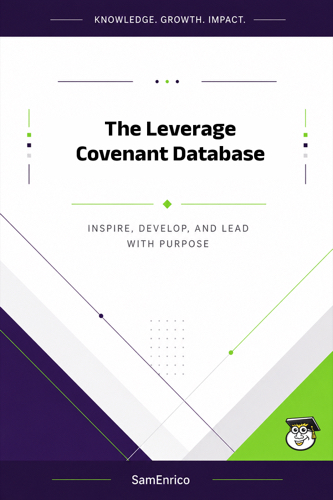
Non-FictionCapital & Valuation RegisterCovenant Analysis
The Leverage Covenant Database eBook
Documents incurrence and maintenance covenants acr
by Hardesty Jay
Documents incurrence and maintenance covenants across debt structures.
Formats
Free sample
Chapter 1: The Invisible Cage--–- In the spring of 2018, a mid-sized retail chain called True North Apparel appeared to be thriving. Its stores were crowded, its e-commerce business was growing at 15 percent annually, and its private equity sponsor had just taken a $200 million dividend. The company's leverage ratio stood at 4.2x EBITDA – well within its 5.0x covenant limit. By every external measure, True North was a success story.Eighteen months later, the company was bankrupt.What happened? Did sales collapse?
Did a competitor emerge? No. True North's underlying business deteriorated slowly and invisibly. EBITDA drifted downward from $180 million to $120 million. Leverage rose silently from 4.2x to 6.3x.
But because True North's credit agreement contained only incurrence covenants – tests triggered only when the company took a specific action, like borrowing new money or paying a dividend – no covenant was ever violated. The company never borrowed a dollar after that dividend. It simply sat inside its debt structure, bleeding cash, while lenders watched from the outside, powerless to intervene until the company missed an interest payment. By then, recovery value was zero.This is the invisible cage of modern debt. Not a cage that traps borrowers – but a cage that blinds lenders until it is too late.The Great Migration: How Maintenance Became Incurrence Twenty years ago, the story of True North would have unfolded differently.
Under a traditional bank loan with maintenance covenants, True North would have been required to report its leverage ratio every quarter. When leverage crept from 4.2x to 4.6x, the lender would have received an early warning. When it hit 5.1x – violating the 5.0x cap – the lender could have called a default, demanded a cure, or renegotiated terms while the company still had value. The slow bleed would have been visible.That world no longer exists for most institutional loans.The migration from maintenance covenants (continuous compliance) to incurrence covenants (testing only upon action) is the single most important structural change in debt markets over the past two decades. Today, over 80 percent of institutional term loans are "Cov-Lite" – meaning they contain no maintenance covenants at all.
High-yield bonds have been incurrence-only since the 1990s. Even middle-market loans, traditionally the last bastion of maintenance protections, have seen Cov-Lite structures rise from 10 percent of issuance in 2012 to over 60 percent in 2024.This chapter establishes the master framework for understanding this shift. Every subsequent chapter in this book – from the mechanics of leverage ratios to the latest innovations in private credit – builds on the distinction introduced here. When later chapters refer to "incurrence covenants" or "maintenance covenants," they are referencing the definitions established in this chapter. When Chapter 5 discusses the "lag problem" of quarterly testing, it is addressing a weakness inherent to maintenance covenants.
When Chapter 11 examines "springing covenants" that activate upon a ratings downgrade, it is describing a hybrid structure that blurs the line between the two regimes.Defining the Two Regimes Let us begin with precise definitions.A maintenance covenant requires the borrower to satisfy a specific financial ratio – typically maximum leverage, minimum interest coverage, or minimum fixed charge coverage – at regular intervals, usually quarterly. The test is continuous in effect, even if measured discretely. The borrower must maintain compliance as a condition of the loan. Failure is an immediate event of default, though grace periods and cure rights may apply (see Chapter 9 for a full treatment of remedies).A practical example: "The Borrower shall maintain a Consolidated Leverage Ratio of not more than 4.00 to 1.00 as of the last day of each fiscal quarter, measured on a trailing four-quarter basis."An incurrence covenant prohibits the borrower from taking a specific action – incurring new debt, making a restricted payment (dividend, share buyback, or investment), creating liens, or selling assets – unless a specified ratio test is satisfied. The borrower may be in compliance with all incurrence covenants while its leverage ratio drifts from 4.0x to 6.0x, as long as it takes no action that triggers a test.A practical example: "The Borrower shall not incur any Indebtedness unless, immediately after giving pro forma effect to such incurrence, the Consolidated Leverage Ratio would be less than 3.50 to 1.00."The difference is not technical.
It is existential. Maintenance covenants are about state. Incurrence covenants are about action. A borrower in a maintenance regime must continuously manage its leverage. A borrower in an incurrence regime can let leverage drift indefinitely, as long as it stops borrowing.The Economic Drivers of the Shift Why did lenders abandon maintenance covenants?
The answer lies in three structural changes to credit markets.First, the rise of institutional investors. Prior to 2000, most leveraged loans were held by commercial banks. Banks have relationship incentives to monitor borrowers; they also have deposit franchises that give them patient capital. When a bank sees a borrower deteriorating, it can work out a solution quietly. When the loan is sliced into 100 pieces and sold to CLOs (collateralized loan obligations), hedge funds, and insurance companies, no single lender has the incentive or the authority to monitor.
These investors prefer tradability over monitoring. A Cov-Lite loan is easier to trade because its value is not subject to sudden covenant breaches.Second, sponsor pressure. Private equity sponsors are the primary borrowers in leveraged loan markets. Sponsors have a simple objective: maximize equity returns. Maintenance covenants constrain a sponsor's ability to lever up, pay dividends, or ride out temporary underperformance.
Incurrence covenants give sponsors the flexibility to let leverage drift higher as long as they do not trigger a test by taking new action. Sponsors have successfully argued that Cov-Lite structures are "market standard" – a self-fulfilling prophecy that became true through repetition.Third, the low interest rate environment. From 2009 to 2022, interest rates were historically low. Default rates were correspondingly low. In a benign credit environment, maintenance covenants seem unnecessary – why pay for protection you never use?
This logic proved seductive. But as interest rates rose in 2023-2025, the hidden risk of incurrence covenants became visible. Borrowers that had drifted to high leverage under Cov-Lite structures found themselves unable to refinance at higher rates. The covenants offered no early warning because they had never been triggered.The Agency Problem: Shareholders vs. Lenders At the heart of the shift is a fundamental conflict of interest.
Shareholders (and sponsors) have a call option on the assets of the firm. If the company performs well, shareholders capture the upside. If the company performs poorly, shareholders lose only their equity. This asymmetry creates an incentive to take risk – including the risk of letting leverage drift upward.Maintenance covenants act as a governor on this risk-taking. They force periodic renegotiation with lenders, which disciplines shareholders.
Incurrence covenants remove this governor. A borrower in an incurrence regime can allow leverage to increase without any negotiation, as long as it does not borrow more money.The agency problem is not theoretical. A 2023 study by the National Bureau of Economic Research (NBER) examined 500 Cov-Lite loans originated between 2015 and 2020. The study found that borrowers with incurrence-only covenants increased their leverage by an average of 1.8 turns over the life of the loan, compared to 0.4 turns for borrowers with maintenance covenants. Moreover, the Cov-Lite borrowers that ultimately defaulted showed deteriorating fundamentals for an average of seven…
This is the end of the free sample. Get the eBook to keep going. Buy now
About this book
Details
- Author
- Hardesty Jay
- Publisher
- SamEnrico
- Language
- English
- Genre
- Non-Fiction, Capital & Valuation Register, Covenant Analysis
- Released
- 2026-06-09
- Pages (approx.)
- 145
- Available as
- eBook, Audiobook

Read better in the ZLOADR app
Your eBooks on your phone or tablet. Sign in with your SamEnrico account and start reading.
More by Hardesty Jay
 Nightmare Processing Without Details GuideHardesty Jay$11.99
 The Teen Self Esteem Through StudyHardesty Jay$11.99
 Bipolar And OCD ComorbidityHardesty Jay$11.99
 Criticism Anger TriggersHardesty Jay$11.99
 The Shadow of the Golden Fleece: Australia's First Political Assassination in the Digital AgeHardesty Jay$11.99
 Executive Summary for Annual ReportsHardesty Jay$12.99
 ClassPass GuideHardesty Jay$12.99
 Understanding Progressive Kinking of The Hair, AcquiredHardesty Jay$17.99
 How to Start a Hobby in WatercolorHardesty Jay$11.99
 Customer Relations AssociateHardesty Jay$11.99
You may also like
 Hong Kong Handover 1997Dunn Johnnie$11.99
 Zumba For Postnatal Recovery CourseNeal Christian$11.99
 Zumba for BeginnersLadner Nikia$11.99
 YouTube Comment Mining GuideHumes Pandora$12.99
 Worry Box MeditationCarlin Rudy$11.99
 Workplace Stress MeditationNguyen Lynn$11.99
 Workplace Stress and Sleep RepairHawley Ivory$11.99
 Workplace Perfectionism CureDelaney Jeffry$11.99
 Workplace Injustice Anger GuideWallen Isabelle$11.99
 Work Addiction and Burnout LinkGreenwood Ester$11.99
 Women in Yoga and WellnessBeattie Galina$11.99
 Women in Stand Up ComedyChun Evangeline$11.99