
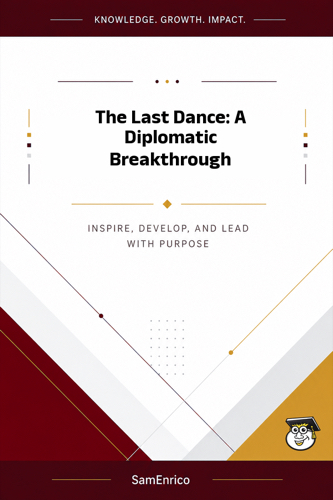
The Last Dance: A Diplomatic Breakthrough eBook
Unveils the high-stakes negotiations behind the hi
Unveils the high-stakes negotiations behind the historic 2021 U.S.-China climate deal, where a single ambassador’s quiet persistence changed global policy.
Formats
Free sample
Chapter 1: The Ghost of Copenhagen...--–- The air in the Bella Center had the chemical smell of desperation—sweat, cheap coffee, and the ozone hum of thousands of laptops running on fraying batteries. Michael Vance had been awake for thirty-seven hours, and he was fairly certain his suit jacket no longer belonged to him. Somewhere between the Danish border police and the security checkpoint, he had lost his left cufflink, his dignity, and any remaining faith in multilateral process.It was December 18, 2009. The final day of the fifteenth Conference of the Parties to the United Nations Framework Convention on Climate Change. COP15.
Copenhagen. The city that was supposed to save the world.Vance, forty years old and running on adrenaline and spite, stood at the back of the main plenary hall, pressed against a wall that had not been cleaned since the Reagan administration. Before him stretched a sea of delegates—nearly twenty thousand of them from 193 countries—packed into a space designed for half that number. The air was thick with translation feedback, the shuffle of paper, and the low hum of whispered negotiations conducted in a dozen languages. Flags hung from the rafters like funeral bunting.
The whole room felt like a wake for a planet that had not yet died but had received a terminal diagnosis.He was a mid-level Foreign Service officer, assigned to the U.S. delegation as a technical advisor on emissions accounting—a job so boring that even other diplomats avoided him at cocktail receptions. But Vance had a habit that would define his career: he paid attention. While the senior negotiators huddled in private rooms, drafting language they would never share, Vance stood in the back of the plenary and watched. He watched the delegates from Tuvalu, whose country was literally sinking, sit in silence while their future was debated in acronyms.
He watched the delegate from Bolivia stand and shout until his voice cracked, demanding that someone—anyone—acknowledge that the accord being negotiated behind closed doors was a death sentence for his people. He watched the chair, a Danish politician named Connie Hedegaard, bang her gavel so hard that the head flew off and skittered across the floor.No one laughed. No one was laughing in Copenhagen.The Anatomy of a Failure The Copenhagen Accord, when it finally emerged from the back room, was not a treaty. It was not an agreement. It was not even a particularly good draft.
It was a six-paragraph document that had been written by a small group of men—Barack Obama, Wen Jiabao, Manmohan Singh, Luiz Inácio Lula da Silva, and Jacob Zuma—in a room that excluded the other 193 nations. The text was vague. The targets were non-binding. The language on finance was aspirational. The word "shall" appeared nowhere.
Every verb was a wish. Every noun was a loophole.Vance read the document on his Black Berry, standing in a corridor where the heating had failed, watching his breath fog in the December cold. He read it twice. Then he closed the device and leaned his forehead against a concrete pillar.This is it, he thought. This is what twenty thousand people traveled across the world to produce.
A press release.The plenary hall, when Vance returned, had descended into something between a riot and a funeral. The delegate from Tuvalu—a young woman named Ian Fry, whose name Vance would remember for the rest of his life—rose to speak. Her voice was steady, but her hands were shaking."Mr. President," she said, "my country is drowning. We came here in good faith.
We came here believing that the world would not let us die in silence. But you have negotiated an accord in a back room, without our participation, and you are asking us to accept it without amendment. I cannot do that. I will not do that. My people did not send me here to sign their death warrant."The hall fell silent.
Then someone applauded—a single pair of hands, sharp and lonely in the cavernous space. Then another. Then the room erupted into chaos. Delegates shouted over each other. The chair banged her gavel until the head fell off again.
The translator for the Bolivian delegation began to cry, though whether from exhaustion or despair, no one could tell.Vance stood frozen. He had studied diplomacy at Georgetown. He had read Kissinger and Holbrooke and Albright. He had memorized the negotiating tactics of the Cold War and the trade disputes of the nineties. But no textbook had prepared him for this: the raw, unfiltered grief of watching people fight for their survival while the powerful pretended to listen.The Copenhagen Accord was never adopted.
It was merely "noted" by the COP—a procedural death that allowed everyone to save face while accomplishing nothing. The delegates filed out in silence. The media packed up their cameras. The world moved on. And Michael Vance went back to his hotel room, sat on the bathroom floor, and tried not to vomit.The Scar Tissue What happened in Copenhagen was not just a failure of diplomacy.
It was a trauma. And like all traumas, it left scars that would never fully heal.Vance spent the next decade watching those scars shape every subsequent climate negotiation. The fear of another Copenhagen made negotiators deeply risk-averse. They avoided ambitious targets because ambitious targets could fail publicly. They avoided top-down deals because top-down deals had collapsed in 2009.
They avoided last-minute leader interventions because leader interventions had produced the disastrous back-room accord. Instead, they defaulted to lowest-common-denominator language, carefully crafted to offend no one and inspire no one.The unwritten rules hardened into dogma: no surprises. No secret texts. No exclusion of small island states. Never again let a handful of powerful nations dictate terms to the vulnerable.
These rules were wise, in their way. But they also made progress agonizingly slow.Vance carried these lessons with him as he rose through the State Department ranks. He was in Durban in 2011, watching the parties agree to negotiate a new agreement by 2015. He was in Warsaw in 2013, watching developing nations walk out over a procedural fight about loss and damage. He was in Lima in 2014, watching the fragile consensus nearly collapse over a single word—"differentiation"—that took thirty-six hours to resolve.And he was in Paris in 2015, watching the world finally do what Copenhagen had failed to do: produce a real agreement.
The Paris Agreement was not perfect. The targets were still nationally determined, not globally mandated. The enforcement mechanisms were weak. But it was legal. It was binding.
It was a treaty. And when the gavel came down on December 12, 2015, Vance allowed himself a single tear.He did not know, then, that the worst was yet to come.The Phone Call That Broke Everything June 1, 2017. Vance was in Beijing, attending a technical working group on carbon market rules. He was forty-eight years old now, graying at the temples, carrying twenty extra pounds that he blamed on diplomatic receptions. The meeting was in a windowless conference room on the fifteenth floor of a hotel that smelled like cigarette smoke and regret.
The Chinese negotiators were polite, professional, and utterly immovable on Article 6.At 3:47 PM local time, Vance's phone buzzed. He…
This is the end of the free sample. Get the eBook to keep going. Buy now
About this book
Details
- Author
- Manuel Shaunda
- Publisher
- SamEnrico
- Language
- English
- Genre
- Non-Fiction, Ambassador
- Released
- 2026-06-03
- Pages (approx.)
- 125
- Available as
- eBook, Audiobook

Read better in the ZLOADR app
Your eBooks on your phone or tablet. Sign in with your SamEnrico account and start reading.
More by Manuel Shaunda
 EQ For Military Personnel GuideManuel Shaunda$11.99
 Stress Induced Withdrawal FixManuel Shaunda$11.99
 Rapid Cycling Bipolar GuideManuel Shaunda$11.99
 Back Pain Sleep MeditationManuel Shaunda$11.99
 Palace for ChildrenManuel Shaunda$11.99
 The Scholarship Search StressManuel Shaunda$11.99
 Memory Palace Team CollaborationManuel Shaunda$11.99
 Double Taxation Treaty GuideManuel Shaunda$11.99
 Self Worth And Adoption SearchManuel Shaunda$11.99
 The Architect of the Cosmos: Benjamin Banneker's Celestial LegacyManuel Shaunda$11.99
 The Poison Diaries: The Untold Story of Dr. Marie BeechamManuel Shaunda$11.99
 The Mineral Guide to CleveiteManuel Shaunda$11.99
You may also like
 Hong Kong Handover 1997Dunn Johnnie$11.99
 Zumba For Postnatal Recovery CourseNeal Christian$11.99
 Zumba for BeginnersLadner Nikia$11.99
 YouTube Comment Mining GuideHumes Pandora$12.99
 Worry Box MeditationCarlin Rudy$11.99
 Workplace Stress MeditationNguyen Lynn$11.99
 Workplace Stress and Sleep RepairHawley Ivory$11.99
 Workplace Perfectionism CureDelaney Jeffry$11.99
 Workplace Injustice Anger GuideWallen Isabelle$11.99
 Work Addiction and Burnout LinkGreenwood Ester$11.99
 Women in Yoga and WellnessBeattie Galina$11.99
 Women in Stand Up ComedyChun Evangeline$11.99