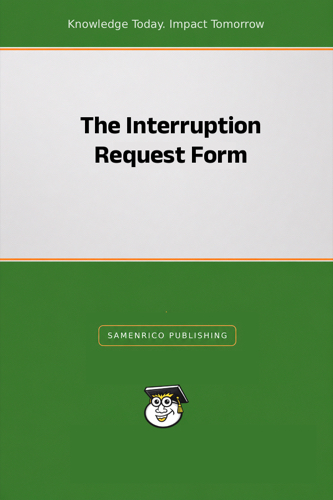
The Interruption Request Form Audiobook
Creates physical or digital form requiring colleag
by Conroy Kyoko
Creates physical or digital form requiring colleagues to document non-urgent interruptions.
Formats
Free sample
Chapter 1: The Twenty‑Three Minute Heist–- The email arrived at 9:47 AM. A simple question: “Hey, got a sec?” The developer, Sarah, paused her debug session—seventy‑two lines of code balanced in working memory. She replied “sure” at 9:48. The colleague asked about a password reset policy. Sarah answered in forty‑five seconds.
The colleague left at 9:49. Sarah stared at her screen until 10:12 AM before she could relocate the exact line where the memory leak originated. That is the twenty‑three minute heist.This chapter establishes the foundational problem that the entire book exists to solve: the seemingly harmless “quick question” is one of the most expensive behaviors in modern knowledge work. Most professionals believe they handle interruptions well. They believe they multitask effectively.
They believe a thirty‑second question costs only thirty seconds. Every single one of those beliefs is demonstrably, scientifically, and ruinously false.We begin with the science of attention, then move to the hidden mathematics of workplace interruptions, then introduce the solution that will reclaim those stolen minutes: the Interruption Request Form (IRF). By the end of this chapter, you will never look at a knock on your office door the same way again.The Myth of the Harmless Interruption Walk into almost any open office and you will hear the same soundscape: keyboards clacking, phones buzzing, and the perpetual murmur of “quick questions.” “Do you have a minute?” “Can I grab you for one second?” “Sorry to interrupt, but…” These phrases have become so common that we have stopped hearing them as what they truly are: the sound of productivity being drained from the room one question at a time.The myth persists because the interruption itself is brief. A colleague asks something. You answer.
They leave. In clock time, perhaps forty‑five seconds elapsed. That feels harmless. That feels like collaboration. That feels like being a good teammate.The problem is that human beings do not work like computers.
A computer can pause one process, attend to another, and resume the first process exactly where it left off, with zero overhead. The context is saved perfectly. The registers are preserved. The state is restored.Your brain cannot do this.When you are focused on a complex task—writing a proposal, debugging code, designing a marketing campaign, analyzing financial data—your brain builds what cognitive psychologists call a “contextual scaffold.” You hold multiple variables in working memory. You maintain…
This is the end of the free sample. Get the Audiobook to keep going. Buy now
About this book
Details
- Author
- Conroy Kyoko
- Publisher
- SamEnrico
- Language
- English
- Genre
- Non-Fiction, Self-Help, Workflow Design
- Released
- 2026-06-09
- Pages (approx.)
- 127
- Available as
- eBook, Audiobook

Listen in the VoxFlicks app
Audiobooks and audio dramas wherever you go. Sign in with your SamEnrico account and press play.
More by Conroy Kyoko
 Loneliness and Nature TherapyConroy Kyoko$11.99
 Wholesaling Income Tracking GuideConroy Kyoko$11.99
 Professional Association NetworkingConroy Kyoko$11.99
 Zumba Belly Dance InfusionConroy Kyoko$11.99
 Road Rage Self Talk GuideConroy Kyoko$11.99
 Wholesaling Title Company GuideConroy Kyoko$11.99
 The Animal Attack Cover UpConroy Kyoko$11.99
 School Of Turin HeistConroy Kyoko$11.99
 The Maverick and the Machine: How a Third-Party Candidate Almost Won the White HouseConroy Kyoko$11.99
 The Ghost in the Machine: How a Cyberattack Almost Stole the 2016 US ElectionConroy Kyoko$11.99
 The Forbidden Ice: Zheng He’s Lost Antarctic ExpeditionConroy Kyoko$11.99
 The Mineral Guide to StauroliteConroy Kyoko$11.99