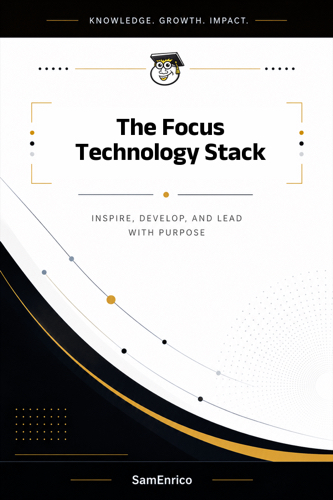
The Focus Technology Stack eBook
Use apps and tools that enhance rather than harm a
by Agee Eryn
Use apps and tools that enhance rather than harm attention.
Formats
Free sample
Chapter 1: The Hijacked Brain--–- You are holding a supercomputer. It has more processing power than the systems that guided Apollo 11 to the moon, more storage than the Library of Congress, and access to the entirety of human knowledge. And you just picked it up to check the weather. Then you saw a notification. Then you opened Instagram.
Then you watched a video of a golden retriever opening a door. Then you closed Instagram. Then you opened it again because you couldn't remember if you liked that video. Then you put the phone down. Then you picked it up.
Then you checked the weather. Twenty-three minutes have passed. You do not know the temperature.This is not a failure of willpower. This is not a character flaw. This is not laziness, weakness, or a lack of discipline.
This is the predictable outcome of a mismatch between your ancient nervous system and a trillion-dollar industry that has reverse-engineered the very mechanisms of attention. The people who built your phone know more about your brain than you do. They have spent billions of dollars studying exactly which colors, sounds, and timing intervals will cause you to reach for your device against your own best interest. And they have won. But winning a battle is not the same as winning a war.
This chapter is about understanding how they captured your attention in the first place—because you cannot build a fortress around something you do not understand.The Two Attention Systems Your brain has two fundamentally different ways of paying attention. They are not better or worse than each other; they evolved to serve different purposes. But the attention economy has learned to exploit one of them ruthlessly while systematically starving the other.Bottom-up attention is the older, faster, more primitive system. It lives in your limbic system—the ancient core of your brain that you share with lizards and squirrels. Bottom-up attention is automatic, involuntary, and driven by sensory cues.
A loud bang. A flash of light. A sudden movement in your peripheral vision. The sound of your name being called across a crowded room. You do not decide to pay attention to these things.
Your brain decides for you, because for 99 percent of human history, paying attention to sudden changes in the environment was the difference between seeing the predator and becoming lunch.Bottom-up attention is what makes you glance at your phone when it buzzes. It is what makes your eyes dart to a notification badge—specifically a red one, because red is the color of ripe fruit, blood, and danger, and your ancient brain cannot ignore red. It is what makes you feel a small spike of arousal when your screen lights up. You did not choose to feel that spike. It happened to you.
And the people who designed your operating system know exactly how to trigger it.Top-down attention is the newer, slower, more deliberate system. It lives in your prefrontal cortex—the part of your brain that separates you from most other animals. Top-down attention is voluntary, effortful, and goal-directed. It is what allows you to read a dense book, write a complex email, solve a math problem, or have a deep conversation without interrupting. You decide what to focus on, and your brain allocates resources accordingly.
Top-down attention is the engine of every meaningful accomplishment in human history. Every book written, every bridge built, every piece of software coded, every child raised with patience—all of it depends on top-down attention.Here is the problem. Bottom-up attention is fast and cheap. Top-down attention is slow and expensive, metabolically speaking. Your brain would rather use bottom-up attention whenever possible, because it conserves energy.
The attention economy has built an entire infrastructure of artificial bottom-up triggers—pings, badges, buzzes, flashes, red dots, vibration patterns—that keep your ancient limbic system in a constant state of low-grade alert. You are not choosing to be distracted. Your brain is being hijacked by its own wiring.The Neuroscience of the Grab Let us get specific. In 2015, researchers at the University of California, Irvine, conducted a study that has been cited more than three thousand times. They observed knowledge workers in their natural environment and found that the average person switches tasks every three minutes and five seconds.
When they repeated the study in 2022—after a decade of smartphone proliferation—the number had dropped to forty-seven seconds. Workers were switching tasks, on average, nearly once per minute. But here is the detail that matters. The researchers also measured how long it took to return to the original task at the same level of cognitive focus. The answer was twenty-three minutes.
Twenty-three minutes to get back to where you were before you checked that notification.This is called the switch cost effect. Every time you shift your attention from one task to another—even for a split second—you pay a penalty. The penalty is not just the time you spend looking at the new thing. The penalty is the time your brain needs to disengage from the first task, reorient to the new task, then disengage again, and reorient back to the original task. That process takes, on average, between ninety seconds and five minutes, depending on the complexity of the original task.
And when you have been fully interrupted by a notification, the penalty can stretch to twenty-three minutes.Let us do the math. The average smartphone user checks their phone ninety-six times per day, according to a 2023 study from the University of Texas at Austin. Ninety-six times. Each check takes about five seconds to look at the screen, read the notification, and put the phone down. That is eight minutes of screen time.
But the switch cost effect means that each of those five-second checks costs you an additional two to five minutes of recalibration. Even if we take the lower bound of two minutes per check, ninety-six checks multiplied by two minutes is one hundred ninety-two minutes. Three hours and twelve minutes. Every single day. You are losing more than three hours of cognitive focus every day not to the time you spend on your phone—but to the time your brain spends recovering from looking at it.This is not an accident.
This is the business model.The Slot Machine in Your Pocket In the 1950s, a psychologist named B.F. Skinner made a discovery that would eventually fund the attention economy. Skinner placed a hungry rat in a box with a lever. When the rat pressed the lever, a food pellet dropped. The rat learned to press the lever regularly.
But Skinner was curious about what would happen if the food pellet did not drop every time. So he changed the schedule. Sometimes pressing the lever produced a pellet. Sometimes it produced nothing. And sometimes—this was the critical condition—the rat had to press the lever an unpredictable number of times before a pellet dropped.What Skinner found changed psychology.
The rats pressed the lever more often, more persistently, and for longer periods when the reward was unpredictable than when it was guaranteed. They became compulsive. They ignored food that was freely available elsewhere…
This is the end of the free sample. Get the eBook to keep going. Buy now
About this book
Details
- Author
- Agee Eryn
- Publisher
- SamEnrico
- Language
- English
- Genre
- Non-Fiction, Business Brief, Tech
- Released
- 2026-06-07
- Pages (approx.)
- 139
- Available as
- eBook, Audiobook

Read better in the ZLOADR app
Your eBooks on your phone or tablet. Sign in with your SamEnrico account and start reading.
More by Agee Eryn
 In Law Stress Boundary GuideAgee Eryn$11.99
 Vaginal Dryness Solutions GuideAgee Eryn$11.99
 Second Career Success After FiftyAgee Eryn$11.99
 Affirmations for TeensAgee Eryn$11.99
 Space Station Orbit CalmAgee Eryn$11.99
 Lacrosse Player's HypnosisAgee Eryn$11.99
 Eisenhower Matrix for AccountantsAgee Eryn$11.99
 Ashes to Ashes: The Phoenix King Who Defied TimeAgee Eryn$11.99
 Baba Yaga's Bone House: The Witch Who Tests the WorthyAgee Eryn$11.99
 A Collector's Handbook to the Wolseley Series Iii 16HP, 21HP, 25HPAgee Eryn$11.99
 10 Ways to Use Aristida Pungens (Recipe Book)Agee Eryn$11.99
 Cooperatives Merger and RestructuringAgee Eryn$12.99