
Non-FictionSelf-HelpNote Taking
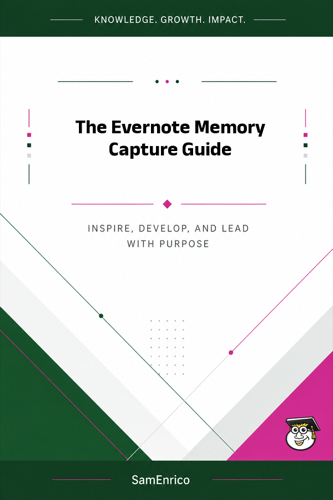
The Evernote Memory Capture Guide eBook
Stores notes, web clips, and images for searchable
by Bader Bo
Stores notes, web clips, and images for searchable recall.
Formats
Free sample
Chapter 1: The Forgetting Epidemic--–- On a Tuesday morning in March, Sarah sat in a glass-walled conference room, her palms pressed flat against a polished mahogany table. Across from her, three investors waited. She had exactly ninety seconds to deliver the numbers that would secure a $2 million seed round for her startup. She had prepared for weeks. She knew the data intimately.
Somewhere in her Evernote account, buried beneath 4,000 notes accumulated over eighteen months, was the exact chart she needed—a quarterly growth projection she had clipped from a Mc Kinsey report, annotated with her own handwriting, and tagged with the word "critical."She couldn't find it.She typed "quarterly growth projection" into search. Nothing. She tried "Mc Kinsey." Thirty-seven results, none correct. She tried the notebook she thought it was in. It wasn't there.
The investors shifted in their seats. One of them glanced at his watch. Sarah felt the heat rise from her collar to her cheeks. She stumbled through an approximation of the numbers, but the confidence was gone. The meeting ended fifteen minutes later with a polite "we'll be in touch." They were not in touch.
The funding went to a competitor. Sarah's startup folded six months later.This is not a story about a software failure. It is a story about a broken relationship with information. Sarah had saved the note. She had done the thing we all believe is sufficient: she had stored it.
But storage, as this book will demonstrate, is not the same as capture. And the difference between those two words is the difference between a $2 million check and a polite rejection.The Anatomy of a Modern Plague Every day, the average knowledge worker saves forty-seven pieces of information. Web articles. Screenshots. PDF attachments.
Email threads. Meeting notes. Voice memos. Photos of whiteboards. Bookmarks.
Tweets. Linked In posts. Slack messages. By the end of a single year, that is more than 17,000 individual items. By the end of a decade, it is nearly 200,000.And we cannot find any of them.The consulting firm Mc Kinsey published a now-famous statistic in 2012 that has only grown more urgent with time: the average knowledge worker spends 1.8 hours per day—nearly ten hours per week—searching for and reconstructing information that already exists but cannot be located.
That is the equivalent of one full workday lost every week. Over a forty-year career, that adds up to nearly eight years of your life spent hunting for things you already saved.Let that sink in. Eight years. Not creating. Not thinking.
Not making decisions. Hunting.But the cost is not merely temporal. It is cognitive and emotional. A 2018 study from the University of California, Irvine found that the frustration of failed information retrieval triggers the same neural pathways as physical pain. When you cannot find a note you know you saved, your brain registers it as a mild injury.
Over time, this accumulated frustration leads to what researchers call "digital hoarding disorder"—a compulsive pattern of saving everything because you cannot trust your ability to find anything.The result is a population of knowledge workers drowning in their own archives, suffering from what I have come to call The Forgetting Epidemic.The Illusion of Saving Why does this happen? The answer lies not in our tools but in our brains. Specifically, it lies in a neurological mechanism that was perfectly adapted for the physical world but catastrophically maladapted for the digital one.When you save a piece of information—whether by bookmarking a webpage, screenshotting a chart, or emailing yourself a document—your brain releases a small burst of dopamine. This is the same neurotransmitter associated with reward and satisfaction. Your brain is essentially congratulating you: "Good job," it says.
"That information is now safe. You don't need to hold it in working memory anymore."This mechanism evolved for a world of physical storage. When you placed a document in a labeled filing cabinet, the act of filing was itself the retrieval system. You knew where it was because you put it there. Your brain could safely forget the content because it remembered the location.But in the digital world, this mechanism becomes a trap.
You click "save," your brain releases dopamine, and then your brain promptly tags that information as "stored externally, no longer needed." The problem is that digital storage is invisible. You cannot see the filing cabinet. You cannot run your finger along the tabs. You have outsourced the memory of where the information lives without building a system for how to retrieve it.This is what I call The Illusion of Saving. It is the belief that the act of storing information is equivalent to the act of making it findable.
It is the single greatest source of productivity loss in the modern knowledge economy.The 1-Second Test Throughout this book, I will ask you to apply a simple diagnostic to every note you save. I call it The 1-Second Test.Close your eyes. Imagine you have just captured a piece of information—a web clip, a photo of a whiteboard, a voice memo. Now imagine it is six months from today. You need to find that exact note.
Can you describe, in one sentence, exactly what you would type into the search bar to find it?If you cannot, you have not captured the information. You have buried it.Let me give you an example. Most people save a web article by clicking the "Clip Article" button and leaving the default title. Six months later, they search for "article about marketing" and receive 400 results. They have failed the 1-Second Test.A person who understands capture, by contrast, would clip the same article, change the title to something specific like "Mc Kinsey B2B Marketing Trends Q3 2024," add tags like #strategy and #client-xyz, and write a one-sentence summary in the note body: "Key insight: mid-market companies are shifting 40% of budgets to social video." Six months later, they search for "Mc Kinsey B2B social video" and find the note in 1.2 seconds.The difference between these two scenarios is not effort.
It is intention. The first person performed storage. The second person performed capture.Storage vs. Capture: A Critical Distinction Because this distinction is the foundation of everything that follows, let me state it as clearly as possible:Storage is the passive act of depositing information into a digital container with no regard for future retrieval. Examples include: saving a PDF to your Downloads folder, bookmarking a webpage without annotation, taking a photo of a whiteboard without organizing it, or forwarding an email to yourself.Capture is the active act of encoding information in a way that prioritizes future searchability.
Examples include: renaming a clipped article with specific keywords, adding a one-sentence summary of why the information matters, applying consistent tags that reflect the note's status or topic, and moving the note to a notebook that corresponds to an active project.Storage asks: "Where can I put this?"Capture asks: "How will I find this?"Storage is reactive. Capture is proactive.Storage takes one second. Capture takes thirty seconds.Storage creates digital landfills. Capture builds a searchable external brain.The thesis of this book is simple and uncompromising: Every note you…
This is the end of the free sample. Get the eBook to keep going. Buy now
About this book
Details
- Author
- Bader Bo
- Publisher
- SamEnrico
- Language
- English
- Genre
- Non-Fiction, Self-Help, Note Taking
- Released
- 2026-06-10
- Pages (approx.)
- 132
- Available as
- eBook, Audiobook

Read better in the ZLOADR app
Your eBooks on your phone or tablet. Sign in with your SamEnrico account and start reading.
More by Bader Bo
 Home Staging for Boomer SellersBader Bo$11.99
 Redis Cloud Failure ProtocolBader Bo$11.99
 Affirmation Breath Counting MethodBader Bo$11.99
 Stress Proof Your Marriage GuideBader Bo$11.99
 The Last Chronometer: When Time Stood StillBader Bo$11.99
 Refund Policy Terms GuideBader Bo$12.99
 Startup Visa Driving License GuideBader Bo$12.99
 Quality Site SpecialistBader Bo$11.99
 Understanding Von Willebrand DiseaseBader Bo$17.99
 How to Start a Blocks for The Manufacture of Smoking Pipes Business (Beginners Guide)Bader Bo$11.99
You may also like
 Hong Kong Handover 1997Dunn Johnnie$11.99
 Zumba For Postnatal Recovery CourseNeal Christian$11.99
 Zumba for BeginnersLadner Nikia$11.99
 YouTube Comment Mining GuideHumes Pandora$12.99
 Worry Box MeditationCarlin Rudy$11.99
 Workplace Stress MeditationNguyen Lynn$11.99
 Workplace Stress and Sleep RepairHawley Ivory$11.99
 Workplace Perfectionism CureDelaney Jeffry$11.99
 Workplace Injustice Anger GuideWallen Isabelle$11.99
 Work Addiction and Burnout LinkGreenwood Ester$11.99
 Women in Yoga and WellnessBeattie Galina$11.99
 Women in Stand Up ComedyChun Evangeline$11.99