
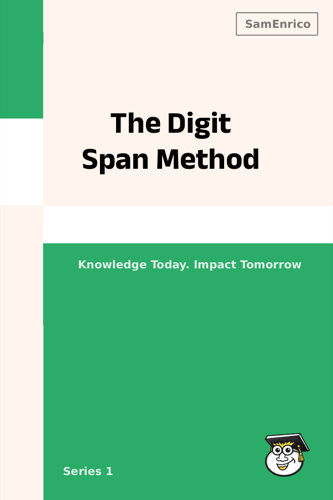
The Digit Span Method eBook
Increase your number recall capacity from seven di
by Sweet Tammi
Increase your number recall capacity from seven digits to twelve or more.
Formats
Free sample
Chapter 1: The Seven-Digit Lie--–- You have been told a lie about your memory, and you have believed it every time you struggled to recall a phone number, a confirmation code, or a password.The lie is this: your brain has a fixed capacity for numbers, and you have reached yours.It feels true, does it not? You try to hold a nine-digit sequence in your head. The first three digits come easily. The next two arrive with effort. By the seventh, you are straining.
By the eighth, the earlier digits begin to blur, to fade, to vanish like footprints in rising tide. You repeat them silently—four, one, nine, two, six—but the loop breaks. Something slips. You are left with fragments, a partial sequence, the humiliating sense that your own mind has betrayed you.You tell yourself: I just don't have a good memory for numbers.That is the lie.The truth—the one that will transform how you think about every digit you will ever encounter—is that your memory is not the problem. Your method is.
And method can be learned.The Man Who Remembered Nothing In 2003, a twenty-three-year-old German law student named Simon Reinhard sat in a quiet room and took a digit span test. A researcher read a sequence of numbers at exactly one digit per second. Simon listened, then repeated them back.Seven digits. He could reliably remember seven digits. On a good day, eight.
Never nine.By every cognitive metric, Simon was unremarkable. He forgot where he put his keys. He lost his train of thought during conversations. He studied for exams with flashcards and still blanked on dates. His friends called him absent-minded.
He agreed.Three years later, Simon Reinhard stood on a stage at the World Memory Championship in London. He listened to a sequence of 240 random digits read aloud at one digit per second. He closed his eyes for thirty seconds. Then he recited every single digit in perfect order, without error, without hesitation, without notes.The audience applauded. Judges verified.
A new world record was set.What happened in those three years? Did Simon undergo brain surgery? Did he discover a hidden genetic mutation? Did he practice for ten thousand hours until his neural architecture rewired itself?No. Simon learned a set of techniques that have existed for over two thousand years.
He learned to chunk. He learned the Major System. He built memory palaces. And he practiced deliberately for twenty minutes a day—not to strengthen his memory, but to bypass it entirely.Here is the part the news articles leave out: after his championship win, Simon took the same digit span test he had failed at age twenty-three. He listened to nine random digits with no time to prepare, no mnemonic allowed.
He repeated them back. He got seven correct.His raw digit span had not changed. It never will. No amount of training can expand the fundamental limit of short-term memory. But his strategic digit span—his ability to use external memory systems to recall far more than his raw capacity could ever hold—had grown from seven to two hundred and forty.Simon Reinhard is not proof that you can train your brain to be a supercomputer.
He is proof that you do not need to.The Magical Number, Revisited In 1956, a Harvard psychologist named George Miller published a paper with a deceptively simple title: The Magical Number Seven, Plus or Minus Two. Miller synthesized decades of research on what he called "the span of absolute judgment"—the number of distinct items a human can hold in conscious awareness at one time.His conclusion: for a wide range of stimuli—tones, colors, spatial positions, and yes, digits—the average adult capacity is between five and nine items. Seven, plus or minus two.This paper became one of the most cited in the history of psychology. It also became one of the most misunderstood. People read Miller and concluded: I can remember seven things.
End of story. But Miller was not describing a prison. He was describing a measurement. And measurements are only meaningful if you understand what they measure.Miller measured raw span. He gave subjects a list of unrelated items—random digits, nonsense syllables, unrelated words—and asked them to repeat the list back immediately, with no time to rehearse, no chance to use strategies, no opportunity to find patterns.
Under those conditions, seven is the limit.But those conditions are not real life. In real life, you are not forced to treat every digit as a stranger. In real life, you have existing knowledge, patterns, and experiences that turn raw data into meaningful chunks. And chunks, as you are about to learn, change everything.The Chunking Breakthrough In 1956—the same year Miller published his paper—a psychologist named Herbert Simon made an observation that should have been headline news. Simon noted that chess masters could look at a complex board for five seconds and then reconstruct it from memory with near-perfect accuracy.
But when the pieces were arranged randomly—in ways that violated the rules of chess—the masters performed no better than beginners.Why? Because the masters were not remembering the positions of thirty-two individual pieces. They were remembering chunks: configurations they had seen thousands of times before. A king's gambit opening. A Sicilian defense formation.
A midgame pawn structure. Each chunk contained multiple pieces, but the brain treated it as a single unit.This is chunking—the process of grouping individual items into larger, meaningful units that your brain can store and retrieve as one.Chunking is not a trick. It is how your brain works. You do it every day without noticing. When you read the word "psychology," you do not process the letters P-S-Y-C-H-O-L-O-G-Y one by one.
You process the word as a single chunk. When you see the number 1492, you do not see four digits. You see "Columbus sailed the ocean blue." A chunk.Here is the critical insight for digit span: the raw limit of short-term memory is seven chunks, not seven digits. If you can turn two digits into one chunk, your effective capacity doubles. If you can turn four digits into one chunk, your capacity quadruples.
This is not magic. This is information compression.Consider the sequence: 1-9-4-5-1-7-7-6-2-0-0-1. Twelve digits. Most people cannot hold twelve raw digits in memory. But break it into chunks: 1945 (end of World War II), 1776 (American independence), 2001 (9/11).
Suddenly, twelve digits become three chunks—well within Miller's limit. Your brain has not changed. Your encoding has.This is the first and most important technique in this book. Before we get to the Major System, before we build a single memory palace, you will learn to chunk. And chunking alone—without any other mnemonic—will raise your strategic digit span from seven to nine or ten.Your Starting Line Before you can improve, you need an honest baseline.
Not the score you wish you had. Not the number you tell yourself you can remember on a good day. Your actual, current, raw digit span, measured under conditions that prohibit any strategy.You will…
This is the end of the free sample. Get the eBook to keep going. Buy now
About this book
Details
- Author
- Sweet Tammi
- Publisher
- SamEnrico
- Language
- English
- Genre
- Non-Fiction, Self-Help
- Released
- 2026-06-06
- Pages (approx.)
- 115
- Available as
- eBook, Audiobook

Read better in the ZLOADR app
Your eBooks on your phone or tablet. Sign in with your SamEnrico account and start reading.
More by Sweet Tammi
 The Shame Inventory MethodSweet Tammi$11.99
 Gambling Addiction and Lottery AddictionSweet Tammi$11.99
 Construction Contract NegotiationSweet Tammi$11.99
 Child Loss and LGBTQ ParentsSweet Tammi$11.99
 HIIT for Substance RecoverySweet Tammi$11.99
 Divorce and Family RelationshipsSweet Tammi$11.99
 Obituary Writing With PurposeSweet Tammi$11.99
 When the Sky Married the Earth: The Love That Shaped the WorldSweet Tammi$11.99
 The Lost Victory of the Ionian Revolt: What If Sparta Had Sided with Persia?Sweet Tammi$11.99
 Growing BaileyaSweet Tammi$11.99
 How to Produce Motor Vehicle Parking CamerasSweet Tammi$11.99
 Co Founder Time Zone ManagementSweet Tammi$12.99
You may also like
 Workplace Stress MeditationNguyen Lynn$11.99
 Volcano Monitoring ScientistCox Alexis$11.99
 The Tech Professional NetAguiar Nevada$11.99
 The Morning Metta RitualCanales Anya$11.99
 The Chunking Memory TechniqueClanton Hyacinth$11.99
 The Beginner Mistake FixAmmons Cassondra$11.99
 Surrendering to What IsGrimm Reatha$11.99
 Self Hypnosis for Fear of FireBillups Eli$11.99
 Road Rage for Professional DriversBrackett Janise$11.99
 Psychiatric Ward Nurse StressDunning Wyatt$11.99
 Observation vs Evaluation NVCTimmons Alda$11.99
 Networking for Nonprofit ProfessionalsPoole Jesse$11.99