
Non-FictionSelf-HelpMemory Training
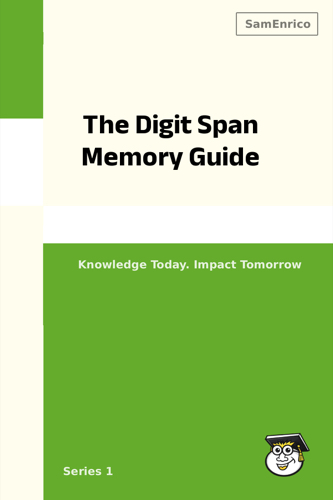
The Digit Span Memory Guide eBook
Increases number of digits you can hold and manipu
Increases number of digits you can hold and manipulate.
Formats
Free sample
Chapter 1: The Seven-Second Panic--–- The phone rang at 11:47 on a Tuesday morning. You didn’t recognize the number, but you answered anyway. It was your bank’s fraud department. The polite automated voice asked you to enter your sixteen-digit card number, followed by your three-digit CVV, followed by the last four digits of your Social Security number. You fumbled for your wallet.
You repeated the first four digits to yourself, then glanced back at the card, then lost your place. The line went silent. Then the voice said, “I’m sorry, we didn’t catch that. Please try again.” Your heart rate climbed. Your palms felt slick.
By the third attempt, the call disconnected. You were locked out of your account.That moment—the cold wash of cognitive failure when numbers slip through your mental fingers—has a name. Call it the seven-second panic. It happens when you try to hold just a few digits in your head, and they dissolve like morning frost. It happens when someone gives you a two-factor authentication code and you close the app to type it in, only to realize the code has vanished.
It happens when you repeat a phone number to yourself while walking to the phone, and by the time you reach the keypad, all you remember is the area code and a vague sense of failure.This chapter is not about making you feel bad. Quite the opposite. It is about giving a name and a structure to something almost everyone experiences but almost no one understands. The seven-second panic is not a sign of a bad memory. It is not early dementia.
It is not a character flaw. It is the predictable, measurable, and remarkably trainable behavior of a system called working memory. Once you understand how that system works—and more importantly, why it has a low ceiling by default—you can begin to raise that ceiling. By the end of this book, the seven-second panic will become a distant memory. In its place will be calm, deliberate control over digits that used to make you anxious.But first, we need to measure where you are starting from.The Smallest Test That Feels Huge Before we talk about theory, let’s talk about data.
You are going to take a digit span test. Do not worry. This is not an IQ test. It is not a graded exam. No one will see your score except you.
The purpose is simply to establish a baseline so that thirty days from now, when you have doubled or tripled your span, you can look back with evidence of real, measurable improvement.Here is how it works. Read the following sequence of digits at a steady pace—approximately one digit per second. Do not write them down. Do not repeat them out loud more than once. Simply read them, then close your eyes or look away, and try to recall the sequence in the exact order.Sequence A: 4 – 9 – 2 – 7 – 1Did you get all five?
Most people do. Five digits is comfortable. It feels like holding a small stone in your palm. Now try Sequence B:Sequence B: 6 – 3 – 8 – 5 – 2 – 7 – 4Seven digits. This is where many people begin to feel a faint strain.
You might have gotten them all, but you had to concentrate. Now try Sequence C:Sequence C: 5 – 9 – 2 – 8 – 4 – 7 – 1 – 3 – 6Nine digits. If you are like the vast majority of adults, you missed at least one. Perhaps you swapped the 8 and the 4, or you recalled the first five correctly and then the last four blurred together. That is not a failure.
That is a fingerprint of human working memory architecture.Your longest correct sequence length—the maximum number of digits you can recall without error—is your current digit span. For most adults, that number is between five and nine. The average hovers around seven. That number, seven, is not arbitrary. It has a name, a history, and a deeply misleading reputation.The Magical Number That Isn’t Magic In 1956, a cognitive psychologist named George Miller published one of the most famous papers in the history of psychology.
Its title was “The Magical Number Seven, Plus or Minus Two: Some Limits on Our Capacity for Processing Information.” Miller argued that the human ability to process information in immediate memory is bounded by a narrow window: most people can hold roughly seven items at once, give or take two.That paper changed the field. For decades, “seven plus or minus two” was taught as a hard biological limit. Students memorized it. Textbooks repeated it. Even today, if you ask a neuroscientist about working memory capacity, they are likely to cite Miller.
But here is what most people miss: Miller himself was not entirely serious about the magic. The number seven appeared so often in his experiments that he found it almost spooky, but he never claimed it was a fixed ceiling. He called it “a range” and noted that the true limit depends entirely on what you mean by an “item.”This is the most important sentence in this chapter: the limit of seven digits is not a limit of memory. It is a limit of how you define a “digit.”Let me explain. When you see the sequence “1 – 9 – 4 – 5,” you are processing four separate items.
That uses four slots of your working memory. But when someone who knows history sees “1945,” they process a single item: the end of World War II. That uses one slot. The raw digits are identical. The cognitive load is radically different.
The limit of seven plus or minus two applies to items, not to digits. If you can turn ten digits into two items, your memory span effectively becomes ten digits while still respecting Miller’s law.This is not a trick. This is how expert memory works. This is how people memorize hundreds of digits in competition. This is how you will go from seven digits to thirty.
You are not expanding your working memory’s biological capacity—because that capacity is largely fixed. You are learning to compress more information into each item. You are learning to change the resolution of your mental camera.Storage Versus Manipulation: The Hidden Distinction Most people assume that remembering digits is a single skill. You either hold them or you don’t. But cognitive science draws a sharp line between two different abilities, and confusing them is one of the main reasons people feel stuck.Storage is the ability to hold digits passively, like a shelf holding books.
If someone reads you a phone number and you can repeat it back in the same order without changing anything, that is storage. It is important, but it is also the simpler of the two skills.Manipulation is the ability to hold digits while doing something to them—reversing the order, sorting them low to high, adding or subtracting values, or recalling every other digit. Manipulation is harder because it requires the central executive part of your brain to manage two tasks at once: maintaining the digits and transforming them.Why does this distinction matter? Because most people train storage and ignore manipulation. They drill themselves on forward digit spans, feel frustrated when improvement stalls, and conclude that…
This is the end of the free sample. Get the eBook to keep going. Buy now
About this book
Details
- Author
- Miranda Agustina
- Publisher
- SamEnrico
- Language
- English
- Genre
- Non-Fiction, Self-Help, Memory Training
- Released
- 2026-06-08
- Pages (approx.)
- 129
- Available as
- eBook, Audiobook

Read better in the ZLOADR app
Your eBooks on your phone or tablet. Sign in with your SamEnrico account and start reading.
More by Miranda Agustina
 Empathy For Birth TraumaMiranda Agustina$11.99
 ED in Young MenMiranda Agustina$11.99
 The Parent Anger and MarriageMiranda Agustina$11.99
 Black Garbage Bag BelongingsMiranda Agustina$11.99
 The Last Broadcast: The Mysterious Signal from IcarusMiranda Agustina$11.99
 The Breeder's Guide to Oxford SheepMiranda Agustina$11.99
 Industry Awards for PRMiranda Agustina$12.99
 Minority Firm State ContractingMiranda Agustina$12.99
 A Beginners Guide to Happy Families (Volume 1)Miranda Agustina$11.99
 Molecular BiologistMiranda Agustina$11.99
You may also like
 Hong Kong Handover 1997Dunn Johnnie$11.99
 Zumba For Postnatal Recovery CourseNeal Christian$11.99
 Zumba for BeginnersLadner Nikia$11.99
 YouTube Comment Mining GuideHumes Pandora$12.99
 Worry Box MeditationCarlin Rudy$11.99
 Workplace Stress MeditationNguyen Lynn$11.99
 Workplace Stress and Sleep RepairHawley Ivory$11.99
 Workplace Perfectionism CureDelaney Jeffry$11.99
 Workplace Injustice Anger GuideWallen Isabelle$11.99
 Work Addiction and Burnout LinkGreenwood Ester$11.99
 Women in Yoga and WellnessBeattie Galina$11.99
 Women in Stand Up ComedyChun Evangeline$11.99