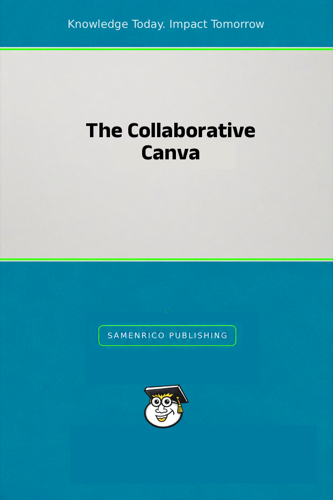
The Collaborative Canva eBook
Visual team whiteboard for mapping creative projec
Visual team whiteboard for mapping creative projects and ideas.
Formats
Free sample
Chapter 1: The $47,000 Mistake--–- Every Monday morning, in offices around the world, a ritual unfolds. A project manager opens a slide deck. She has spent six hours on it—aligning fonts, crafting bullet points, embedding charts. She clicks “Present.” Twenty-three people stare at a screen. Three are checking email.
Two are on Slack. One is physically present but mentally cataloguing their grocery list. After thirty minutes, she asks, “Any questions?” Silence. Then someone says, “Can you send the slides?” The meeting ends. The project does not move forward.
No one can remember what was decided. By Wednesday, the team has reversed two of the decisions made on Monday. By Friday, they are running in six different directions.This is not a failure of effort. It is a failure of medium.The question this book poses is uncomfortable but urgent: What if your team’s biggest problem is not a lack of talent, unclear strategy, or insufficient budget—but a stubborn, invisible addiction to text?The Conspiracy of the Document For the past three decades, the corporate world has operated under an unspoken assumption: that professional communication means documented communication. Memos.
Email threads. Slide decks. Spreadsheets. Project charters. Requirements documents.
Meeting minutes. Each of these artifacts is linear, text-heavy, and sequential. They are designed for transmission—sending information from one person to another—but they are terrible at collaboration, the messy, non-linear, emergent process of building shared understanding.Consider how a creative project actually unfolds. A team gathers to map a new product launch. Ideas bounce.
Someone says something half-formed that sparks a completely different thought in a colleague. A sketch on a napkin becomes a breakthrough. A question asked at 2:00 PM changes the direction of work at 4:00 PM. This process is not linear. It is a web.
It is recursive. It is alive.Now compare that to how most teams document that process. A project manager types a status report in a Word document. A designer attaches a PDF. A developer comments on a Jira ticket.
The marketing lead sends an email with “final final v3” in the subject line. Each of these artifacts captures a frozen moment in time. By the time they are read, the context has shifted. The conversation has moved on. The document is already a fossil.This is the Complexity Gap—the space between what a team knows together (tacit knowledge, shared context, unspoken assumptions) and what they can successfully explain in a linear document.
The gap widens as projects become more creative, more cross-functional, and more uncertain. And here is the cruel irony: when the gap widens, teams typically respond by producing more text. More emails. More slides. More meeting minutes.
They mistake documentation for communication. They mistake volume for clarity.What the Research Actually Says The evidence against text-only communication is not anecdotal. It is robust, replicated, and largely ignored.The Picture Superiority Effect is among the most well-established findings in cognitive psychology. First documented by Allan Paivio in the 1970s and replicated in hundreds of studies since, the effect is simple: people remember information significantly better when it is presented as images rather than words. The numbers are striking.
After three days, people remember approximately 10 percent of information presented through text alone. When the same information is presented through text and relevant visuals, retention jumps to 65 percent.Let that sink in. A 55-point difference.This is not because people are “visual learners” (a concept that has been largely debunked; nearly everyone learns better with visuals). It is because the human brain processes images differently than text. Text is sequential.
The brain must decode each word, hold it in working memory, and assemble meaning over time. Images are simultaneous. The brain processes shape, color, spatial relationships, and meaning all at once. One is a slow assembly line. The other is an instantaneous gestalt.Yet most business communication continues to privilege the slower, less effective medium.A 2021 study from the MIT Sloan School of Management examined decision-making quality in product development teams.
Researchers found that teams who used visual mapping tools (whiteboards, diagrams, journey maps) made decisions 23 percent faster and had 31 percent higher alignment on those decisions three weeks later compared to teams who used text-only documents. The visual teams also reported higher psychological safety—a finding we will return to in Chapter 2.At the Stanford d.school, researchers have documented what they call the “Slide Deck Illusion.” Teams who present their work in polished slide decks believe they have achieved alignment because the slides look finished and professional. But when those same teams are asked to execute the plan, misalignments emerge constantly. The slides created a false consensus. Rough sketches and whiteboard photos, which look unfinished, paradoxically generate more honest feedback and earlier detection of misunderstandings.The lesson is uncomfortable: polish is the enemy of clarity.The Meeting Autopsy: A Diagnostic Tool Before we go any further, I want you to perform a quick diagnosis.
Think about the last meeting on your calendar that felt like a waste of time. Not a disaster—just the quiet, draining kind where nothing really happened.Now ask yourself three questions:Question 1: Was the primary artifact of that meeting a text-based document (slide deck, memo, spreadsheet, email thread)?Question 2: After the meeting, could every attendee summarize the decisions made and the next actions assigned in two sentences or less?Question 3: One week later, were those actions completed without confusion or rework?If you answered “yes” to Question 1 and “no” to either Question 2 or 3, you have experienced what I call a text failure—a breakdown caused not by bad facilitation or unclear goals, but by the inherent limitations of the medium itself.Text failures are everywhere. They are the meetings where everyone nods along but no one agrees. The email threads that grow to forty messages without resolution. The slide decks that are “shared for feedback” and then never opened.
The project charters that are signed and then ignored.Text failures are distinct from process failures (where the meeting structure was flawed) and purpose failures (where no one knew why they were there). We will address those in Chapter 2 with the Missing Block Diagnostic. For now, focus only on the medium.Here is a simple test you can run with your team tomorrow. Take a decision that needs to be made—a real one, not a hypothetical. Capture it in two ways.
First, write a one-page memo. Second, sketch a simple diagram on a whiteboard (physical or digital). Show both to a colleague who was not in the original conversation. Ask them: “What do you understand? What’s missing?
What would you do next?”I have run this exercise with dozens of teams. In nearly every case, the whiteboard sketch produces more accurate understanding, more questions about gaps, and more actionable next steps—in a fraction of the time it took to write the memo.Why Your Brain Loves Whiteboards (Even If You Don't)If text is so problematic, why does it dominate? The answer is institutional inertia and a mistaken belief about professionalism. We have been trained to believe that serious work produces serious documents. A whiteboard sketch feels provisional.
A slide deck feels final. But provisional is exactly what creative work needs during its messy middle stages.The digital whiteboard—whether…
This is the end of the free sample. Get the eBook to keep going. Buy now
About this book
Details
- Author
- Keith Candance
- Publisher
- SamEnrico
- Language
- English
- Genre
- Non-Fiction, Self-Help, Visual Collaboration
- Released
- 2026-06-07
- Pages (approx.)
- 150
- Available as
- eBook, Audiobook

Read better in the ZLOADR app
Your eBooks on your phone or tablet. Sign in with your SamEnrico account and start reading.
More by Keith Candance
 John Lewis MarchKeith Candance$11.99
 Problem Validation Interview ScriptKeith Candance$11.99
 Intermittent Fasting WorkbookKeith Candance$11.99
 Nonprofit Worker Stress GuideKeith Candance$11.99
 Medical Trauma Dream WorkKeith Candance$11.99
 TM for ConsultantsKeith Candance$11.99
 No Days Off Discipline CodeKeith Candance$11.99
 HGH And EpigeneticsKeith Candance$11.99
 The House Always Wins: How a Vegas Showgirl Built a Billion-Dollar EmpireKeith Candance$11.99
 Blacktop Lament: The Phantom of Route 666Keith Candance$11.99
 The Star Map of the Dogon: Ancient Astronomy in MaliKeith Candance$11.99
 The Dancer's Guide to MoonwalkerKeith Candance$11.99