
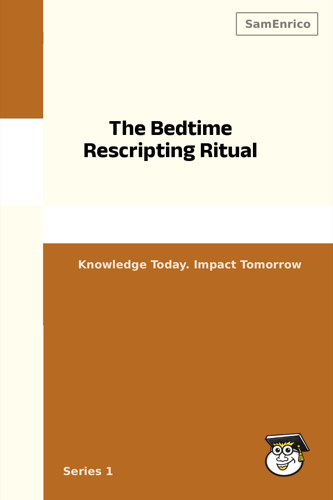
The Bedtime Rescripting Ritual eBook
Performs dream rewriting just before falling aslee
Performs dream rewriting just before falling asleep for direct encoding.
Formats
Free sample
Chapter 1: The Twilight Key...--–- The ceiling of your bedroom is familiar, almost boring. You have traced its cracks a hundred times. But tonight, something shifts. Your thoughts stop making linear sense. An image flashes—a door you have never seen, a face you cannot place, a sensation of falling that feels nothing like fear.
Your body is heavy. Your breathing has slowed. You are not asleep, not quite, but you are no longer fully awake either.This is the twilight key. And in the next few minutes, you are about to discover that this strange, floating state—the one you have ignored your entire life—is actually the most powerful psychological tool you never knew you owned.Most people spend their entire lives treating the moment before sleep as worthless. It is the "shut-down" phase, the time to scroll through a phone, to worry about tomorrow's meeting, to replay the argument from dinner.
We treat the transition from wakefulness to sleep like a hallway we rush through to get to the "real" destination of dreaming. But what if that hallway is the destination? What if the three to five minutes between here and asleep are the only minutes of your day when your brain is actually listening—really listening—without its guards up?This book is built on a single, startling fact: the hypnagogic state—the technical name for this twilight zone between waking and sleeping—is a neurochemical loophole. In these minutes, your brain stops defending its old stories and becomes willing to accept new ones. Not just willing.
Eager.If you have ever had a nightmare that returns again and again, like a movie someone forces you to watch every night, you have felt the cost of this loophole being used against you. Your brain, in its twilight vulnerability, accepted a terrifying narrative once, and it has been replaying it ever since. But here is the truth no one tells you: the same door that let the nightmare in can let a new story in instead.This chapter is your first step through that door.The Three Minutes That Shape Your Night Before we go any further, take a moment to think about your average bedtime. You get into bed. Maybe you read.
Maybe you watch something. You turn off the light. And then—what? For most people, there is a blank space between "lights off" and "asleep." That blank space is not empty. It is full of neurological activity so specific, so predictable, and so exploitable that sleep scientists have given it its own name, its own brainwave signature, and its own set of rules.The hypnagogic state was first described in the 19th century by a French researcher named Alfred Maury, who noticed that the images appearing just before sleep felt different from both waking imagination and full dreaming.
But it took modern neuroimaging to understand why. When you are fully awake, your brain operates primarily in the beta wave range (13–30 Hz). This is the frequency of problem-solving, critical thinking, and—crucially—reality testing. Your prefrontal cortex, the part of your brain just behind your forehead, is constantly asking: Does this make sense? Is this real?
Should I believe this?That internal skeptic is useful during the day. It stops you from believing every advertisement, every fear, every worst-case scenario. But at night, that same skeptic is the enemy of change. Because if you try to suggest a new ending to your nightmare while your prefrontal cortex is fully online, your brain will reject it. That is not how the dream goes, your waking mind will say.
You are just making things up. This is silly.The hypnagogic state is the moment your prefrontal cortex takes a break.As you transition from wakefulness to sleep, your brain shifts from beta waves to alpha waves (8–12 Hz), the frequency of relaxed wakefulness, and then into theta waves (4–8 Hz). Theta waves are the brain's creativity and memory-encoding frequency. They are present during deep meditation, daydreaming, and the moments just before sleep. But here is what most books get wrong: theta waves alone do not create suggestibility.
What creates suggestibility is the combination of theta waves plus reduced prefrontal cortex activity. Your brain is producing the waves of deep creativity, but the part that says "that is impossible" has temporarily lowered its volume.This is not a metaphor. Functional MRI studies show that during the hypnagogic state, blood flow to the dorsolateral prefrontal cortex—the region responsible for reality monitoring—drops by approximately 30–40%. At the same time, activity in the amygdala (fear processing) and hippocampus (memory encoding) remains high. The result is a brain that feels emotions strongly but questions them weakly.In plain English: during the twilight key, your brain accepts new stories almost as easily as it accepts real memories.I say "almost" deliberately, because the original version of this book made a claim that needed correcting.
Your brain does not completely confuse imagination and reality, even in the hypnagogic state. You will still know, somewhere in your sleeping mind, that you are dreaming. The difference is that the emotional weight of an imagined event becomes indistinguishable from the emotional weight of a real one. If you visualize a monster dissolving into dust while in theta state, your amygdala will respond as if that dissolution actually happened. The fear tag attached to that memory will begin to loosen.That is the mechanism.
That is the key. And it is the foundation of every technique in this book.The Gateway Check: How to Know You Are There Knowing about the hypnagogic state is useless if you cannot recognize it when it arrives. Most people drift through this window every single night without ever noticing. They are too busy worrying, scrolling, or simply waiting for sleep to take them. But once you learn to recognize the signs, you can begin to use the window intentionally.The hypnagogic state announces itself through three reliable signals.
Not everyone experiences all three, but most people experience at least two.Signal One: Hypnagogic Imagery. This is the most famous sign. You begin to see fleeting images that are not voluntarily produced. They might be faces, landscapes, geometric patterns, or fragments of scenes. They last only a second or two before dissolving.
Critically, you are still aware that you are awake—this is not dreaming yet. If you try to hold onto the image, it usually vanishes. The skill is to notice it without grasping.Signal Two: The Floating Sensation. Many people describe a feeling of limb heaviness combined with a subtle sense of drifting or rocking. Your body feels as if it is sinking into the mattress, but your awareness feels slightly detached.
Some people experience a brief sensation of falling—this is normal and harmless, caused by the brain's vestibular system transitioning to sleep mode.Signal Three: Altered Breathing. Without any conscious effort, your breathing becomes slower and more diaphragmatic. The pause between exhale and inhale lengthens. If you are paying attention, you might notice that your breath feels as if it is happening to you rather than by you.These three signals are your entry cues. The moment you notice any of them…
This is the end of the free sample. Get the eBook to keep going. Buy now
About this book
Details
- Author
- Negrete America
- Publisher
- SamEnrico
- Language
- English
- Genre
- Non-Fiction, Self-Help, Sleep Hygiene
- Released
- 2026-06-07
- Pages (approx.)
- 137
- Available as
- eBook, Audiobook

Read better in the ZLOADR app
Your eBooks on your phone or tablet. Sign in with your SamEnrico account and start reading.
More by Negrete America
 Cross Platform Reputation SyncNegrete America$11.99
 Immigrant Mom EntrepreneurNegrete America$11.99
 Wireless Mic TechniqueNegrete America$11.99
 Social Support Resilience GuideNegrete America$11.99
 The Post Hypnotic TriggerNegrete America$11.99
 Doe Network New Technology 2025Negrete America$11.99
 Breast Lumps GuideNegrete America$11.99
 Whispers of the Marid: The Djinn Who Commanded the SeaNegrete America$11.99
 The Knightly Games: How Medieval Tournaments Forged the Spirit of the OlympicsNegrete America$11.99
 How to Produce Nutrition BarsNegrete America$11.99
 Ghana Dropshipping Competitor GuideNegrete America$12.99
 Philippines Internet Backup PlanningNegrete America$12.99
You may also like
 The Chronic Pain Sleep MeditationNiles Buster$11.99
 Sugar Addiction and Sleep RecoveryDozier Debora$11.99
 Sleep Recovery for WorkersSwain Joaquin$11.99
 Sleep Hygiene Recall PlanFoote Jovan$11.99
 Sleep For Success GuideValles Gayle$11.99
 Benzo Recovery Sleep And Serenity GuideMusgrove Kam$11.99
 Sleep for Caregivers GuidePatterson Cecilia$11.99
 Self Hypnosis For Sleep Trance GuideLawler Reva$11.99
 Opioid Recovery Sleep Hygiene ManualLaporte Anjanette$11.99
 Job Loss Sleep Recovery GuideGage Annett$11.99
 Discussing Sleep Divorce ArrangementBull Vannesa$11.99
 Breath Before Sleep MeditationSchiller Long$11.99