
Non-FictionSelf-HelpSelf Esteem
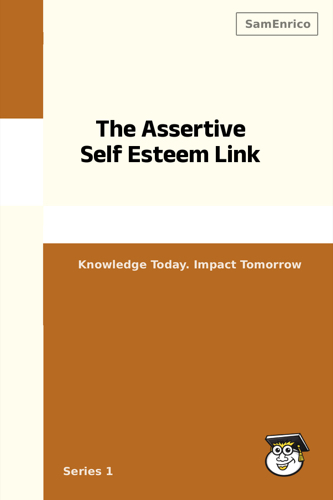
The Assertive Self Esteem Link eBook
Build confidence to support assertive rather than
Build confidence to support assertive rather than aggressive or passive styles.
Formats
Free sample
Chapter 1: The Quiet That Kills--–- Every morning for the past eleven years, Margaret has woken up at 5:47 AM. Not because she needs to. Not because she enjoys the quiet. But because if she stays in bed any longer, her husband will sigh—that particular sigh that lands somewhere between disappointment and impatience—and she has built her entire life around avoiding that sound. She makes his coffee at 6:15, exactly two sugars, stirred for precisely eight seconds.
She packs his lunch. She lays out his pills. She does this even on the days when her own back spasms make standing at the counter feel like a form of torture. And then she smiles, kisses his cheek, and says, "Have a good day, honey." What she wants to say is: "I am exhausted. I am in pain.
And I would like, just once, for you to make your own coffee." But she doesn't. Because Margaret has learned, over sixty-two years of being a good woman, a good wife, a good mother, a good employee, that silence is the price of belonging. And she is not alone.Margaret is an invention, but she is also millions of people. She is the executive who nods along to a decision she knows will bankrupt her department because she doesn't want to seem difficult. She is the teenager who laughs along with the joke about her own body because disagreeing would mean losing her seat at the lunch table.
She is the new father who tells his boss, "No problem at all," when asked to work through his child's fever, because admitting limitation feels like admitting failure. And she is you, reading this sentence, already cataloging the places where your own voice has gone missing.This book is not about becoming a jerk. It is not about learning clever comebacks or domination tactics or the kind of "assertiveness" that leaves other people feeling smaller so you can feel bigger. Those approaches are not assertiveness at all. They are aggression wearing a cheap disguise.
And they fail—not slowly, not quietly, but spectacularly and inevitably. What this book is about is something far more radical and far more difficult: learning to stand firmly in your own dignity without trampling anyone else's. That is the Assertive Self-Esteem Link. It is the recognition that you cannot sustainably stand up for yourself until you genuinely believe you are worth standing up for. And that belief cannot be faked.
It cannot be scripted. It must be built, brick by brick, from the ground up.Before we build, however, we must survey the damage. This chapter is an excavation. We are going to dig into the foundations of your current behavioral patterns—the ones that may have kept you safe in the past but are now costing you far more than you realize. We will define the three core styles of communication that every psychologist who studies this terrain agrees upon.
We will dismantle two seductive illusions that keep people trapped in passivity and aggression for decades. And we will end with a diagnostic tool—a clinically-informed quiz—that will give you a personalized baseline for the rest of this book. By the time you finish this chapter, you will not have solved your assertiveness challenges. But you will, for perhaps the first time, see them clearly.The Three Faces of Response Every human interaction involves a negotiation of needs. Yours and theirs.
The question is never whether you will respond to a conflict, a request, or a challenge. The question is always which of three fundamental patterns you will default to. Psychologists have studied these patterns for nearly a century, across cultures, genders, and contexts, and the taxonomy has proven remarkably stable. Let us name them plainly.The Doormat (Passive Style)The passive communicator has forgotten—or perhaps never learned—that their needs matter as much as anyone else's. When a conflict arises, the Doormat's instinct is to fold.
To apologize. To shrink. To say "it's fine" when it is not fine, to agree when they disagree, to stay when they desperately want to leave. The Doormat operates from a deep, often unconscious belief system: If I am small enough, no one will attack me. If I need nothing, no one can disappoint me.
If I never say no, no one will reject me.Of course, this belief system is a lie. But it is a seductive lie because it offers the illusion of safety. The Doormat tells herself that she is keeping the peace, that she is being kind, that she is the reasonable one in a world full of unreasonable demands. She is none of these things. She is avoiding.
And avoidance, when it becomes a lifestyle, is its own form of violence—not against others, but against the self.Consider the physiology of the Doormat. When a passive person suppresses their own voice, they are not calmly choosing silence. They are fighting a war inside their own body. The heart rate elevates. Cortisol—the stress hormone that, over time, degrades everything from immune function to memory—floods the system.
The jaw clenches. The shoulders rise toward the ears. The person may smile, because they have learned that smiling disarms, but underneath that smile is a nervous system screaming for release. This is not peace. This is a hostage situation where you are both the hostage and the hostage-taker.The long-term costs of passivity are well-documented and devastating.
Chronic passive behavior correlates with higher rates of depression, anxiety disorders, autoimmune conditions, and even certain cancers—not because passivity causes disease directly, but because the physiological stress of constant self-suppression degrades the body's ability to repair itself. The Doormat does not explode in a single dramatic moment, typically. She crumbles over decades, one swallowed word at a time.The Steamroller (Aggressive Style)At the opposite end of the continuum sits the Steamroller. Where the Doormat collapses inward, the Steamroller expands outward—crushing boundaries, overriding objections, and treating every interaction as a zero-sum game where someone wins and someone loses. The Steamroller will never be the loser.
Or so they tell themselves.Aggression comes in two distinct forms, and understanding this distinction is crucial for both recognizing it in others and rooting it out in ourselves. The first form is predatory aggression—the cold, calculated use of dominance to achieve outcomes. This is the boss who publicly humiliates a subordinate to motivate the rest of the team. The partner who withholds affection as punishment. The friend who turns every conversation into a competition.
Predatory aggression is strategic. It is chosen. And it is the closest thing to pure malice that this book will discuss.The second form is defensive aggression—and this one is far more common, far more隐蔽, and far more likely to be hiding inside the very people who consider themselves passive. Defensive aggression is what happens when a Doormat finally breaks. It is the explosion after years of silence.
The screaming fit after decades of swallowing. The slammed door after a lifetime of being told to be reasonable. Defensive aggression is not a choice, in the moment; it is a convulsion. And it leaves the person who…
This is the end of the free sample. Get the eBook to keep going. Buy now
About this book
Details
- Author
- Millard Allene
- Publisher
- SamEnrico
- Language
- English
- Genre
- Non-Fiction, Self-Help, Self Esteem
- Released
- 2026-06-06
- Pages (approx.)
- 129
- Available as
- eBook, Audiobook

Read better in the ZLOADR app
Your eBooks on your phone or tablet. Sign in with your SamEnrico account and start reading.
More by Millard Allene
 Sexual Abuse Dream Healing GuideMillard Allene$11.99
 Napoleon's Egyptian Institute Science CourseMillard Allene$11.99
 Emerson Fittipaldi Young ChampMillard Allene$11.99
 The Major System for PalacesMillard Allene$11.99
 The Vanishing Agent: The First Spy Who DisappearedMillard Allene$11.99
 Chinese Supplier Deadline GuideMillard Allene$12.99
 Writing Samples for PhD AppsMillard Allene$12.99
 Understanding SynechiaMillard Allene$17.99
 Geranium HarvestingMillard Allene$11.99
 How to Start a Mussel Production, Freshwater Business (Beginners Guide)Millard Allene$11.99
You may also like
 Hong Kong Handover 1997Dunn Johnnie$11.99
 Zumba For Postnatal Recovery CourseNeal Christian$11.99
 Zumba for BeginnersLadner Nikia$11.99
 YouTube Comment Mining GuideHumes Pandora$12.99
 Worry Box MeditationCarlin Rudy$11.99
 Workplace Stress MeditationNguyen Lynn$11.99
 Workplace Stress and Sleep RepairHawley Ivory$11.99
 Workplace Perfectionism CureDelaney Jeffry$11.99
 Workplace Injustice Anger GuideWallen Isabelle$11.99
 Work Addiction and Burnout LinkGreenwood Ester$11.99
 Women in Yoga and WellnessBeattie Galina$11.99
 Women in Stand Up ComedyChun Evangeline$11.99