
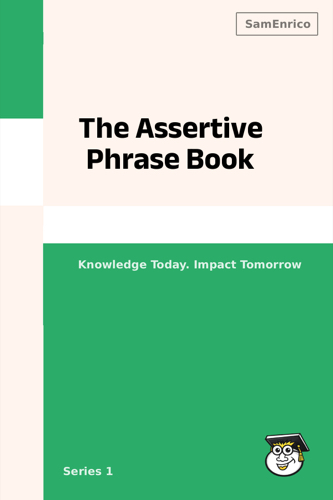
The Assertive Phrase Book eBook
Use scripts to replace aggressive language in diff
by Hazel Lissa
Use scripts to replace aggressive language in difficult conversations.
Formats
Free sample
Chapter 1: The Three-Second Window...--–- You are about to say something you will regret. You cannot feel it yet, but the words are already forming. Your chest is tightening. Your jaw is clenching. Your voice is about to get louder or sharper or colder.
And in three seconds, you will watch the person across from you shut down, fight back, or walk away. You will spend the next hour replaying what you said. You will wish you could take it back. But you cannot. The words are already out.This is the "blurt and regret" cycle.
It is the single most common reason people feel out of control in difficult conversations. And it is not a personality flaw. It is not a sign that you are "bad at communication." It is a neurological pattern that you have unknowingly trained into your brain over years of practice. The good news is that patterns can be untrained. But first, you need to understand what is actually happening inside your body and mind during those three seconds.Let us be precise about the timeline, because precision matters.
You have probably heard that you have three to five seconds between a trigger and an outburst. This is incorrect. The actual neuroscience is both more alarming and more hopeful. Emotional reactions occur in approximately ninety milliseconds. That is ninety one-thousandths of a second.
That is faster than you can consciously perceive. By the time you realize you have been triggered, the emotional reaction has already happened.Here is what you actually have: you have three to five seconds to intervene before the outburst becomes automatic. The trigger happens instantly. The emotional reaction happens almost instantly. But the response—the words that leave your mouth, the tone you use, the volume you choose—those take three to five seconds to become locked in.
Those seconds are your window of agency. They are the difference between a life where you constantly apologize for what you said and a life where you say what you mean the first time.This chapter will teach you to see that window, to widen it, and to use it. You will learn the physical signals that tell you the window is open. You will learn two scripts that buy you time when you need it most. And you will learn why walking away from a heated conversation is not weakness but tactical intelligence.
By the end of this chapter, you will have a concrete, repeatable method for interrupting the blurt and regret cycle before it starts.The Physiology of Regret Before you can interrupt the cycle, you need to recognize when you are inside it. Most people do not notice they are escalating until they have already escalated. They feel the anger or frustration, but they mistake it for justification. "I am angry because they are wrong," they tell themselves. "My volume is rising because they are not listening." This is the brain's most clever trick: it disguises loss of control as righteous certainty.The truth is that your body knows you are losing control before your mind does.
Your conscious brain is busy constructing arguments and planning what to say next. But your nervous system is sending signals that you can learn to read. These are the early warning signs of rising aggression. They appear during the three- to five-second window. They are not weaknesses.
They are not signs that you are "too emotional." They are data. And data is power.The seven most common physiological signals are these:First, a tightness in your chest. Not pain, but a sense of compression, as if something is sitting on your sternum. This is your sympathetic nervous system preparing for a perceived threat. Your body does not know the difference between a physical attack and a verbal insult.
It treats both the same way.Second, flushed skin, particularly in your face and neck. Blood is rushing to your extremities and your head. You may feel warm or even hot. This is your body redirecting resources away from long-term thinking and toward immediate action.Third, a clenched jaw. You may not realize you are doing it.
Your teeth may be pressing together. Your tongue may be pushing against the roof of your mouth. This is a preparation for speaking loudly or forcefully. It is also a signal that your body is bracing for impact.Fourth, rapid heartbeat. Your heart rate is climbing above its resting baseline.
When it exceeds one hundred beats per minute, your cognitive processing begins to degrade. At one hundred twenty beats per minute, you are in full fight-or-flight mode. Your ability to think creatively, to see nuance, or to remember multiple pieces of information drops significantly.Fifth, shallow breathing. Your breaths are coming from your chest rather than your diaphragm. They are shorter, faster, and higher in your body.
This reduces oxygen flow to your prefrontal cortex—the part of your brain responsible for impulse control and long-term planning. In other words, shallow breathing makes you dumber in the moment.Sixth, tense shoulders. Your trapezius muscles are rising toward your ears. Your posture may be leaning forward. Your body is preparing to strike or defend.
This is not a metaphor; your muscles are literally primed for physical conflict.Seventh, a sudden urge to speak faster. You feel as if you need to get your words out before the other person interrupts or before you lose your nerve. Your sentences get longer. Your pauses get shorter. You stop breathing between phrases.
This is the most dangerous signal because it feels like urgency. But urgency is just speed, and speed is the enemy of clarity.If you recognize even three of these seven signals, you are inside the three-second window. You have not yet said the thing you will regret. But you are close. The next three seconds will determine whether you react or respond.Reacting Versus Responding These two words sound similar, but they describe completely different neurological processes.
Understanding the difference is the single most important distinction in this entire book.Reacting is automatic. It is fast. It is emotional. It is the path of least resistance for your brain. When you react, your amygdala—the threat-detection center of your brain—bypasses your prefrontal cortex and sends signals directly to your motor systems.
This is why reactive statements feel like they come from nowhere. They do not pass through the "think about it" part of your brain. They go straight from trigger to mouth.Reactive statements share common characteristics. They use absolute language like "always" and "never." They attack character rather than behavior. They escalate volume.
They speed up. They feel satisfying in the moment because they release pent-up energy. That satisfaction is the trap. The release feels good for one second. The regret lasts for hours or days.Responding is chosen.
It is slower. It is thoughtful. It requires energy and intention. When you respond, your amygdala sends signals to your prefrontal cortex first. That part of your brain considers options, imagines consequences, and selects the best available choice.
Responding is harder than reacting. It takes practice. It takes attention. But it produces outcomes that do not require repair.Think…
This is the end of the free sample. Get the eBook to keep going. Buy now
About this book
Details
- Author
- Hazel Lissa
- Publisher
- SamEnrico
- Language
- English
- Genre
- Non-Fiction, Self-Help, Scripts
- Released
- 2026-06-10
- Pages (approx.)
- 139
- Available as
- eBook, Audiobook

Read better in the ZLOADR app
Your eBooks on your phone or tablet. Sign in with your SamEnrico account and start reading.
More by Hazel Lissa
 Agency vs In House BenchmarksHazel Lissa$11.99
 Battle Of Waterloo Final Defeat CourseHazel Lissa$11.99
 William J Seymour Azusa StreetHazel Lissa$11.99
 The Operations Manager CreativityHazel Lissa$11.99
 Raven’s Gift: How the World Was Sung Into BeingHazel Lissa$11.99
 Understanding Superior Mesenteric Artery SyndromeHazel Lissa$17.99
 Plastic Neutral Export GuideHazel Lissa$12.99
 Trade Secret Valuation GuideHazel Lissa$12.99
 Email Marketing ManagerHazel Lissa$11.99
 Ultimate Handbook Guide to Ad-dammam : (Saudi Arabia) Travel GuideHazel Lissa$11.99
You may also like
 Hong Kong Handover 1997Dunn Johnnie$11.99
 Zumba For Postnatal Recovery CourseNeal Christian$11.99
 Zumba for BeginnersLadner Nikia$11.99
 YouTube Comment Mining GuideHumes Pandora$12.99
 Worry Box MeditationCarlin Rudy$11.99
 Workplace Stress MeditationNguyen Lynn$11.99
 Workplace Stress and Sleep RepairHawley Ivory$11.99
 Workplace Perfectionism CureDelaney Jeffry$11.99
 Workplace Injustice Anger GuideWallen Isabelle$11.99
 Work Addiction and Burnout LinkGreenwood Ester$11.99
 Women in Yoga and WellnessBeattie Galina$11.99
 Women in Stand Up ComedyChun Evangeline$11.99