
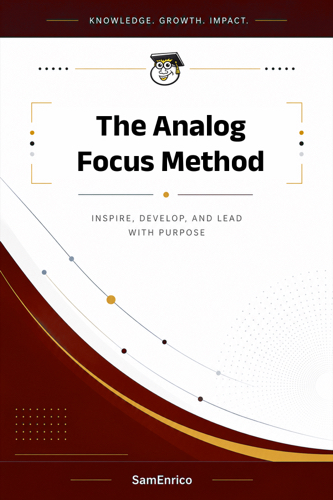
The Analog Focus Method eBook
Go screen free to eliminate digital distractions e
by Pina Silva
Go screen free to eliminate digital distractions entirely.
Formats
Free sample
Chapter 1: The Phantom Buzz...–- You are reading this book for one reason. Not because you lack willpower. Not because you are addicted to your phone in the clinical sense. Not because you are weak, or lazy, or undisciplined. You are reading this book because somewhere in the last ten years, a device that was supposed to serve you has quietly taken up residence in your nervous system.
And you can feel it. That low-grade hum of anxiety when the phone is face-down on the table. That phantom vibration in your thigh pocket when no notification has arrived. That strange, hollow pull in your chest when you reach for the phone and realize you left it in the other room.This chapter is not about why social media is bad. You already know that.
This chapter is about the physical sensation of withdrawal—the sweaty palms, the restless hands, the automatic reach for a slab of glass that offers nothing but the possibility of something. Because until you understand what your body is doing, no amount of screen time limits or app blockers will work. You cannot think your way out of a habit that lives in your fingertips.The Experiment You Did Not Know You Were Running Let us begin with a question. When was the last time you sat in a waiting room, or stood in a grocery line, or stopped at a red light, and did not reach for your phone? Not because you had something urgent to check.
Not because you were expecting an important call. Just because your hand moved on its own, like a reflex, like muscle memory, like the phone was an extension of your arm that had been temporarily misplaced.That reflex is not a habit. It is a conditioned physical response, and it operates below the level of conscious thought. In psychological terms, this is called a "learned physiological reaction," and it is the same mechanism that causes amputees to feel pain in limbs that no longer exist. Your brain has mapped the phone onto your body.
When the phone is not there, your brain experiences a phantom sensation—a buzzing, a tingling, an urge that has no object. You reach for something that is not there because your nervous system has been rewired to expect it.This is not a metaphor. Research on nomophobia—the clinical term for no-mobile-phone phobia—has shown that the separation anxiety triggered by phone removal activates the same neural pathways as separation from a loved one or a physical safety object. Your phone has become what attachment theorists call a "secure base": an object you turn to for comfort, regulation, and orientation. When it is taken away, your body responds as if you have lost something essential.
Your heart rate increases. Your palms sweat. Your breathing becomes shallow. And your hand reaches for your pocket, over and over again, even when you know the phone is not there.The Slot Machine in Your Pocket To understand why your hand reaches for the phone even when you have nothing to check, you need to understand the neuroscience of variable rewards. In the 1950s, psychologist B.F.
Skinner discovered that rats would press a lever more frequently if the reward was unpredictable than if it arrived every single time. A lever that delivered a pellet every ten presses was less compelling than a lever that delivered a pellet randomly, sometimes after one press, sometimes after fifty, sometimes not at all. The uncertainty created obsession.Your phone operates on exactly the same principle. When you check your email, you might find nothing—a dull message from a newsletter, a calendar reminder, a spam filter notification. But sometimes, just sometimes, you find something good: a message from a friend, a like on a post, a piece of news that makes you feel informed or validated.
That "sometimes" is the variable reward. And because you never know which check will deliver the reward, you check again and again and again.But here is what most books miss. The variable reward schedule does not just affect your behavior. It affects your body. The anticipation of a potential reward triggers a dopamine release in your brain's reward pathway, and that dopamine release produces physical sensations: a quickening of the pulse, a tightening in the chest, a subtle shift in posture.
You lean forward. You hold your breath. Your fingers twitch toward the screen. These are not psychological states. They are physiological events.
They happen in your body before you have made any conscious decision to check the phone.This is why telling yourself "I will check my phone less" does not work. You are trying to use reason to override a physical urge that is operating at the level of your autonomic nervous system. It would be like trying to stop your heart from racing by reciting the multiplication table. The urge is not a thought. It is a sensation.
And sensations cannot be argued with. They can only be noticed, tolerated, and eventually retrained.The One-Week Pre-Experiment Before you change anything, you need to know what you are dealing with. Most people have no idea how often they reach for their phone because the reaches have become automatic—they happen in the background of awareness, like breathing or blinking. You do not remember reaching for your phone ten times during a one-hour meeting because each reach lasted only a second and left no trace. But those reaches add up.
And they are not neutral. Each reach is a micro-interruption, a tiny fracture in your attention, a small betrayal of your intention to focus.For the next seven days, you are going to do something that feels strange. You are going to not change your behavior. You are going to keep using your phone exactly as you normally do. The only difference is that you are going to carry a small index card in your back pocket, and every time you feel the urge to check your phone—every single time your hand starts to move toward the device, every time you feel that phantom pull in your chest—you are going to make a tally mark on the card.
You are not going to stop yourself from checking. You are not going to judge yourself for the urge. You are simply going to notice. And you are going to count.Most people who complete this exercise discover that they have between forty and one hundred urges per day. That is an urge every ten to twenty waking minutes.
Some urges are weak—a flicker of curiosity, a half-formed thought about checking the weather. Some urges are strong—a desperate need to see if anyone has responded to a message, a compulsive pull toward the phone that feels almost painful to resist. But whether weak or strong, each urge is a data point. And data, unlike shame, is useful.The Intention Check: Your First Analog Tool The index card you will carry for the next seven days is called the Intention Check. It is a simple tool with a specific purpose: to separate the urge to check your phone from the action of checking it.…
This is the end of the free sample. Get the eBook to keep going. Buy now
About this book
Details
- Author
- Pina Silva
- Publisher
- SamEnrico
- Language
- English
- Genre
- Non-Fiction, Self-Help, Analog
- Released
- 2026-06-07
- Pages (approx.)
- 140
- Available as
- eBook, Audiobook

Read better in the ZLOADR app
Your eBooks on your phone or tablet. Sign in with your SamEnrico account and start reading.
More by Pina Silva
 Musk Risk Tolerance GuidePina Silva$11.99
 Meal Prep for AthletesPina Silva$11.99
 Apathy Root Causes UncoveredPina Silva$11.99
 Parent Marriage After Child LossPina Silva$11.99
 Normandy Paratrooper Night JumpPina Silva$11.99
 IBS Master GuidePina Silva$11.99
 OT Security IncidentsPina Silva$11.99
 The Icebound Gambit: Russia's Frozen Fortress at NarvaPina Silva$11.99
 The Blood Cult of Ballarat: Victorian Australia's Occult Murder PanicPina Silva$11.99
 How to Start a Lysine and Glutamic Acid and Salts Thereof (wholesale) Business (Beginners Guide)Pina Silva$11.99
 A Collector's Handbook to the Ansaldo T22Pina Silva$11.99
 How to Produce Field Hockey SticksPina Silva$11.99
You may also like
 Hong Kong Handover 1997Dunn Johnnie$11.99
 Zumba For Postnatal Recovery CourseNeal Christian$11.99
 Zumba for BeginnersLadner Nikia$11.99
 YouTube Comment Mining GuideHumes Pandora$12.99
 Worry Box MeditationCarlin Rudy$11.99
 Workplace Stress MeditationNguyen Lynn$11.99
 Workplace Stress and Sleep RepairHawley Ivory$11.99
 Workplace Perfectionism CureDelaney Jeffry$11.99
 Workplace Injustice Anger GuideWallen Isabelle$11.99
 Work Addiction and Burnout LinkGreenwood Ester$11.99
 Women in Yoga and WellnessBeattie Galina$11.99
 Women in Stand Up ComedyChun Evangeline$11.99