
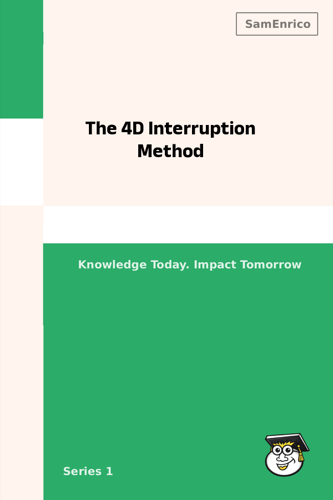
The 4D Interruption Method eBook
Categorizes interruptions as Delete, Defer, Delega
Categorizes interruptions as Delete, Defer, Delegate, or Do and acts accordingly.
Formats
Free sample
Chapter 1: The Cognitive Tax--–- At 7:23 AM, before his feet touched the floor, Mark had already lost. His phone, resting on the nightstand, had been quietly accumulating demands while he slept: forty-seven notifications. Three emails marked "urgent" from colleagues in earlier time zones. Fourteen Slack messages. Sixteen social media alerts.
Five news headlines. Two calendar reminders. Seven assorted pings from apps he had installed for reasons he could no longer remember. And one text from his spouse asking if he remembered to buy coffee.Mark did not remember. He had not remembered anything yet.
It was 7:23 AM.He picked up the phone and began what he would later describe as "just catching up." Forty-seven notifications became forty-seven micro-decisions. Each one required a flicker of attention, a moment of context, a small but real cognitive expenditure. By 7:31 AM, he had processed all forty-seven. He had also forgotten the dream he was having, lost the thread of the morning he had planned, and started the day in a state of mild but persistent reactivity. He was not late.
He was not overwhelmed. He was simply... scattered. And he would remain scattered for the next fourteen hours.This is not a story about Mark. It is a story about you.If you are reading this book, you have experienced some version of Mark's morning.
Perhaps your phone is the first thing you see. Perhaps email is your breakfast. Perhaps you have developed the uneasy sense that your attention no longer belongs to you—that it has been colonized, fragmented, and sold back to you in pieces small enough to swallow without noticing. You are not wrong. And you are not alone.The problem this book solves is simple to state but devastating in its implications: your attention is the most valuable asset you own, and you are giving it away for free to anyone who asks.The Attention Heist You Didn't Notice Let us begin with a question that sounds philosophical but is entirely practical: what do you actually own?You own your house, or you rent it.
You own your car, or you make payments on it. You own your laptop, your phone, your furniture. But these are not the assets that determine the quality of your life. The asset that determines everything—your career trajectory, the depth of your relationships, your capacity for joy, your ability to learn, your freedom from anxiety—is your attention. Where you direct your attention is where you direct your life.And here is the uncomfortable truth that most productivity books dance around: you are not the primary beneficiary of your own attention.
The companies that built your phone, the platforms that send you notifications, the colleagues who email you at midnight, the culture that equates responsiveness with virtue—these forces have a vested interest in keeping your attention fragmented. A fragmented attention is a profitable attention. A fragmented attention clicks on ads. A fragmented attention answers emails within minutes. A fragmented attention confuses busyness with productivity and confuses both with purpose.This is not a conspiracy.
It is a design feature.The late neuroscientist Jaak Panksepp identified seven primary emotional systems in the mammalian brain. Among them is the seeking system—the neural circuitry that drives curiosity, exploration, and the anticipation of reward. This system evolved to help your ancestors find food, water, and mates. It feels good to seek. The anticipation of a reward is often more pleasurable than the reward itself.
And here is where the trouble begins: the seeking system is exquisitely hijackable.Every time your phone buzzes, your brain releases a small pulse of dopamine—not because you have received something valuable, but because you might have. The uncertainty is the drug. The slot machine does not pay out every time; if it did, you would stop playing. The intermittent, unpredictable reward is what keeps you pulling the lever. Your phone is a slot machine.
Your inbox is a slot machine. Your Slack channels are slot machines. And you are the gambler.The average knowledge worker checks email seventy-seven times per day. The average smartphone user touches their phone 2,617 times per day. The average professional will experience approximately 87,000 interruptions this year.
These numbers are not neutral. They represent a steady, ongoing transfer of wealth from your attention to the attention economy. You are not using these tools. These tools are using you.The 20-Minute Lie Perhaps you have heard the statistic: after an interruption, it takes an average of twenty minutes to return to a state of deep focus. This statistic is cited frequently in productivity literature.
It is also consistently misunderstood.The twenty-minute figure comes from research by Gloria Mark at the University of California, Irvine. Her team studied knowledge workers in their natural environments and found that when someone was interrupted, they did not simply resume their previous task. They engaged in a period of "task switching" that involved reorienting to the original goal, recalling where they had left off, and rebuilding the cognitive context that had been shattered. On average, this recovery period lasted about twenty-three minutes.But here is what the statistic does not tell you: the twenty-three minutes is an average. Some interruptions cost five minutes.
Some cost an hour. And critically, the cost scales with the complexity of the interrupted task. If you are interrupted while answering a routine email, the recovery is quick. If you are interrupted in the middle of strategic planning, creative writing, data analysis, or any task requiring what psychologist Mihaly Csikszentmihalyi called "flow," the recovery time can exceed forty minutes. Some tasks are never recovered at all.Let us do the math on your year.If you experience twenty interruptions per day (a conservative estimate for most knowledge workers), and each interruption costs you fifteen minutes of recovery (a conservative estimate given the complexity of most knowledge work), you are losing three hundred minutes per day.
That is five hours. Every day. Over a two hundred-fifty-day working year, that is 1,250 hours—or one hundred fifty-six eight-hour workdays. Nearly half of your working year is being eaten by the gap between interruption and recovery.This is the Cognitive Tax. And you are paying it whether you track it or not.The Cognitive Tax has three components, each more damaging than the last.The first component is direct time loss.
This is the minutes and hours spent switching between tasks. It is the most visible component and the one most productivity advice targets. But it is also the smallest component.The second component is error multiplication. When you switch tasks, your brain does not simply pause one activity and resume another. It carries residual activation from the previous task, like a stone skipping across water.
This residual activation interferes with the new task. Studies show that task switching increases error rates by 40 to 50 percent for complex tasks. You are not just slower when interrupted. You are worse.The third component is the most damaging and the least discussed: depletion. The act of switching tasks is metabolically expensive.
Your brain consumes glucose and oxygen when it reorients. Over the course of a day, repeated switching depletes your cognitive reserves, leaving you with less…
This is the end of the free sample. Get the eBook to keep going. Buy now
About this book
Details
- Author
- Delaney Layne
- Publisher
- SamEnrico
- Language
- English
- Genre
- Non-Fiction, Self-Help, 4D Method
- Released
- 2026-06-07
- Pages (approx.)
- 130
- Available as
- eBook, Audiobook

Read better in the ZLOADR app
Your eBooks on your phone or tablet. Sign in with your SamEnrico account and start reading.
More by Delaney Layne
 Restless Leg Syndrome In Children GuideDelaney Layne$11.99
 Managing Anger With Your BossDelaney Layne$11.99
 NVC For Activism GuideDelaney Layne$11.99
 Hillary Everest Search BodyDelaney Layne$11.99
 Twelve Step Intergroup GuideDelaney Layne$11.99
 Yitzchak Hutner Pachad YitzchakDelaney Layne$11.99
 Shipwreck Raft OrdealDelaney Layne$11.99
 From the Margins to the Mainstream: The Literary Agent Who Redefined Indigenous StorytellingDelaney Layne$11.99
 Echoes of the Ancients: The Medieval Rediscovery of Europe's Lost Cave ArtDelaney Layne$11.99
 The Last Prophet: The Rise and Fall of Marshall Applewhite’s Heaven’s GateDelaney Layne$11.99
 AI Prompts for Compliance AnalysisDelaney Layne$11.99
 The Mineral Guide to ViolariteDelaney Layne$11.99