
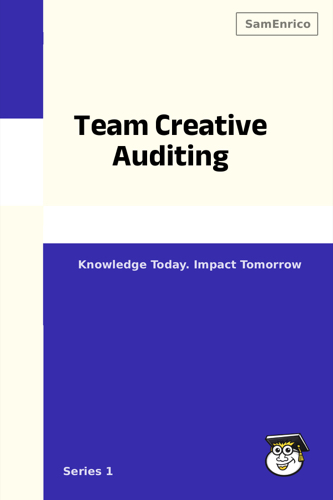
Non-FictionSelf-HelpProcess Auditing
Team Creative Auditing eBook
Reviews past sessions to identify what generated b
by Skaggs Rubin
Reviews past sessions to identify what generated breakthrough moments for replication.
Formats
Free sample
Chapter 1: The Lightning Lie--–- On a Tuesday morning in a glass-walled conference room overlooking the San Francisco Bay, a team of twelve product designers, engineers, and marketing leads sat in stunned silence. They had just spent three hours wrestling with a problem that had defied solution for six months: how to reduce the setup time of their flagship software from forty-five minutes to under five. The whiteboards were covered in sticky notes. The coffee had gone cold twice. And then, at 11:47 AM, according to the timestamp on the recording, a junior designer named Maya said something that changed everything."I don't think this is a software problem," she said, hesitantly.
"I think it's a handoff problem. The software is fine. The way we talk to each other about it is broken."The room went quiet. Not the awkward silence of discomfort, but the electric silence of recognition. A senior engineer leaned forward.
"Say that again," he said. Maya repeated herself. Within fifteen minutes, the team had reframed their entire approach. They stopped trying to fix the code and started mapping the conversational handoffs between sales, implementation, and support. By the end of the week, they had a prototype.
Within a month, average setup time dropped to six minutes.Here is what no one said after that meeting: "Maya is a genius."Here is what everyone actually said: "That came out of nowhere." "It was a lightning strike." "We just got lucky."This book is about why that answer is wrong, why it is expensive, and what you can do instead.The Expensive Myth The myth of the lightning bolt is one of the most persistent and damaging beliefs in modern organizations. It goes like this: creative breakthroughs are random, unpredictable, and reserved for a small number of unusually gifted individuals. You cannot plan for them, you cannot manufacture them, and you certainly cannot audit them. You can only create conditions where they might happen and hope for the best.This myth is pervasive. It appears in the language leaders use when they say "we need more innovation" as if innovation were a resource to be mined.
It appears in performance reviews that reward individual heroism while ignoring the conversational ecosystems that made that heroism possible. It appears in post-mortems that celebrate the outcome but never ask the question that matters most: How did we do that?The cost of this myth is staggering. Teams that believe creativity is random do not bother to study their own breakthroughs. They leave their best ideas on the floor because they cannot remember how they got there. They rely on the same handful of "creative people" for every difficult problem, burning them out while leaving everyone else disengaged.
They repeat the same failed meetings because they have no way of distinguishing between a Hit (a positive outcome achieved by accident) and a true Breakthrough (an insight that can be deconstructed and replicated).This book exists to close that gap.What This Book Is (And What It Is Not)Team Creative Auditing is the systematic process of reviewing past sessions—meetings, projects, sprints, even casual conversations—to identify the specific triggers that led to "Aha!" moments. It draws on research from conversational analysis, neuroscience, organizational psychology, and the study of creative teams across industries. It is not a book about brainstorming techniques, though those appear. It is not a book about design thinking, though the two are compatible. It is a book about retrospective pattern recognition: the discipline of looking backward so you can move forward with intention.The core argument is simple: creativity is not a bolt of lightning.
It is a social artifact. It emerges from specific, identifiable conversational moves—questions, reframes, critiques, and yes, silences—that can be observed, cataloged, and replicated. The goal of this book is to give you the tools to do that observation and cataloging yourself.This is not a theoretical exercise. Every tool in this book has been tested with real teams in real organizations: software companies struggling with product roadmaps, hospital administration teams redesigning patient intake, advertising agencies trying to break out of creative ruts, and even a professional kitchen that wanted to understand why their best menu ideas happened only during dinner service chaos.The Research Foundation The insights in this book rest on three decades of research that has quietly been overturning the conventional wisdom about creativity. Most people believe that creativity comes from unfettered brainstorming—the famous "no bad ideas" rule popularized by advertising executive Alex Osborn in the 1950s.
This belief is not just incomplete; it is often actively counterproductive.A landmark study from Fielding Graduate University analyzed hundreds of creative sessions across technology, healthcare, and education. The researchers coded every conversational turn, looking for patterns that preceded breakthrough moments. Their findings were striking: the most creative sessions were not the ones where everyone politely agreed. They were the ones where participants engaged in what the researchers called "generative critique"—the practice of challenging an idea while simultaneously building on it.This finding has been replicated in multiple contexts. A study of improvisational theater groups found that the most successful scenes emerged not from "yes, and..." alone, but from "yes, and..." combined with specific forms of constraint and resistance.
A study of scientific research teams found that the most productive labs had cultures of "productive friction"—disagreement channeled toward problem-solving rather than personal conflict. And a doctoral dissertation by Romi Boucher introduced the concept of "conversational accomplishment," demonstrating that creativity is not something individuals have but something groups do together through specific, learnable moves.This book synthesizes that research into a practical framework. The references are in the endnotes, but the tools are in these pages.The Breakthrough Scorecard Before we go any further, let me introduce the single most important distinction in this book: the difference between a Hit and a Breakthrough.A Hit is a positive outcome achieved by accident. Your team solves a problem. The product launches successfully.
The campaign resonates. But when you ask how it happened, no one can tell you. The conditions that produced the outcome were not observed, not understood, and therefore cannot be repeated. Hits are frustrating because they feel like progress, but they are actually illusions. They convince you that you know what you are doing when you do not.A Breakthrough is a positive outcome that can be deconstructed into specific triggers and conditions.
You not only solved the problem—you know which conversational move started the chain reaction. You know who was in the room and who spoke to whom in the critical minute before the insight emerged. You know what constraint was active (tight deadline? ridiculous rule? missing resource?).
A Breakthrough is replicable. Not mechanically—you cannot program creativity like a vending machine—but probabilistically. You can increase the odds of future breakthroughs by recreating the conditions of past ones.The Breakthrough Scorecard is the tool that helps teams make this distinction. It is a simple one-page worksheet with six questions:Can you identify the exact moment (within a five-minute window) when the energy shifted?Can you name the specific conversational move that preceded that shift?Can you identify which team members were active in…
This is the end of the free sample. Get the eBook to keep going. Buy now
About this book
Details
- Author
- Skaggs Rubin
- Publisher
- SamEnrico
- Language
- English
- Genre
- Non-Fiction, Self-Help, Process Auditing
- Released
- 2026-06-06
- Pages (approx.)
- 144
- Available as
- eBook, Audiobook

Read better in the ZLOADR app
Your eBooks on your phone or tablet. Sign in with your SamEnrico account and start reading.
More by Skaggs Rubin
 Networking for Real Estate AgentsSkaggs Rubin$11.99
 Witnessing Without ReactingSkaggs Rubin$11.99
 Vegan Zinc Sources GuideSkaggs Rubin$11.99
 Workplace Decision FatigueSkaggs Rubin$11.99
 Morning Breathing ExerciseSkaggs Rubin$11.99
 Fear of Failure in AthletesSkaggs Rubin$11.99
 Anger De escalation with IntoxicatedSkaggs Rubin$11.99
 The Golden Pens of Timbuktu: Scholars Who Lit the WorldSkaggs Rubin$11.99
 The Stolen Heart of Buenos Aires: Love, Betrayal, and a Vanished MasterpieceSkaggs Rubin$11.99
 Service Providers Guide to Furniture Restoration & RefurbishmentSkaggs Rubin$11.99
 Venture Debt Amortization SchedulesSkaggs Rubin$12.99
 Heart Coherence BreathingSkaggs Rubin$12.99
You may also like
 Hong Kong Handover 1997Dunn Johnnie$11.99
 Zumba For Postnatal Recovery CourseNeal Christian$11.99
 Zumba for BeginnersLadner Nikia$11.99
 YouTube Comment Mining GuideHumes Pandora$12.99
 Worry Box MeditationCarlin Rudy$11.99
 Workplace Stress MeditationNguyen Lynn$11.99
 Workplace Stress and Sleep RepairHawley Ivory$11.99
 Workplace Perfectionism CureDelaney Jeffry$11.99
 Workplace Injustice Anger GuideWallen Isabelle$11.99
 Work Addiction and Burnout LinkGreenwood Ester$11.99
 Women in Yoga and WellnessBeattie Galina$11.99
 Women in Stand Up ComedyChun Evangeline$11.99