
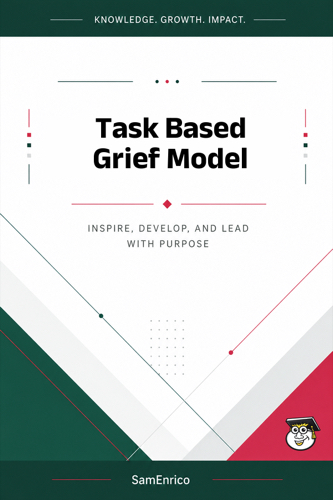
Non-FictionSelf-HelpTask Based
Task Based Grief Model eBook
Worden's four tasks of mourning for PGD.
by Severson Mi
Worden's four tasks of mourning for PGD.
Formats
Free sample
Chapter 1: The Unbelieving Mind...--–- The photograph sat on Elena’s nightstand for fourteen months. In it, her husband John laughed with his head tilted back, a paper umbrella from a tropical drink tucked behind his ear. Every night she said goodnight to that photograph. Every morning she said good morning. And every single day, a quiet voice in her head whispered, He’s just on a long business trip.
He’ll walk through the door any minute now.–- Elena knew, intellectually, that John was dead. She had stood at his graveside. She had watched the casket lower into the frozen February ground. She had signed the death certificate, notified the bank, and worn black to the memorial service. But knowing and believing are two different neurological events, and Elena’s brain had simply refused to integrate the two.
When her sister gently suggested she donate John’s clothes, Elena felt a surge of panic so intense she nearly vomited. “What if he needs them when he comes back?” she thought — and then immediately hated herself for thinking something so irrational.–- Elena had Prolonged Grief Disorder (PGD). And she was stuck, not in a stage, but in the very first task of mourning: accepting the reality of the loss.–- This chapter is about that first task — the most fundamental, the most underestimated, and often the most clinically misunderstood. We will explore what pathological denial looks like in PGD (as opposed to healthy spiritual belief), why the brain fights reality acceptance with such ferocity, and most importantly, what clinicians can actually do to help clients like Elena move from intellectual acknowledgment to deep, embodied belief that the person is gone — without cruelty, without confrontation, and without stripping away meaningful cultural or religious frameworks.The First Task: Why Reality Must Come First–- Worden’s task-based model begins here for a reason. Before a mourner can process pain (Task 2), adjust to a new world (Task 3), or find an enduring connection (Task 4), they must first answer a brutal question: Is this real?
If the answer remains “no” at a visceral level — not just verbally, but somatically and emotionally — then every subsequent intervention will fail. You cannot process the pain of a loss you haven’t fully accepted. You cannot adjust to a world that still contains the deceased in your unconscious map of reality. And you cannot form a healthy continuing bond with someone you secretly believe might walk through the door tomorrow.–- The task of accepting reality is not a single event but a process that unfolds over weeks, months, and sometimes years. It is also not an all-or-nothing phenomenon.
Most mourners oscillate between moments of painful clarity (“She’s gone, she’s really gone”) and moments of protective disbelief (“I’ll just text her and tell her about my day”). The goal of therapy is not to eliminate the latter entirely — some oscillation is normal, even healthy — but to ensure that the balance tips decisively toward acceptance over time. In PGD, the balance remains catastrophically stuck in disbelief, often for years.Pathological Denial vs. Spiritual Belief: A Critical Distinction–- One of the most common errors clinicians make is conflating healthy spiritual or cultural beliefs with pathological denial. A widow who believes her husband is in heaven and that she will see him again someday is not “in denial” — she is operating within a coherent spiritual framework that many cultures have honored for millennia.
Similarly, a bereaved parent who talks to her deceased child every morning is not necessarily stuck in Task 1; she may be engaging in a continuing bond (Task 4) while fully accepting the physical reality of the death.–- The distinction lies in function and flexibility. Pathological denial in PGD has three defining features:It blocks adaptive action. The mourner cannot do things that require reality acceptance — donating belongings, changing legal documents, making future plans that assume the person is gone, or allowing others to speak of the death without correcting or avoiding.It is inflexible. The mourner cannot acknowledge the death even when directly confronted with evidence. They may say “I know he’s dead” when asked directly, but their behavior — leaving his phone active, texting his number, refusing to enter his side of the closet — tells a different story.It causes clinically significant distress or impairment.
The denial itself becomes a source of suffering, often because the mourner knows intellectually that the belief is irrational but cannot shake it.–- By contrast, spiritual belief in an afterlife or ongoing connection typically facilitates adaptive action. A religious widow who believes her husband is in heaven can still donate his clothes, because he no longer needs them. A mother who believes her child’s spirit lives on can still plan a memorial garden. The belief supports reality acceptance rather than blocking it.–- Clinical guidance: When assessing a client’s statements about the deceased (“I still feel him with me,” “He talks to me in my dreams,” “I know I’ll see him again”), do not immediately pathologize. Instead, ask: “Does this belief help you live your life, or does it keep you frozen in place?” If the former, honor it.
If the latter, it may be a target for intervention — but proceed with respect for the client’s cultural and spiritual framework.The Neurobiology of Disbelief: Why the Brain Fights Reality–- Elena knew John was dead. But her brain’s predictive coding system — the neural mechanism that constantly generates expectations about the world — refused to update. Predictive coding works like this: your brain constantly makes predictions (“When I reach for my coffee cup, I will feel its weight”) and then checks those predictions against sensory input. When there’s a mismatch, your brain either updates the prediction (learning) or, if the mismatch is too catastrophic, it rejects the new information (denial).–- The death of a loved one is arguably the most catastrophic prediction error a human brain can experience. The deceased person was woven into thousands of daily predictions: “When I wake up, he’ll be next to me.” “When I get home, she’ll ask about my day.” “When the phone rings at 3 PM, it’s him calling from work.” Each of these predictions now fails — but updating them would require the brain to rebuild its entire model of reality.
That is metabolically expensive and emotionally devastating. So the brain takes a shortcut: it simulates the old reality. It generates the expectation of the deceased’s presence even when it knows, at another level, that they are gone.–- This is why mourners with PGD often report “unbelieving” as an intrusive, involuntary experience — not a choice. Elena did not choose to think John was on a business trip. The thought arrived unbidden, again and again, because her brain’s predictive system kept generating the old expectation.
This is also why reality testing must be gentle and repetitive. The brain needs multiple, consistent inputs over time to overwrite a deeply entrenched prediction. One conversation will not do it. Ten might not do it. But a hundred small, consistent reality checks — delivered with compassion, not confrontation — can slowly retrain the…
This is the end of the free sample. Get the eBook to keep going. Buy now
About this book
Details
- Author
- Severson Mi
- Publisher
- SamEnrico
- Language
- English
- Genre
- Non-Fiction, Self-Help, Task Based
- Released
- 2026-06-10
- Pages (approx.)
- 144
- Available as
- eBook, Audiobook

Read better in the ZLOADR app
Your eBooks on your phone or tablet. Sign in with your SamEnrico account and start reading.
More by Severson Mi
 Greenhouse Winter VisualizationSeverson Mi$11.99
 Never Run Out of Small TalkSeverson Mi$11.99
 GAD And Escalator AnxietySeverson Mi$11.99
 Conversation Starters for Startup FoundersSeverson Mi$11.99
 Workaholic Anxiety LinkSeverson Mi$11.99
 Substance Use Intervention GuideSeverson Mi$11.99
 Health Anxiety GuideSeverson Mi$11.99
 Racing the Sun: The Untold Rivalry of Australia’s F1 MavericksSeverson Mi$11.99
 The Silk and Gold Empire: The Rise of the Yoruba Merchants of OyoSeverson Mi$11.99
 A Collector's Handbook to the Fiat-abarth Ot1000 CoupeSeverson Mi$11.99
 Norway Free Master's ProgramsSeverson Mi$12.99
 How to Produce TablewareSeverson Mi$11.99
You may also like
 Hong Kong Handover 1997Dunn Johnnie$11.99
 Zumba For Postnatal Recovery CourseNeal Christian$11.99
 Zumba for BeginnersLadner Nikia$11.99
 YouTube Comment Mining GuideHumes Pandora$12.99
 Worry Box MeditationCarlin Rudy$11.99
 Workplace Stress MeditationNguyen Lynn$11.99
 Workplace Stress and Sleep RepairHawley Ivory$11.99
 Workplace Perfectionism CureDelaney Jeffry$11.99
 Workplace Injustice Anger GuideWallen Isabelle$11.99
 Work Addiction and Burnout LinkGreenwood Ester$11.99
 Women in Yoga and WellnessBeattie Galina$11.99
 Women in Stand Up ComedyChun Evangeline$11.99