
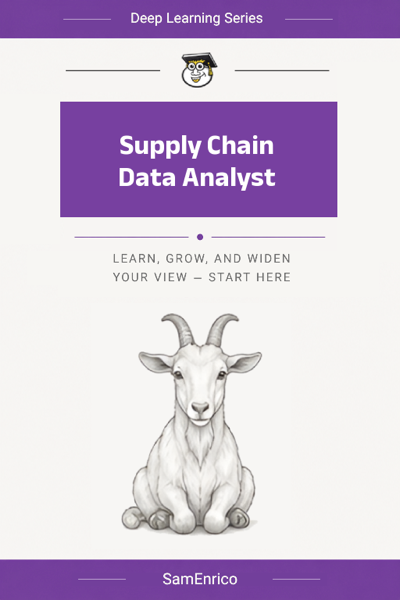
Non-FictionInformativeEducational
Supply Chain Data Analyst eBook
A Coursebook on Supply Chain Data Analyst
A Coursebook on Supply Chain Data Analyst
Formats
Free sample
Chapter 1: The Excel Corpse...--–- The email arrived at 4:47 PM on a Friday, which is corporate code for “this problem is now yours and I will not think about it again until Monday.”Maya Chen stared at her screen. The subject line read: “URGENT – Volt Power 2000 Stockout – CEO Asking Questions.” The body contained exactly three words: “Fix it. Please.” That “please” was doing a lot of heavy lifting. It was not a request. It was a threat wrapped in politeness.She had been a Supply Chain Data Analyst at Omni Goods for exactly eleven days.
Her onboarding had consisted of a fifteen-minute tour of the warehouse, a broken link to the ERP system, and a handshake from her new boss, Darren, who had told her, “Don’t screw up the Excel sheets. Those sheets have been running this place since before you graduated high school.”Maya had graduated six years ago. She had a master’s degree in operations research from a respectable state university. She knew Python, SQL, and the difference between a moving average and exponential smoothing. But none of that mattered at 4:47 PM on a Friday when the company’s highest-margin product had just vanished from every shelf in every store.She pulled up the dashboard.
Or rather, she tried to. Omni Goods did not have a dashboard. It had a folder on a shared network drive called “Reports” with two hundred Excel files, each with a different naming convention. “Q3_analysis_FINAL_v3.xlsx.” “inventory_actuals_March_revised.xlsx.” “do_not_use_old.xlsx.” It was a graveyard of spreadsheet corpses.This was the moment Maya realized that everything she had learned in graduate school was true in theory and useless in practice unless she could get to the data first.The Four Vs That Will Ruin Your Weekend Supply chain data is not like marketing data. It is not like finance data.
Marketing data lives in nice, clean platforms like Google Analytics, where someone has already decided what a “session” means and how to count it. Finance data lives in ledgers that have been standardized for five hundred years. Supply chain data lives in chaos.This chaos can be summarized by something academics call the Four Vs: Volume, Velocity, Variety, and Veracity. Maya was about to meet all four.Volume meant that Omni Goods tracked twenty-three thousand SKUs across fourteen warehouses and three hundred retail stores. That was not a lot by Amazon standards, but it was enough that Excel would choke on the full dataset.
Maya had tried opening the master inventory file once. Excel crashed after loading row one hundred thousand. There were eight hundred thousand more rows.Velocity meant that the data never stopped moving. Every time a cashier scanned a barcode, every time a truck passed through a weigh station, every time a warehouse worker picked a pallet—a new data point was born. By the time Maya had finished analyzing yesterday’s sales, today’s sales had already happened.
By the time she fixed last week’s stockout, next week’s stockout was already brewing.Variety meant that the data came in every shape and form. Invoices from suppliers in CSV format. GPS tracking data from logistics providers in JSON. Inventory snapshots from the ERP system in a proprietary format that required a special connector. Weather data from an API.
Customer feedback from surveys. The data did not match. The SKU for “Volt Power 2000” appeared as “VP2000” in one system, “Volt-Power-2k” in another, and “BATTERY_BOX_2000” in a third. This was not a data problem. It was a translation problem across five different languages, none of which had a dictionary.Veracity was the killer.
Veracity meant truthfulness, or the lack thereof. Maya had learned in her first week that Omni Goods’ inventory records were wrong. Not a little wrong. Systematically wrong. The ERP said there were 450 units of Volt Power 2000 in the Chicago warehouse.
The warehouse manager, a man named Jerry who had not smiled since 1994, said there were 310. The difference of 140 units—thirty-one percent—had simply evaporated. Or been stolen. Or mis-shipped. Or never received.
No one knew.Veracity was the reason Maya’s Friday evening was ruined. If the data had been accurate, the stockout would have been predictable. But the data was not accurate. It had never been accurate. And every decision made on inaccurate data was, by definition, a guess.The Six-Thousand-Dollar Coffee Maya walked to the break room.
The coffee was terrible, but it was free, and she had a feeling she would be here for a while. She poured a cup and sat down at her desk, which was wedged between a filing cabinet full of paper purchase orders from 2012 and a whiteboard that still had someone else’s forgotten notes from a meeting three years ago.She opened the shared drive again. This time, she did not try to open the master file. Instead, she looked at the file names. She looked at the modification dates.
She looked for patterns.Three files had been modified in the last seven days: “inventory_snapshot_20241115.xlsx,” “sales_YTd_v2.xlsx,” and “supplier_lead_times_2024.xlsx.” Maya copied them to her local machine. She opened each one.The inventory file had twenty-three thousand rows, one per SKU per warehouse. The sales file had four hundred thousand rows, one per transaction. The supplier file had eighty rows, one per supplier.She needed to join them. In SQL, she would write:sql Copy Download SELECT * FROM inventory i JOIN sales s ON i.SKU = s.SKU JOIN suppliers sup ON i.supplier_id = sup.id But she did not have SQL access.
IT had given her a read-only account to the ERP’s export function, which meant she could only pull flat files. She could not query the database directly. This was like being given a library card but only being allowed to check out one book at a time, and you had to guess which book you needed before you opened it.So Maya did what any analyst in her position would do. She opened Python.A Thirty-Year Detour Through Supply Chain Hell Before Maya could fix the stockout, she needed to understand how Omni Goods had gotten into this mess. The answer, as it often is, was history.Thirty years ago, supply chain management ran on paper.
Purchase orders were carbon copies. Inventory counts were clipboard surveys. Sales forecasts were the warehouse manager’s gut feeling. It was slow, it was inaccurate, and everyone accepted it because there was no alternative.Then came Material Requirements Planning, or MRP. MRP was a breakthrough: a system that could calculate, based on a production schedule, what materials were needed and when.
It was revolutionary in the 1970s. It was also rigid, expensive, and required teams of specialists to operate.Enterprise Resource Planning, or ERP, arrived in the 1990s. ERP promised to integrate everything—finance, HR, inventory, sales—into a single system. Companies like SAP and Oracle built empires on this promise. But the promise was never fully kept.
ERPs were great at recording what happened. They were terrible at telling you why it happened or what would happen…
This is the end of the free sample. Get the eBook to keep going. Buy now
About this book
Details
- Author
- Montana Glenn
- Publisher
- SamEnrico
- Language
- English
- Genre
- Non-Fiction, Informative, Educational
- Released
- 2026-05-11
- Pages (approx.)
- 150
- Available as
- eBook, Audiobook

Read better in the ZLOADR app
Your eBooks on your phone or tablet. Sign in with your SamEnrico account and start reading.
More by Montana Glenn
 Alcoholism Recovery for Lawyers ManualMontana Glenn$11.99
 Volunteer Burnout ProtectionMontana Glenn$11.99
 Deal By Deal ModelMontana Glenn$11.99
 Workaholism and Vacation AvoidanceMontana Glenn$11.99
 The Sleepwalker's Secret: The Strange Case of the 1987 Sleeping EpidemicMontana Glenn$11.99
 Ultimate Handbook Guide to Dongying : (China) Travel GuideMontana Glenn$11.99
 How to Produce AmaranthMontana Glenn$11.99
 Volume Discount Negotiation GuideMontana Glenn$12.99
You may also like
 Hong Kong Handover 1997Dunn Johnnie$11.99
 Zumba For Postnatal Recovery CourseNeal Christian$11.99
 Zumba for BeginnersLadner Nikia$11.99
 YouTube Comment Mining GuideHumes Pandora$12.99
 Worry Box MeditationCarlin Rudy$11.99
 Workplace Stress MeditationNguyen Lynn$11.99
 Workplace Stress and Sleep RepairHawley Ivory$11.99
 Workplace Perfectionism CureDelaney Jeffry$11.99
 Workplace Injustice Anger GuideWallen Isabelle$11.99
 Work Addiction and Burnout LinkGreenwood Ester$11.99
 Women in Yoga and WellnessBeattie Galina$11.99
 Women in Stand Up ComedyChun Evangeline$11.99