
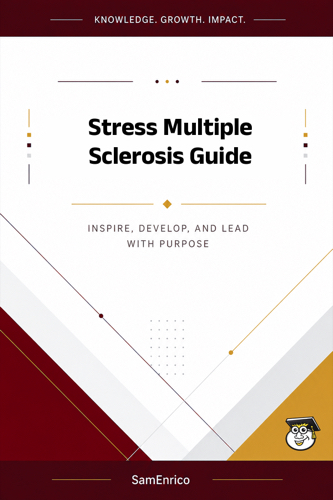
Stress Multiple Sclerosis Guide eBook
Understand how stress triggers MS relapses and acc
by Ocasio Londa
Understand how stress triggers MS relapses and accelerates disease progression.
Formats
Free sample
Chapter 1: The Silent Accelerant...--–- Maria had done everything right. She had taken her disease-modifying therapy religiously for three years. She saw her neurologist every six months. She ate a Mediterranean diet, exercised three times a week, and meditated every morning. Her latest MRI showed no new lesions.
Her neurologist called her "a model patient."Then her mother was diagnosed with pancreatic cancer. Maria flew across the country to be the primary caregiver. For six weeks, she managed medical appointments, insurance disputes, and her mother's pain while also working remotely and trying to maintain her own household. She was exhausted, of course. But she told herself: "I'm handling this.
I'm strong. I've got my MS under control."She did not feel particularly stressed. She felt necessary. She felt focused. She felt like she was doing what anyone would do for their mother.On the forty-third day, she woke up with double vision.
Within a week, she had numbness from the waist down and could not walk without a cane. A new MRI showed three active lesions in her brainstem and cervical spine."But I wasn't stressed," she told her neurologist, bewildered. "I mean, I was busy. But I wasn't anxious. I wasn't worried about myself.
I was just... doing what needed to be done."Her neurologist nodded. "Maria," he said, "you just described chronic physiologic stress perfectly."The Most Dangerous Misconception About MSThis book opens with Maria's story because it illustrates the single most dangerous misconception about stress and multiple sclerosis. That misconception is this: stress is a feeling. If you are not consciously worried, anxious, or overwhelmed, you assume your body is not stressed.
And that assumption can kill your neurons.For decades, MS patients and even many clinicians have operated under this framework. A neurologist asks, "Are you feeling stressed?" The patient—who is not crying, not losing sleep (yet), not having panic attacks—says, "No, I'm fine." And everyone moves on. Meanwhile, the patient's body is quietly, systematically dismantling its own myelin.The central argument of this book—and the foundation of everything that follows—is that stress is not primarily a feeling. Stress is a physiological state. The feeling of anxiety or overwhelm is merely the conscious tip of an iceberg whose bulk lies invisible beneath the surface.
And for people with MS, that invisible bulk is where the real damage occurs.This chapter will dismantle the feeling-based model of stress and replace it with a physiological model. You will learn the distinction between psychic stress (what you feel) and allostatic load (what your body accumulates). You will learn why daily minor hassles are more dangerous than major traumas. You will learn about the Nocebo Effect—how the fear of a relapse can literally create the biological conditions for one. And most importantly, you will learn how to track stress not by asking "How do I feel?" but by measuring concrete, observable signals from your own body: resting heart rate, sleep quality, muscle tension, and digestive function.By the end of this chapter, you will understand why Maria—who was not "feeling" stressed—still experienced one of the most significant relapses of her life.
And you will be equipped to avoid the same trap.The Two Faces of Stress: Psychic vs. Physiologic To understand why Maria's experience is not only possible but common, we must separate two concepts that language has unfortunately fused together.Psychic stress is the subjective, conscious experience of being stressed. It includes feelings of worry, anxiety, overwhelm, irritability, and dread. It is what you mean when you say, "I feel stressed out." Psychic stress is real, and it matters. But it is only half the story.Physiologic stress is the objective, measurable activation of the body's stress-response systems: the sympathetic nervous system (which releases norepinephrine and adrenaline), the HPA axis (which releases cortisol), and the immune system (which releases inflammatory cytokines).
Physiologic stress can be measured—in heart rate, heart rate variability, blood pressure, cortisol levels, inflammatory markers, and muscle tension.The critical insight is that these two can dissociate.In a healthy, resilient person, psychic and physiologic stress move together. When you feel anxious, your heart rate rises. When the anxiety passes, your heart rate returns to baseline. But under conditions of chronic activation—and especially in individuals with certain neuroendocrine profiles (which we will explore in Chapter 3)—the link can break. It is possible to have high physiologic stress (elevated norepinephrine, dysregulated cortisol, high inflammatory cytokines) while reporting low psychic stress.
Your body is in a state of alarm, but your conscious mind has habituated to it. You have forgotten what "calm" feels like because you have not experienced it in months or years.This is the MS Conundrum. It is why patients like Maria can be in full physiologic crisis while genuinely believing they are "fine."Let me be precise, however, because a previous version of this book caused confusion on this point. This dissociation—high allostatic load with low subjective stress—is not universal among MS patients. Approximately 20-30% of MS patients exhibit a repressive coping style (detailed in Chapter 7) that produces this dissociation most dramatically.
But even MS patients who do not repress emotions often experience a milder version: the physiologic stress response lasts longer than the conscious feeling. You feel stressed for an hour, but your body remains activated for three. You feel stressed for an afternoon, but your inflammatory markers stay elevated for a day.The point is this: you cannot reliably track your stress by asking how you feel.Allostatic Load: The Body's Hidden Ledger The concept of allostatic load was developed by neuroscientist Bruce Mc Ewen and his colleagues to describe the cumulative wear and tear on the body's systems resulting from repeated or chronic activation of the stress response. Think of it as a hidden ledger. Every time your body mounts a stress response—every time your sympathetic nervous system fires, every time your HPA axis releases cortisol, every time your immune system produces inflammatory cytokines—you make an entry in that ledger.
Most entries are temporary and harmless. But when the entries accumulate faster than the body can recover, the ledger begins to show damage.Allostatic load affects every major system in the body:Cardiovascular system: Chronically elevated heart rate, high blood pressure, low heart rate variability (HRV). Low HRV, as we will see in Chapter 9, is a powerful predictor of inflammation and disease progression in MS.Endocrine system: Dysregulation of the HPA axis, leading to either elevated baseline cortisol with blunted reactivity or complete adrenal exhaustion (see Chapter 3 for the full explanation).Immune system: Elevated baseline levels of pro-inflammatory cytokines (IL-6, TNF-α, IL-1β), which directly drive neuroinflammation and myelin damage (Chapter 4).Nervous system: Chronic sympathetic dominance, impaired vagal tone, and central sensitization of pain pathways.Metabolic system: Insulin resistance, weight gain, and disrupted sleep architecture.The crucial word in all of this is cumulative. A single stressful event—even a major one like a divorce or job loss—rarely causes a relapse by itself. The studies are clear on this point.
What causes relapses is the accumulation of stressors over time. The daily hassles. The traffic jams. The arguments with a…
This is the end of the free sample. Get the eBook to keep going. Buy now
About this book
Details
- Author
- Ocasio Londa
- Publisher
- SamEnrico
- Language
- English
- Genre
- Non-Fiction, Self-Help, Neurology
- Released
- 2026-06-07
- Pages (approx.)
- 143
- Available as
- eBook, Audiobook

Read better in the ZLOADR app
Your eBooks on your phone or tablet. Sign in with your SamEnrico account and start reading.
More by Ocasio Londa
 Loneliness Toastmasters GuideOcasio Londa$11.99
 Death and Dying TalksOcasio Londa$11.99
 Tech Startup Founder NetworkingOcasio Londa$11.99
 Antwerp Heist Podcast PhenomenonOcasio Londa$11.99
 Senior Doctor Visit ConfidenceOcasio Londa$11.99
 The Prevention ProtocolOcasio Londa$11.99
 Separation Anxiety TranceOcasio Londa$11.99
 Eye Fixation Trance MethodOcasio Londa$11.99
 The Vanishing of the SS Marine Sulphur Queen: A 50-Year MysteryOcasio Londa$11.99
 The Red Cliff Gambit: Zhuge Liang's Shadow War of DeceptionOcasio Londa$11.99
 Echoes of the Ice: The 1982 Discovery That Changed Climate Science ForeverOcasio Londa$11.99
 The Mineral Guide to TarapacaiteOcasio Londa$11.99
You may also like
 The Stress Migraine Trigger GuideLuke Eugene$11.99
 Stress and Cognitive DeclineWitte Irish$11.99
 Anger After Brain InjuryIrish Mara$11.99
 Stress Tremor GuideIsaacs Yevette$11.99
 Stress and Neuropathy GuideMoore Beulah$11.99
 Benzo Seizure Prevention ManualPannell Leatrice$11.99
 Alcohol Neuropathy RecoveryShepard Alva$11.99
 Stress Migraine Trigger GuideMull Jaquelyn$11.99
 Stress Headaches Migraines GuideBehrens Tarah$11.99
 Stress Brain Regeneration GuideGist Nita$11.99
 Stress Brain Shrinkage GuideGetz Yolonda$11.99
 Parkinson Apathy ManagementVanhoose Delta$11.99