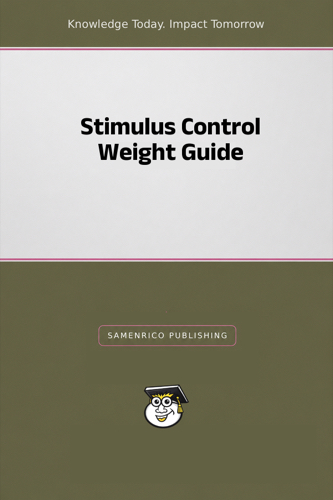
Stimulus Control Weight Guide
Modify your environment to reduce food cues that t
Modify your environment to reduce food cues that trigger overeating.
Formats
About this book
Free sample
Chapter 1: The Invisible Puppeteer--–- The cereal box on your kitchen counter is not innocent. The candy dish on your coworker’s desk is not friendly. The oversized pasta bowl in your cupboard is not neutral. These objects are not passive. They are active agents in a silent war you did not know you were fighting—and they are winning.Every day, you make more than two hundred food-related decisions.
What to eat. How much to eat. When to stop eating. Whether to have a second helping. Whether to grab a snack from the breakroom.
Whether to finish your child’s leftover chicken nuggets. Whether to take the last slice of pizza. Whether to open the bag of chips while watching television.Here is the unsettling truth uncovered by decades of behavioral research: you are consciously aware of only a fraction of these decisions. The rest happen automatically, triggered by cues in your environment that you never notice, never authorize, and never remember. Your kitchen, your workplace, your grocery store, your smartphone—they are all pulling strings you cannot see.This book is about cutting those strings.The Radical Reframing Most weight loss advice begins and ends with a question of character: Do you have enough willpower?
Are you disciplined enough? Do you want it badly enough? These questions assume that overeating is a moral failure, a weakness of the soul that must be conquered through sheer determination.That assumption is wrong.Not slightly wrong. Not incomplete. Fundamentally, structurally, catastrophically wrong.Overeating is not primarily a failure of character.
It is a predictable, almost mechanical response to a toxic food environment. You do not overeat because you are weak. You overeat because you are surrounded by signals that have been engineered, tested, and optimized to trigger eating—often before you even feel hungry.Consider two experiments that changed how scientists understand eating behavior.The Bowl That Never Emptied In the early 2000s, a Cornell University researcher named Brian Wansink designed a seemingly simple experiment. He invited participants to eat soup in a laboratory setting. Some participants ate from normal bowls.
Others ate from a specially designed “bottomless bowl” that refilled slowly and imperceptibly through a hidden tube.The participants in the…
This is the end of the free sample. Get the eBook to keep going. Buy now
Contents
- Chapter 1
- Chapter 2
- Chapter 3
- Chapter 4
- Chapter 5
- Chapter 6
- Chapter 7
- Chapter 8
- Chapter 9
- Chapter 10
- Chapter 11
- Chapter 12
Details
- Author
- Yamamoto Leann
- Publisher
- SamEnrico
- Language
- English
- Genre
- Non-Fiction, Health & Wellness, Behavioral Psychology
- Released
- 2026-06-10
- Pages (approx.)
- 134
- Available as
- eBook, Audiobook

Read better in the ZLOADR app
Your eBooks on your phone or tablet. Sign in with your SamEnrico account and start reading.
More by Yamamoto Leann
 The Everyman Dream SymbolYamamoto Leann$11.99
 The Urdu Historiography of 1857Yamamoto Leann$11.99
 Task Batching Strategies CourseYamamoto Leann$11.99
 COVID Spouse Grief GuideYamamoto Leann$11.99
 Work Addiction And Sleep RecoveryYamamoto Leann$11.99
 Evening Pain Release RitualYamamoto Leann$11.99
 The Mechanical Engineer Idea BookYamamoto Leann$11.99
 Dreams About Step ParentsYamamoto Leann$11.99
 The Silk Road Shadow: How a 19th-Century Merchant Smuggled Secrets Across EmpiresYamamoto Leann$11.99
 The Silent General: How a Forgotten Strategist Won the War No One Knew AboutYamamoto Leann$11.99
 The Last Echoes of the Dodo: A Linguistic ExtinctionYamamoto Leann$11.99
 Understanding Acyl-coa Oxidase DeficiencyYamamoto Leann$17.99