
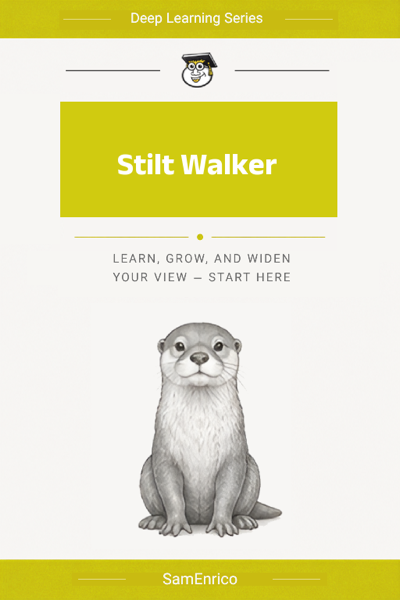
Non-FictionInformativeEducational
Stilt Walker eBook
A Coursebook on Stilt Walker
A Coursebook on Stilt Walker
Formats
Free sample
Chapter 1: Why We Rise--When I tell people I teach stilt walking, the first reaction is almost always a laugh. The second is a story about a parade, a circus, or a drunk uncle who tried it at a wedding and broke his wrist. The third—the one that comes after the laugh fades—is a question delivered in a quieter voice: “Is it hard?”The answer is yes. But not for the reasons most people assume.The difficulty of stilt walking has nothing to do with strength. It has nothing to do with youth, athleticism, or a natural sense of balance.
I have watched a seventy-year-old grandmother with two replaced hips take her first successful steps in under an hour. I have watched a former college gymnast, all muscle and confidence, spend an entire afternoon unable to stand up without grabbing a rope. Strength did not help her. Fear did not stop the grandmother. Something else was at work.Over fifteen years of teaching, I have put stilts on more than five hundred people.
They have ranged in age from four to seventy-four. They have included accountants, construction workers, circus professionals, physical therapists, a retired bull rider, a woman with multiple sclerosis, a man with a prosthetic leg, and a CEO who cried when she could not take three steps and then laughed until tears ran down her face when she finally did. Every single one of them arrived with the same unspoken assumption: that stilt walking is about learning to do something new. They were wrong. Stilt walking is about unlearning something old.That something is the way you walk.The Myth of Natural Walking You do not know how to walk.
Not really. Not in the way you think you do.What you call walking is actually a controlled fall. Your body spends every moment of upright locomotion catching itself from tumbling forward. The process is so automated, so deeply embedded in your cerebellum, that you have not thought about the mechanics of a single step since you were approximately twelve months old. By the time you learned to read, walking had become invisible to you—a background process, like breathing or blinking.This automation is precisely what makes stilt walking so difficult and so transformative.When you strap on a pair of stilts, you are not adding height.
You are removing the ankle joint from the equation entirely. Your foot, which normally articulates through a complex range of motion with every step—heel strike, plantar flexion, toe-off—becomes a rigid block. The calf muscles that have propelled you forward for your entire life become largely irrelevant. The Achilles tendon, that springy marvel of human evolution, might as well be a decorative strap.What remains? Your hips.
Your lower back. Your ability to tolerate being wrong about where the ground is.A normal walking step involves approximately four degrees of freedom: the ankle flexes, the knee bends, the hip rotates, the pelvis tilts. A stilt walking step, depending on the design, reduces that to two degrees of freedom—or sometimes one. The ankle is locked. The knee, surprisingly, does very little.
The hip becomes the primary shock absorber, steering wheel, and engine. Your body must learn an entirely new gait pattern from scratch, using muscles you never knew you had, while suspended in the air.And that is just the mechanics.The real challenge is not physical. It is perceptual.The 10-Foot View Let me describe what happens to your brain the first time you stand on stilts.You mount them correctly—sitting on a high stool, strapping in one leg at a time, pushing up through your heels. For a moment, you are simply standing. The world looks different from eight feet up, but not radically so.
You are taller than everyone in the room, which feels vaguely unsettling and vaguely wonderful. Then you try to take a step.Your brain, which has executed millions of flawless steps over your lifetime, sends the usual command: lift left foot, shift weight, move forward. But the stilt is longer than your leg. It has more inertia. It swings like a pendulum rather than lifting like a piston.
Your foot, locked to the stilt block, cannot feel the ground until the stilt tip arrives—which happens later than your brain expects.You step. The stilt tip lands. Your weight transfers. And then your brain realizes something terrible: it has no idea where your center of mass is.In normal walking, your center of mass stays within a relatively small box bounded by your feet. On stilts, that box shrinks dramatically while your center of mass rises.
The result is a system that is mathematically less stable—not because stilts are poorly designed, but because the human body was never engineered for this. We are good walkers. We are not good stilt walkers. Not yet.What happens next varies by personality.Some people freeze. Their muscles lock up, their breathing becomes shallow, and they grab whatever is nearest—a rope, a wall, my arm—with desperate force.
Some people laugh, a nervous release that helps them relax. Some people curse. Some people close their eyes, which is the worst possible response, because walking on stilts requires more visual input, not less.And some people, a rare few, take another step immediately. Not because they are talented. Because they have already decided that falling is not failure.I remember a man named David, a software engineer in his early forties, who came to a workshop after his wife signed him up for his birthday.
He was quiet, skeptical, and clearly terrified. He mounted the stilts with mechanical precision, stood up without wobbling, and then took exactly one step. The second step went badly. The third step sent him sideways into a crash mat. He sat up, pulled off the stilts, and said: “I fell.”I said: “Yes.
Now do it again.”He looked at me for a long moment. Then he laughed—a real laugh, not nervous—and said: “Okay.”David fell seventeen more times that afternoon. By the end of the session, he could walk the length of the training floor without assistance. He never became a performer. He never bought his own stilts.
But he sent me an email six months later that I have kept ever since. He wrote: “I think about that afternoon every time I’m stuck on a problem at work. I fell seventeen times. Then I walked. That’s not a stilt lesson.
That’s a life lesson.”He was right. And he was not alone.What Five Hundred Students Taught Me After fifteen years of teaching, I have stopped being surprised by who succeeds and who struggles. The patterns are clear, and they have almost nothing to do with physical ability.The people who succeed quickly are not the athletes. They are the people who have already learned to fail gracefully in some other domain. Rock climbers.
Ceramics artists. Programmers who debug code for a living. Parents of toddlers. Anyone who has internalized the reality that progress requires repetition and repetition requires mistakes.The people who struggle are not the uncoordinated. They are the perfectionists.…
This is the end of the free sample. Get the eBook to keep going. Buy now
About this book
Details
- Author
- Gardiner Toshia
- Publisher
- SamEnrico
- Language
- English
- Genre
- Non-Fiction, Informative, Educational
- Released
- 2026-06-03
- Pages (approx.)
- 123
- Available as
- eBook, Audiobook

Read better in the ZLOADR app
Your eBooks on your phone or tablet. Sign in with your SamEnrico account and start reading.
More by Gardiner Toshia
 GAD Worry Management WorkbookGardiner Toshia$11.99
 Habit Formation for Shift WorkersGardiner Toshia$11.99
 The Nobel And TelomeresGardiner Toshia$11.99
 Product Feature PositioningGardiner Toshia$11.99
 Walking Meditation for TinnitusGardiner Toshia$11.99
 The Fire Below: The Race to Map Africa's Volcanic HeartGardiner Toshia$11.99
 The Last Whisper of the Oracle of DelphiGardiner Toshia$11.99
 Understanding Grosse SyndromeGardiner Toshia$17.99
 Non Resident US Tax PrimerGardiner Toshia$12.99
 BPO Voice Support GuideGardiner Toshia$12.99
 A Beginners Guide to Chess Boxing (Volume 1)Gardiner Toshia$11.99
You may also like
 Hong Kong Handover 1997Dunn Johnnie$11.99
 Zumba For Postnatal Recovery CourseNeal Christian$11.99
 Zumba for BeginnersLadner Nikia$11.99
 YouTube Comment Mining GuideHumes Pandora$12.99
 Worry Box MeditationCarlin Rudy$11.99
 Workplace Stress MeditationNguyen Lynn$11.99
 Workplace Stress and Sleep RepairHawley Ivory$11.99
 Workplace Perfectionism CureDelaney Jeffry$11.99
 Workplace Injustice Anger GuideWallen Isabelle$11.99
 Work Addiction and Burnout LinkGreenwood Ester$11.99
 Women in Yoga and WellnessBeattie Galina$11.99
 Women in Stand Up ComedyChun Evangeline$11.99