
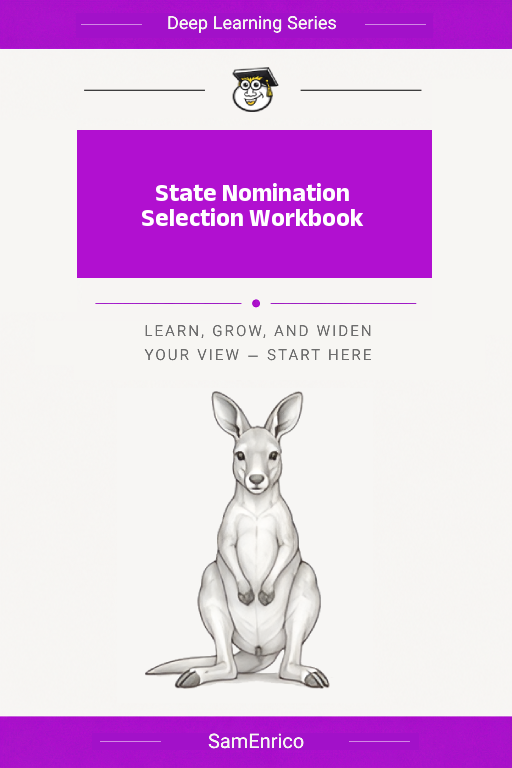
Non-FictionStudent's ShortcutState Strategy
State Nomination Selection Workbook eBook
Target subclass 190 or 491 nominations from Austra
Target subclass 190 or 491 nominations from Australian states like NSW, VIC, and WA. Match your skills to state-specific occupation lists and quotas.
Formats
Free sample
Chapter 1: The 65-Point Lie--–- Priya had done everything right. She was 29 years old, held a Master’s degree in Information Technology from a respected university, had accumulated eight years of professional experience as a Software Engineer, and had scored Superior English on her PTE Academic test. When she calculated her points for the Subclass 190 visa, the number stared back at her with confidence: 95. Fifteen points above the official minimum requirement of 65. She submitted her Expression of Interest to New South Wales in August 2024, expecting an invitation within weeks.
Months passed. Her friend Raj, a General Practitioner with only 70 points, received an invitation to Victoria within six weeks of lodging. Another acquaintance, a Carpenter with 65 points, secured a 491 nomination for regional NSW. Priya received nothing. Not a rejection.
Not a request for more information. Just silence.Priya’s story is not unusual. It is, in fact, the most common frustration expressed in Australian migration forums, Whats App groups, and consultation rooms across the world. The 65-point minimum is real. It is legally enshrined in the Migration Regulations 1994.
But it is also, for many applicants, a complete and devastating distraction. The question Priya should have asked was not “Do I have 65 points?” but rather “Do I have the right combination of points, occupation, location, and timing for the state I am targeting?”This chapter dismantles the 65-point myth once and for all. It explains the fundamental differences between the Subclass 190 and Subclass 491 visas, clarifies what “regional” actually means for migration purposes, and introduces the uncomfortable truth that states do not evaluate all points equally. By the end of this chapter, you will understand why a 65-point Carpenter can succeed where a 95-point Software Engineer fails, and you will complete a workbook element that gives you a realistic picture of your competitiveness for New South Wales and Western Australia. (Victoria, as you will learn, plays a completely different game.)The 65-Point Myth: Why Minimum Requirements Are a Trap The Department of Home Affairs publishes a points test table.
Age, English ability, work experience, education, partner skills, and a handful of other factors combine to generate a score between 0 and 135. For the Subclass 190 visa, the minimum is 65 points. For the Subclass 491 visa, the minimum is also 65 points, but the visa itself automatically adds 15 points for state nomination, meaning a candidate needs only 50 base points to reach the threshold.These numbers are true. They are also dangerously misleading.The 65-point minimum is the floor — the absolute lowest score the Department will accept. It is not the ceiling of competitiveness, nor is it the score at which states actually issue invitations.
In the 2024-2025 program year, data from publicly available invitation rounds showed that for occupations classified as “pro-rata” (high-volume occupations that states ration throughout the year), invitation cut-offs routinely exceeded 90 points for the Subclass 190 visa. Software Engineers in New South Wales often required 95 points. Accountants in Victoria needed 90 points even with a strong Registration of Interest. Meanwhile, trades occupations such as Carpenters, Plumbers, Electricians, and Motor Mechanics received invitations in Western Australia and regional New South Wales at scores between 65 and 75 points.The difference is not fairness. The difference is supply and demand.Think of state nomination as a market.
States have a fixed number of nomination slots allocated by the Commonwealth each financial year. In 2024-2025, New South Wales received approximately 4,000 nomination places across both the 190 and 491 visas. Victoria received approximately 5,000. Western Australia received approximately 3,000. Within each state, those slots are distributed across occupation lists that can include hundreds of different ANZSCO codes.
For an occupation like Software Engineer, there may be ten times as many applicants as there are available nomination slots. For a trade like Carpenter, there may be more slots than qualified applicants.The result is an inverted competition curve. Occupations with the highest salaries and most prestigious job titles are often the least likely to receive an invitation unless the candidate has exceptional points. Occupations that Australia genuinely needs — particularly in healthcare, construction, aged care, and hospitality — often receive invitations at or near the minimum threshold.This is not a secret. State governments publish occupation lists that clearly indicate priority sectors.
But applicants frequently ignore these lists or misinterpret them, assuming that “Available” means “invitation likely.” It does not. “Available” means the state is willing to consider applicants in that occupation. It says nothing about how many applicants are competing for those slots or what score you need to be competitive.The first rule of this book is therefore simple and non-negotiable: Stop asking whether you have 65 points. Start asking whether your occupation, location, and points align with a specific state’s demand.The Two Visas: Subclass 190 vs. Subclass 491Before you can select a target state, you must understand the two visa pathways available for state nomination.
They are fundamentally different in duration, rights, obligations, and strategic value.Subclass 190: Permanent Residency (Skilled Nominated)The Subclass 190 visa is a permanent residency visa. Once granted, you may live, work, and study anywhere within the state that nominated you. (You cannot move permanently to a different state immediately after grant without risking your residency status, but after a reasonable period — typically six to twelve months — you may relocate.) The 190 visa does not have a work location restriction; you are not required to live in a regional area. You have full access to Medicare, can sponsor eligible family members for certain visas, and may apply for Australian citizenship after meeting the standard residence requirements.The Subclass 190 visa requires a valid nomination from a state or territory government. The state nomination itself adds 5 points to your total score.
The minimum points requirement for the visa application is 65, but as discussed above, effective cut-offs are often much higher.Who should target the 190 visa? Candidates who want permanent residency immediately, who do not want to live in a regional area for three years, and who have a competitive points score (typically 85+) in an occupation that is not severely oversubscribed.Subclass 491: The Provisional Pathway (Skilled Work Regional)The Subclass 491 visa is a five-year provisional visa. It is not permanent residency. To transition to permanent residency, you must hold the 491 visa for a minimum of three years, live and work in a designated regional area of Australia during that period, and meet minimum taxable income requirements (currently AUD 53,900 per year, adjusted annually). After meeting these conditions, you may apply for the Subclass 191 visa, which grants permanent residency.The Subclass 491 visa has two significant advantages that are often overlooked.
First, the state nomination itself adds 15 points to your score, not just 5. A candidate with only 50 base points reaches the 65-point threshold automatically upon nomination. Second, competition for the 491 visa is generally lower than for the 190 visa because many applicants are unwilling to commit to three years of regional living.Who should target the 491 visa? Candidates with lower points scores (50-80), candidates whose occupations are in high demand in regional areas (healthcare, trades, hospitality, education), candidates who are willing to live regionally for three years, and candidates who have been unsuccessful with 190 applications.The 15-Point Difference (And Why It Matters)The following table illustrates the real-world impact of the 15-point difference:Base Points190 Visa (with 5 state…
This is the end of the free sample. Get the eBook to keep going. Buy now
About this book
Details
- Author
- Legg Christal
- Publisher
- SamEnrico
- Language
- English
- Genre
- Non-Fiction, Student's Shortcut, State Strategy
- Released
- 2026-05-29
- Pages (approx.)
- 142
- Available as
- eBook, Audiobook

Read better in the ZLOADR app
Your eBooks on your phone or tablet. Sign in with your SamEnrico account and start reading.
More by Legg Christal
 Tariff Engineering StrategiesLegg Christal$11.99
 Post Infectious IBS GuideLegg Christal$11.99
 Food Addiction and the Brain CourseLegg Christal$11.99
 Shopping Addiction and MindfulnessLegg Christal$11.99
 The Spear and the Shield: The Battle of Murethi (185 BC)Legg Christal$11.99
 Threat Intelligence AnalystLegg Christal$11.99
 How to Produce AntennasLegg Christal$11.99
 How to Start a Alloy Pig Iron Business (Beginners Guide)Legg Christal$11.99
You may also like
 Hong Kong Handover 1997Dunn Johnnie$11.99
 Zumba For Postnatal Recovery CourseNeal Christian$11.99
 Zumba for BeginnersLadner Nikia$11.99
 YouTube Comment Mining GuideHumes Pandora$12.99
 Worry Box MeditationCarlin Rudy$11.99
 Workplace Stress MeditationNguyen Lynn$11.99
 Workplace Stress and Sleep RepairHawley Ivory$11.99
 Workplace Perfectionism CureDelaney Jeffry$11.99
 Workplace Injustice Anger GuideWallen Isabelle$11.99
 Work Addiction and Burnout LinkGreenwood Ester$11.99
 Women in Yoga and WellnessBeattie Galina$11.99
 Women in Stand Up ComedyChun Evangeline$11.99