
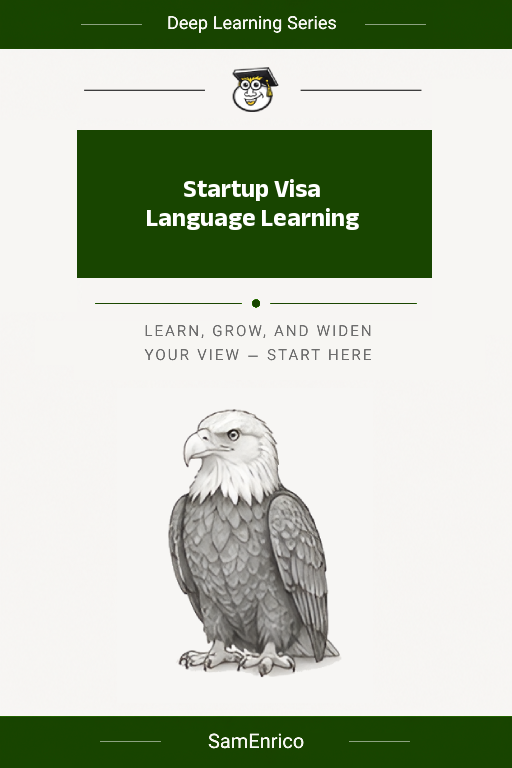
Non-FictionStartup GuideFounder Immigration
Startup Visa Language Learning eBook
Learn local language after startup visa. Free and
Learn local language after startup visa. Free and paid resources for integration.
Formats
Free sample
Chapter 1: The Visa Mirage--The moment your startup visa is approved, you will feel invincible.You have cleared the legal hurdles. The immigration officer stamped your passport. Your business plan passed scrutiny. You have done what thousands of others only dream of. You are the chosen one.That feeling will last approximately ten days.Then you will land in your new country.
You will walk through immigration, collect your luggage, and step into the arrivals hall. And for the first time since you conceived your startup, you will realize something terrifying: no one here knows who you are. Not your title. Not your track record. Not your potential.
You are not a founder anymore. You are just a person who cannot find the train platform.This is not a metaphor. This is the daily reality of startup visa holders across the world. And it is the single biggest predictor of whether your startup will succeed or fail.Not your product-market fit. Not your funding.
Not your team.Your ability to speak the local language.The Counterintuitive Truth That Changes Everything For the past twenty years, migration researchers have been documenting a strange pattern. High-skilled immigrants—people with advanced degrees, executive experience, and proven track records—fail to integrate at significantly higher rates than low-skilled immigrants. Not because they lack intelligence or motivation. Because they have more to lose.Ingrid Piller, a sociolinguist at Macquarie University, spent over a decade studying this phenomenon. Her 2024 book, Life in a New Language, tracks migrant families across multiple countries and uncovers a brutal irony: the more successful you were in your home country, the harder the language shock hits you.
A construction worker who cannot speak the local language is not surprised by their limitations. A former C-suite executive who cannot answer a simple question at a coffee meeting feels their entire identity crumble.This is arrival shock. And it is the hidden epidemic of the global startup visa system.Consider the numbers. According to immigration data from Canada, the UK, and Australia, approximately thirty percent of startup visa holders abandon their ventures within the first two years. Immigration lawyers will tell you the reasons are complex: market conditions, funding gaps, personal circumstances.
But when researchers dig deeper, a different story emerges. Most of those failures do not trace back to business problems. They trace back to integration problems. The founder could not build a local network. Could not access the informal advice that every entrepreneur needs.
Could not read the cultural cues that turn a cold email into a warm introduction.Language isolation killed the business. Not the idea. Not the market.The Arrival Shock Timeline Arrival shock follows a predictable pattern. Understanding it will not prevent it from happening to you. But it will stop you from believing that you are uniquely broken when it does.Week One: The Honeymoon You are excited.
Everything is new and interesting. You take photos of street signs. You smile at strangers. You feel like an explorer. Your language limitations are charming quirks.
You gesture and point and laugh at your mistakes. This phase lasts approximately seven days.Week Two: The Wall You need to open a bank account. The bank's website is entirely in the local language. There is no English option. You call customer service and the automated menu speaks too fast.
You try to visit a branch but cannot find the correct documents because you did not understand the email they sent you. You finally get to a teller who switches to English out of pity. You feel both relieved and humiliated. This is the first crack.Week Three: The Collapse You attend your first networking event. You practiced your pitch for three days.
You walk in confident. Then you hear the speed of real conversation. The slang. The inside jokes. The way people interrupt each other and finish each other's sentences.
You try to insert yourself into a conversation and someone says "Sorry?" in a tone that makes it clear they heard you but did not understand you. You spend the rest of the event standing near the snacks, pretending to check your phone. On the way home, you consider whether you made a terrible mistake.Week Four: The Silence You stop trying. Not consciously. But the cost of speaking feels too high.
You answer emails instead of making phone calls. You stay home instead of going to meetups. You tell yourself you are focusing on the product. In truth, you are hiding. And every day you hide, the wall gets higher.This is not weakness.
This is neurology.Why High Achievers Crash Harder Your brain is wired for status. Not ego—survival. In every human society, status signals safety. When you have status, people listen to you, help you, protect you. When you lose status, your brain treats it as a threat response.
The same neural circuits that fire when you are in physical danger fire when you are linguistically humiliated.Now consider what happens when you move from being a founder with a track record to a person who cannot order coffee correctly.Your brain does not differentiate between "I cannot find the word for 'oat milk'" and "I am in danger." It floods with cortisol. Your working memory collapses. You literally become dumber in the moment. This is not a metaphor. Studies of second-language anxiety show that high-stress speakers perform up to forty percent worse on cognitive tasks than their baseline.
You are not imagining that your brain feels slower. It actually is.But here is the crucial distinction that will save you: your competence has not diminished. Your ability to access that competence in the moment has been temporarily blocked by stress. The knowledge is still there. The patterns are still there.
The neural pathways are still there. They are just being overridden by a threat response that evolved to help you escape predators, not to conjugate verbs.Understanding this distinction is the difference between giving up and pushing through.The Visa Plus Voice Equation This book introduces a simple framework that will organize everything that follows. It is not complicated. But it is unforgiving.Visa + Voice = Success The visa gets you in the door. Voice scales the business.A visa without voice is a trap.
You can legally live in a country but functionally never belong. You will rely on intermediaries who charge you more than locals pay. You will miss the hallway conversations where real decisions happen. You will be the last to hear about opportunities and the first to be forgotten when they are allocated.Voice without a visa is just tourism. You can speak beautifully and still be deported.The startup visa system gives you the first half of the equation.
This book gives you the second half. But here is the provocation that separates this approach from every other language learning method you have ever encountered:You do not need to become fluent. You need to become functional enough to build relationships.This is the single most important sentence in this book. Read it again.The traditional language learning industry has convinced you that fluency is the goal. Thousands of hours.
Perfect grammar. Native-like accent. That is a lie designed to sell courses. For a startup founder, fluency is irrelevant. What…
This is the end of the free sample. Get the eBook to keep going. Buy now
About this book
Details
- Author
- Cable Annabel
- Publisher
- SamEnrico
- Language
- English
- Genre
- Non-Fiction, Startup Guide, Founder Immigration
- Released
- 2026-06-01
- Pages (approx.)
- 150
- Available as
- eBook, Audiobook

Read better in the ZLOADR app
Your eBooks on your phone or tablet. Sign in with your SamEnrico account and start reading.
More by Cable Annabel
 The Psychic TipsCable Annabel$11.99
 Self Talk for Sleep ParalysisCable Annabel$11.99
 Multigenerational Housing as Downsizing AlternativeCable Annabel$11.99
 The Apple Reminders Master GuideCable Annabel$11.99
 Subscription Box Addiction FixCable Annabel$11.99
 The Ghosts of San Juan Hill: Roosevelt’s Charge and the Cursed HeightsCable Annabel$11.99
 Understanding VulvovaginitisCable Annabel$17.99
 Affiliate Terms of ServiceCable Annabel$12.99
 How to Start a Blocks for Industrial Engines Business (Beginners Guide)Cable Annabel$11.99
You may also like
 Hong Kong Handover 1997Dunn Johnnie$11.99
 Zumba For Postnatal Recovery CourseNeal Christian$11.99
 Zumba for BeginnersLadner Nikia$11.99
 YouTube Comment Mining GuideHumes Pandora$12.99
 Worry Box MeditationCarlin Rudy$11.99
 Workplace Stress MeditationNguyen Lynn$11.99
 Workplace Stress and Sleep RepairHawley Ivory$11.99
 Workplace Perfectionism CureDelaney Jeffry$11.99
 Workplace Injustice Anger GuideWallen Isabelle$11.99
 Work Addiction and Burnout LinkGreenwood Ester$11.99
 Women in Yoga and WellnessBeattie Galina$11.99
 Women in Stand Up ComedyChun Evangeline$11.99